Showing posts with label Mieczysław Weinberg. Show all posts

Sunday, March 1, 2015

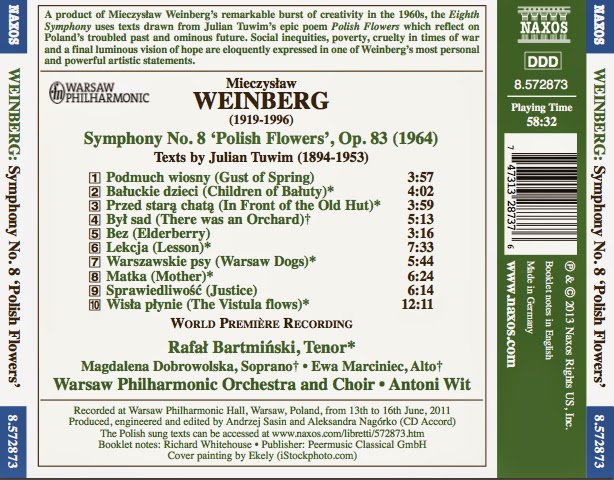
Mieczysław Weinberg - Symphony No. 8 "Polish Flowers" Op. 83 - Warsaw Philharmonic Orchestra & Chorus - Naxos 2013

Here's a Weinberg disc from my "unopened discs from 2013 pile" that I literally just unwrapped. I have to say, with other great bloggers out there, it's sometimes difficult to post Weinberg (especially more recent recordings from the past few years) that has not already been shared, especially these highly regarded Naxos recordings. It seems that this choral symphony "Polish Flowers" has not been shared, as far as I can tell anyhow. So, time to add it to the blogosphere and cosmos  :)

I am typing out the booklet notes as I cannot comment whatsoever on Weinberg's 8th.
Here's hoping we all enjoy it! I have a premonition it's going to go swimmingly. On to the notes.......


Mieczysław Weinberg was born on 8 December 1919 in Warsaw, where he emerged as a highly regarded pianist. He might well have continued his studies in the United States until the Nazi occupation saw him flee to Minsk (in the course of which his travel documents were inscribed as Moisey Vainberg, by which name he was ‘officially’ known until 1982). During 1939–41 he studied composition with Vasily Zolotaryov, then, soon after the Nazi invasion, he headed further east to Tashkent where he immersed himself in theatrical and operatic projects. There he also wrote his First Symphony, which favourably impressed Shostakovich and resulted in his settling in Moscow in 1943, where he was to remain for the rest of his life. In spite of numerous personal setbacks (his father-in-law, actor Solomon Mikhoels, was executed in 1948 and he himself was briefly imprisoned for alleged Jewish subversion prior to the death of Stalin in 1953), he gradually amassed a reputation as a composer who was championed by many of the leading Soviet singers, instrumentalists and conductors.

Despite several official honours Weinberg’s fortunes declined notably over his final two decades, not least owing to the emergence of a younger generation of composers whose perceived antagonism to the Soviet establishment ensured them much greater coverage in the West, and his death in Moscow on 26 February 1996 went all but unnoticed. Since then, however, his output—which comprises 26 symphonies and seventeen string quartets, along with seven operas, some two dozen song-cycles and a wealth of chamber and instrumental music—has received an increasing number of performances and recordings, and has been held in ever greater regard as a substantial continuation of the Russian symphonic tradition.

The 1960s was a decade of great productivity for Weinberg and not least in terms of the symphony, with seven written from 1962 to 1970. After the Fifth Symphony, moreover, his largest pieces in the genre were choral, beginning with the Sixth Symphony then continuing with the Eighth and Ninth. Composed in 1964, the Eighth is his first wholly choral symphony, its twelve movements drawing on the epic poem (itself the only completed part of an intended trilogy) Polish Flowers by Julian Tuwim (1894–1953), whose poetry Weinberg set as early as his song-cycle Acacias of 1940. At once a history and a critique of Poland over the period between the two world wars, Tuwim’s verse struck a resonance in Weinberg who, other than a visit to the Warsaw Autumn Festival in 1966, was not to see his native country after having fled the Nazi advance in 1939. The Eighth Symphony, first given in Moscow on 6 March 1966 by Alexander Yurlov with the Russian Academic Choir and the Moscow Philharmonic Orchestra, is therefore among his most personal artistic statements.

The first movement, Gust of Spring, sets the tone for the work as a whole with its reflections on Poland’s troubled past and ominous future. It begins pensively with female voices sounding plaintively over tolling lower strings and percussion, the former continuing at length until strings have an elegiac response that is continued by solo clarinet towards the close.

The second movement, Children of Bałuty, evokes the social inequities of pre-war Poland as seen through the industrial landscape of Bałuty, a suburb of Łódź. It commences with lively and rhythmically agile writing for female voices over a pizzicato accompaniment which soon draws in the strings and woodwind. A pause and then the tenor soloist responds in more immediately expressive terms, before elements of both themes are briefly combined prior to the brusque ending.

The third movement, In Front of the Old Hut, surveys the degradation endured by the mass of Polish people in earlier times. It starts with plangent woodwind entries that are joined by solo tenor in an almost Baroque-like texture, offset by discreet gestures on percussion. Strings and muted brass enter before unaccompanied voices bring about a hushed conclusion.

The fourth movement, There was an Orchard, expands on the issue of poverty with its depiction of the squalor common to peasants, gypsies and Jews alike. It begins with a burgeoning of folk-like gestures on woodwind and strings—the chorus entering stealthily, followed by a dialogue for soprano and mezzo soloists from within the chorus. The emotional mood heightens only gradually, with the instrumental component becoming more forceful prior to its sudden curtailment.

The fifth movement, Elderberry, contrasts the hope offered by springtime with the alienation of urban life. It commences with solo tenor accompanied by wistful woodwind gestures over a chord in lower strings. The chorus responds in almost prayerful terms, leading on to the work’s initial climax in which the whole orchestra is also to be heard for the first time.

The sixth movement, Lesson, is a warning to Polish infants of the inequities that they are to encounter. It opens with dance-like music for chorus and orchestra, percussion much in evidence. This tails off to leave the chorus sounding hesitant over fragmentary gestures on woodwind and brass, before the activity resumes on orchestra alone. The chorus then re-emerges at its height, after which calmer yet sombre exchanges between brass and percussion gradually subside into nothingness.

The seventh movement, Warsaw Dogs, equates the cruelties dealt out to dogs with that of the Polish people in time of war. It launches with stark unison chords on piano and percussion, chorus and woodwind replying with similarly forceful writing which builds in intensity until the initial chords are hammered out by full orchestra. An impassioned tenor solo brings a sudden hush, with only fugitive gestures from voices and instruments remaining prior to a powerful orchestral chord.

The eighth movement, Mother, takes the murder of a woman at her son’s grave as emblematic of the atrocities inflicted by the Nazi invaders. It unfolds with an eloquent solo from tenor over static chords—derived from that which ended the preceding movement—on lower (wordless) voices and instruments. At length a solo horn and then upper strings wearily assume the melodic foreground, followed by glacial gestures on celesta and lower woodwind as a rounding off.

The ninth movement, Justice, contrasts the collapse of Nazi rule with a promise of freedom and equality in the wake of the Soviet victory. It starts with starkly dramatic writing for unaccompanied voices in rhythmic unison, with a discreet underpinning from strings and brass at key moments. A more passive section (derived from the 1958 song-cycle Reminiscences) finds the chorus in subdued dialogue with woodwind (derived from the 1958 song-cycle Reminiscences) before a climactic unison gesture from chorus and orchestra.

The tenth movement, The Vistula flows, likens the poet’s verse to the flowers of Poland that each year bring new hope, with the river Vistula as a metaphor for the indestructibility of the Polish spirit. It begins with an expressive solo from the tenor, continued in more ruminative terms by the chorus over a luminous orchestral backdrop. The tenor resumes in more measured terms against an imploring choral response, before the woodwind gestures from the fifth movement reappear prior to the chorus bringing about the work’s main climax in a monumental passage for all the voices and instruments combined. This rapidly dies down to leave fragmentary choral gestures, together with recollections from the very opening of the work, as the plangent sound of upper woodwind brings about a subdued yet tenuously optimistic ending: as if to reflect, in Weinberg’s own words, ‘the deep faith of the poet in the victory of freedom, justice and humanism’.


Weinberg_Symphony_No.8_Tveti_Pol'shi-Tzadik.zip

http://www31.zippyshare.com/v/1flzA5BJ/file.html

Tuesday, February 24, 2015

Mieczyslaw Weinberg - Trio for Violin, Violoncello & Piano - Sonatina for Violin & Piano - Sonata for Double Bass Solo - CPO 2014

Let's explore some of Weiberg's chamber works on this fine CPO recording. Although some of the bio info here is likely (somewhat) similar to my earlier posts, I've added (a few) what I think are pretty interesting quotes by Weinberg, Shostakovich and others as well as (frankly) extremely depressing information that is truly testament to Weinberg's inextinguishable spirit and unfathomable strength. What a fascinating, great composer and human being he was!!


There are various ways of approaching the composer Mieczyslaw Weinberg. A purely musicological idea would be one of them. After all, Weinberg was one of Dmitri Shostakovich's most important companions, advisers, and personal friends. This is not the only reason-but certainly one reason-why Weinberg’s compositions have experienced a renaissance during recent years.
Like many composers (not only in the Soviet Union), Weinberg had to earn his everyday livelihood. The composition of music for feature films or television films enabled him to do so. It was thus that he even wrote the music for the animated "Winnie the Pooh" (a Russian short film version, from 1969). Weinberg's compositions are distinguished by a very personal idiom. Their overall mood differs substantially from that of the compositions of his friend Shostakovich. Considered individually, however, they are often quite different stylistically. 


Mieczyslaw Weinberg was a Polish Jew by birth and fled to the east during the Nazi occupation of Poland. He felt like a foreigner in the Soviet Union throughout his life. Other colleagues of his had made a better decision; they had fled to the west (e.g., Alexandre Tansman, to Paris) or even overseas. Weinberg had underestimated one important aspect-the anti-Semitism inherent in the Soviet regime. Additionally, until his death he spoke Russian only with a strong Polish accent, which was another reason why he was not highly regarded by the bureaucrats in the communist party and music world in the Soviet Union. Weinberg never served the Soviet system. What saved him was his friendship with Shostakovich. (Shostakovich, among other things, wrote a letter to Lavrentiy Pavlovich Beria, the head of the Russian secret police; the officer in charge of the hearing commented with cynicism, "Your little friends are helping you...but an old German proverb states "from the frying pan into the fire". Shostakovich wrote of Weinberg, "He is so different, and he is no slave". Shostakovich's decisive intervention and perhaps Stalin's death, which for Weinberg occurred at the right (last) moment, alone kept Weinberg, who had already been imprisoned, from being deported to Siberia. Stalin's cultural policies had brought about the virtual silencing of Dmitri Shostakovich as an opera composer-at least since the scandal involving the premiere of his opera Lady Macbeth. However, Weinberg was not eliminated from this sphere; instead, he continued to write operas (a total of seven), including "The Passenger and The Idiot", which have recently been presented with great success in Germany and Austria..


"A human being of incredible purity; he did not live in a country-not in the reality that surrounded him". It was thus that the conductor Thomas Sanderling, one of few people of those times who had the opportunity to meet Weinberg personally, described this composer. Even though Weinberg's music was quite literally prohibited, many great artists such as Emil Gilels, Leonid Kogan, and Mstislav Rostropovich performed his works. They all held Weinberg in great esteem-especially as a human being. Kirill Kondrashin also played a very important role; he firmly committed himself to Weinberg’s cause and conducted his works.


Weinberg's childhood years were wonderful and music was often the top priority. His father was a violinist and composer who wrote music for a Jewish theater, traveled with it throughout the country, and conducted. Weinberg later stated, "I was certain that Father's baton sounded like a trumpet". He was apparently very disappointed when his father explained to him that it did not produce any tones at all! By the the age of eleven Mieczyslaw was playing the piano with his father in the theater and
indeed Weinberg was an extraordinary pianist and all of his piano compositions (and especially the trio) clearly demonstrate just how phenomenal his technical gifts as a pianist were. 


Weinberg's plans for his life were repeatedly painfully dashed, and the war very quickly caught up with him in Minsk, the city to which he had initially fled. In 1953 he spent three months in prison-on the charge of having advocated the establishment of a Jewish republic in the Crimea.


Much of the grief, tears and constant worry during the war years is reflected in the music of the "Trio op. 24 for Violin, Cello, and Piano" from 1945. By this point in time, Weinberg was certain that he has lost his parents and his sister (upon fleeing with his sister, Weinberg could not have imagined that this would literally be the last moments that he would ever see her...all because she attempted to run back home to put on another pair of shoes) and his feelings were indeed correct; all three were murdered at Trawniki concentration camp, about 25 miles southeast of Lublin, as Weinberg would learn after his escape. Weinberg reflected on the general nightmare which surrounded him that day: "I will never forget the mothers, with children on the border, who embraced the legs of the horses of Soviet customs soldiers and pleaded with them to let them go over to the Soviet side, for the Nazis were on one side, and the Soviet soldiers were on the other". 


Weinberg wrote the Trio op. 24 during the same time he composed the Clarinet Sonata (1945), the Sonata for Cello and Piano No. 1,  and the Children's Album No. 3 for piano solo, and the String Quartets No. 4 and No. 5. The premiere of the piano trio was held on 9 January 1947 along with two members of the Beethoven Quartet, the violinist Dmitri Tsyganov and the violoncellist Sergei Shririnsky. The trio creates the impression of a grand architectonic work. As in all of Weinberg's compositions, tempo and mood shift relatively quickly, almost as if they were reproducing a theatrical scenario. After a monumental beginning 'Prelude and Aria', doubts about this almost euphoric seemingly optimistic basic mood quickly spread-the shift from A major, previously the movement’s dominant key, to A minor, and the conclusion in terrifying eighths in pianissimo confirms this. The ensuing toccata, beginning in 5/16 time, is endowed with enormous power. The tireless thundering of aggressive rhythms produces an eerie, intense, and almost hectic effect. And things gradually intensify to what is like a devilish dance of the kind often encountered in Weinberg-for example, in the Quintet for Piano and Strings (1944). The third movement 'Poem' begins with a slow piano solo-and this too is something that we often find in Weinberg's chamber music-full of passion and melancholic intensity. When the cello assumes the melody, one cannot yet imagine that the violin accompaniment recalling descending drops of water will later lead to the relentlessly hammering culmination point. The circle closes, but there is a role reversal in the concluding adagio: it is now the violin that narrates the story and concludes it melancholily and poetically. The finale is a masterpiece of counterpoint, but before it becomes a genuinely monumental fugue, Weinberg avails himself of a genial dissimulation. The first theme, presented by the piano in pianissimo as if ex nihilo is so pure and clear that it could be a fugue subject by Bach-but instead of the expected canonic entry of the other voices, it is initially a hurried insert of the violin that at this point leads to the first rhythmic diminution in the piano. The actual fugue subject (completely different thematic material) is presented to us only much later by the cello, and we also first reencounter the hectic violin motif in other circumstances. A fugue truly to be termed genial then follows, and the tension repeatedly increases on the basis of dynamic sequences ascending in pitch and then finally-almost abruptly-is released by a nostalgic waltz (now in the interval sequence of the initial motif), which brings the movement to its conclusion in a conciliatory A major.


Weinberg wrote the lovely "Sonatina for Violin and Piano" op. 46 in 1946. Forming associations with the depiction of an idyllic landscape, in what is almost a Schubertian tone, everything is actually situated -though peacefully, tranquilly, harmonically, or narratively-in the key of D minor(!). The tragic element in all these idylls is first eliminated in the final chord, which at last is in the desired key of D major. The second, very tragic movement reflects concern and incredible misfortune. One feels as if one has been petrified, and then suddenly a marking reads 'very fast, mysteriously'. Weinberg seems to be attempting to render the listener breathless..   By way of sarcasm, theatricality, and then a lento concluding the third movement, the tragic element of life's experiences nevertheless again finds its place. But-the lento is again in D major. Weinberg’s quest for a "good" ending, for peace, is found in a quantity his works.


Weinberg: "I believe that each moment in the life of a genuine artist is work. Interesting work, hard, endless. Work not only at the writing desk but the observation and assimilation of sounds, colors, movements, and rhythms in the real world. I am always at work".


During the 1970s, Weinberg wrote some solo sonatas: three for violoncello in 1971 (op. 106), one for viola (op. 107), two for viola in 1978 (op. 123), and one for violin in 1979 (op. 126). The sonata for solo bassoon came later (op. 133), and the "Sonata for Double Bass Solo" op. 108 was written in 1971. The performance history of the double bass sonata is not documented in any sources. All that is known is that it first appeared in print in Moscow with the 'Sovietsky Kompositor'. Since it was published in an anthology organized by the Russian double bassist Rodion Azarkhin, it seems natural to assume that it was he who first performed this work. Although there is no dedication in the autograph, Azarkhin is regarded as one of the double bassists who wanted to enhance the role of this rather underrepresented instrument in the solo literature by writing arrangements of his own and also by lending his energetic support to new compositions. Shostakovich stated of Azarkhin, "The double bassist Rodion Azarkhin is an outstanding virtuoso. Apart from his brilliant technique, his recital artistry is of high culture and expressive power".
This sonata does not really belong to the standard repertoire of double bassists. With its six movements, it is similar to a suite in which each movement is structured very clearly thematically. It's a work that, although it's taking some time, is growing on me.


Enjoy!

Weinberg_Piano_Trio_Violin_Sonatina_Dble_Bass_Sonata-Tzadik.zip

http://www51.zippyshare.com/v/Nz4VrnTG/file.html

Monday, December 22, 2014

Mieczysław Weinberg - Symphonies, Vol. 1 - National Polish Radio Symphony Orchestra, Katowice - Gabriel Chmura, Director - Chandos 2003

Mieczysław Weinberg (Or Moishe Vainberg) was one of the most talented of 20th century composers, his reputation constantly increasing each year as his music has the power and brilliance of such masters as Shostakovich (Weinberg's close friend and biggest advocate) and Prokofiev. How fortunate we are that recordings have been popping up like springtime flowers in the past decade! The reason for the neglect of his music is largely political, for Weinberg, as a bourgeois Jew, suffered under both Nazism and Socialism. It is only since the barriers between the Soviet Union and the West have relaxed, that scholars worldwide are realizing the importance of Weinberg’s legacy.


Shostakovich described Weinberg as "one of the most outstanding composers of the present day". That someone who endured the horrors of Nazi genocide, World War II and the Gulag managed to compose at all is extraordinary, let alone produce an oeuvre of such size and quality (22 Symphonies, four Chamber Symphonies, two Sinfoniettas, seventeen String Quartets and numerous other pieces of chamber music as well as seven operas). Weinberg was the only one of his family to escape Nazi atrocities during the war. His father-in-law was assassinated by the Soviet authorities. Weinberg himself was detained and came close to death in 1953 when he was falsely accused of plotting to set up a Jewish republic in the Crimea.

Weinberg’s music shares stylistic traits with that of Shostakovich which is unsurprising, considering the closeness of their relationship. They met in 1943 when, as a refugee in the Soviet Union, Weinberg sent him a score of his First Symphony. The older composer was so impressed that he arranged for Weinberg to be officially invited to Moscow. Weinberg felt as if he had been ‘born anew’ through their encounter. It was not a question of his taking lessons, rather, he had found someone in whom he could confide. The two composers would play each of their newly completed works to one another-Weinberg was the primary source of the Jewish musical influences in Shostakovich’s music. Besides Shostakovich, other palpable influences on Weinberg’s music were Prokofiev, Stravinsky and Mahler. More of a romantic than his mentor, his music is notable for the lyrical beauty of its melodies and its extraordinarily fine thematic development.

The Symphony No. 5 Op. 76 emerged in 1962 influenced by the first performance, after a long suppression, of Shostakovich's Fourth Symphony. It is dedicated to Kondrashin, a lifelong Weinberg champion, who conducted the premiere of the Shostakovich work and recorded it for Melodiya shortly afterwards. Alistair Wightman comments, in his notes, on the similarities between the music of Shostakovich and Weinberg. The four movement Symphony is indeed bleak, has its moments of soured triumph threaded through with disillusion. There is a beleaguered comfort about the fine tenderly plangent adagio sostenuto which is I think more powerful than anything in Shostakovich 4. It bridges across to the tense adagios of the Roy Harris symphonies of the 1930s and 1940s. Tension bursts the bonds at 9.01 when the tender theme thrusts forward with all the torque of a supercharged spiritual; impressive by anyone's reckoning. The impishly playful flute and then other solo wind instruments seem to dance in macabre delicacy in the shortish allegro. This soon takes on a distinctly Shostakovichian edginess and dazzle before restively petering out into silence from which emerges a pastoral attacca final.

The First Sinfonietta dates from 1948, shortly after Shostakovich encouraged Weinberg to come to Moscow. Half the length of the symphony, it is more simply constructed and less emotionally complex. In this work, the Jewish elements are especially pronounced. The final movement, for example, is clearly based on klezmer music. Initially, the Sinfonietta's Jewish elements earned it praise from the commissars- this was music for the people-but it wouldn't be long before they were used against the composer, as anti-Semitism became more prominent in the Soviet Union. (Btw-is it my eyes or is the text smaller in this paragraph? Blogger is messing with me I do think..)

Enjoy!

M.Weinberg_Symphonies_Vol.1_Chandos_Tzadik.zip

http://www33.zippyshare.com/v/6322293/file.html