Saturday, March 14, 2015

Michael Horvit - Cullen Overture - Concerto for Brass Quintet & Orchestra - Invocation & Exultation - Aleinu (Adoration) - Daughters of Jerusalem: Fantasy for Violin & Orchestra - Albany Records 1997

Michael Horvit is yet another example of a great yet seriously neglected American composer. Albany Records to the rescue! Indeed the Albany catalog is overflowing with hidden gems and in many cases neglected masterpieces. I feel indebted to the label, their mission has provided me with an abundance of excitement and joy. The majority of Arnold Rosner's recorded music is on Albany, enough reason alone to make me want to seek out Albany's founder Peter Kermani and the producer John Proffitt just to give them long, awkward hugs :) Horvit's music will be enthusiastically welcomed and enjoyed by anyone who loves melodic, proudly tonal 20th century music in a style not unlike Walter Piston, Eric Ewazen, Arnold Rosner, Aaron Copland (Horvit studied with both Walter Piston and Aaron Copland as well as Lucas Foss and Quincy Porter), David Diamond, Paul Creston and others. As Horvit has also written many works that take inspiration from Israeli and Hebraic sources, this is music too that listeners fond of Ernst Bloch, Ben-Haim, Joseph Achron etc. will undoubtedly enjoy.


Michael Horvit (b. 22 June 1932) received his bachelor of music and master of music degrees from Yale University and his doctorate of musical arts from Boston University and is a Professor at the University of Houston Moores School of Music, where he has headed the Theory and Composition Department since 1967. He also served for 25 years as the music director at Houston’s Temple Emanu El and is also co-author of three widely used theory texts. He is the recipient of awards from organizations that include B.M.I., ASCAP, the Martha Baird Rockefeller Foundation, the National Endowment for the Arts, the Fridge Trust, Meet the Composer, the F. O. Butler Foundation, and the University of Houston.

His works have been performed in the U.S. and abroad, although clearly not very much. They range from solo instrument and vocal works to large symphonic compositions, choral cantatas and operas, many written specifically for the Jewish liturgy. Among his significant works are his "Even When God Is Silent" and "A Child’s Journey", based on poems by the Israeli poet Yaakov Barzilai, "Invocation and Exultation" for string orchestra, which has been performed throughout Europe and in Japan; "Land of Dreams", a cantata celebrating the fiftieth anniversary of the founding of the State of Israel; "The Mystic Flame" a choral symphony, the "Concerto for Brass Quintet and Orchestra, commissioned by the Chicago Chamber Brass; "Antiphon II", for clarinet and electronic tape; and "The Gardens of Hieronymus B.", premiered by the Houston Symphony, which Horvit has called a "free (musical) interpretation" of the painting by the 15th-century Dutch painter Hieronymus Bosch-and whose title is taken from Bosch’s triptych, The Garden of Earthly Delights. 

Until the opening of the Moores School of Music in 1997, Cullen Performance Hall was the main concert hall on the campus of the University of Houston. In October, 1988, after a year of extensive renovations, the hall was rededicated with a gala concert featuring the "Cullen Overture", which was commissioned by the university for the occasion.

The overture begins with a stately brass fanfare. This is followed by a fast section which contains two ideas: the first, very rhythmic and featuring the percussion; the second, a lyrical theme stated by the cellos and first bassoon. The central part of the overture is slow. A mysterioso section played by tremolo strings is followed by a chorale, presented by the brass and restated by the winds. The themes of the fast section return and are followed by a brief restatement of the opening fanfare, which brings the overture to a stirring conclusion.

Commissioned by Richard Frazier for the Chicago Chamber Brass, the "Concerto for Brass Quintet and Orchestra" is a showpiece for brass and orchestra. It explores the wide palette of technical and expressive qualities offered by the brass quintet. These attributes are presented together with and sometimes in contrast to the infinitely variable sonorities of the symphony orchestra.

The work has three movements. The first and third are fast, energetic, and vivacious. Rhythmic excitement and the colors of percussion section play a large part in these movements. There are quick shifts from one section of the orchestra to another, and significant displays of technical virtuosity by the solo quintet. In its outer sections, the orchestra provides a sensuous, contrapuntal texture, against which the solo quintet presents its own dialogues and solos. The middle section is an antiphonal chorale for the solo and orchestral brass.

The lyrical "Invocation and Exultation" was commissioned by the Missouri Unit of the American String Teachers Association in commemoration of the 200th anniversary of Mozart's death and was premiered in January, 1991. The subscript to the title page bears the dates, 1791-1991. There are subtle references to Mozart's music in the piece. This is especially true of the first movement which is largely built on an inversion (which re-inverts itself, eventually) of the main theme of Symphony No. 41, last movement. The first movement is "a call to the spirit of Mozart". It is built on a series of canonic entrances, each a self-contained arch, which combine with increasing intensity to a chorale climax. The second movement is a lively mixed meter dance celebrating the spirit of Mozart. It is in ternary form, with the opening and closing sections in an exuberant fortissimo, while the middle section is a calm reflection of the first movement.

"Aleinu" or "Adoration" in Hebrew was commissioned by Congregation Emanu El, Houston, in 1985, in celebration of the fiftieth anniversary of the ordination of Rabbi Robert I. Kahn. Composed for baritone, solo violin, SATB choir, and organ, it was premiered in the spring of that year with the composer conducting and Fredell Lack as the violin soloist. This prayer is one of the most important and ancient in Jewish liturgy a heartfelt expression of belief in God. The baritone soloist sings the original Hebrew text, while the choir responds with the English translation. The organ is heard throughout, binding the work together, providing unity and continuity. The melodic style of both solo voice and violin is patterned after the cantorial tradition of Jewish worship. "Aleinu" was written ten years prior to the Daughters of Jerusalem. The composer writes: "Every time I heard Fredell perform the Aleinu, I was deeply moved by her depth of expression, her intuitive, complete understanding of the style, and her gorgeous tone. Over the years we discussed my following Aleinu with a major work for her. At last, with Daughters of Jerusalem, the opportunity arrived." This is a truly beautiful composition, ethereal and spiritually potent. Although "Aleinu" is brief, it shares some of the atmosphere found in parts of Bloch's masterpiece, the 50+ minute "Sacred Service" (Avodath Hakodesh) scored for large chorus, soloists and orchestra. 

"Daughters of Jerusalem" and this special work (Aleinu) are my favorites on this rare disc.

"Daughters of Jerusalem-Fantasy for Violin and Orchestra" was commissioned by Congregation Emanu El, Houston, and is dedicated to violinist Fredell Lack, who premièred it at Temple Emanu El on 25 February 1996, with Franz Anton Krager conducting the Moores School Symphony Orchestra. This is an extremely gorgeous work, the finest work on this recording and not to be missed imo.
"Daughters..." is titled a Fantasy, because it does not follow the usual plan of a concerto, but rather draws its inspiration and meaning from several poems taken from 'The Song of Songs'. The text which provides inspiration for the music consists of three longer poems introduced, separated and followed by a brief refrain. The Fantasy follows the same design, and is played without pause between the movements. Music based on the following short poem, and varying at each appearance, serves as an Introduction, Interludes, and Postlude to the three main movements. The title of the fantasy is taken from this poem:

I adjure you, O daughters of Jerusalem,
By the gazelles, and by the hinds of the field,
That ye awaken not, nor stir up love, until it please.

The three main movements contrast in tempo, character, and emotional content. The first is a lyrical, lush, romantic expression of love.

As a lily among thorns, so is my love among the daughters...
Stay ye me with dainties, refresh me with apples; For I am lovesick.

The middle movement is agitated at first;

"By night on my bed I sought him whom my soul loveth..."

Then builds in intensity;

"I sought him, but I found him not."

And culminates in an explosion of energy;

"When I found him whom my soul loveth, I held him and would not let him go..."

The music of the final movement evolves from the music of the first. It begins expectantly:

"I sleep, but my heart waketh; Hark! My beloved knocketh.
My beloved put his hand by the hole of the door,
And my heart was moved for him."

And ends in despair:

I opened to my beloved; but my beloved had turned away, and was gone... The watchmen that go about the city found me, they smote me, they wounded me..."

The final statement of the refrain, as in the biblical text, differs from the others:

"I adjure you, O daughters of Jerusalem,
If ye find my beloved, what will ye tell him?
That I am love-sick."


The substantial Fantasy has many of the characteristics we generally associate with a concerto. It contrasts the solo violin with a large orchestra, and much of the music for the solo violin displays the virtuoso qualities of the instrument. While the orchestra is moderate in size, so as not to overpower the solo violin, the instrumentation was chosen for its coloristic possibilities. The English horn and harp in particular, are given major roles.


Track listing:

1) "Cullen Overture" (1988) (11:43) (Texas Music Festival Orchestra, Adrian Gnam, conductor)

"Concerto for Brass Quintet & Orchestra" (1989)

2) I-fast, with energy (5:50)
3) II-moderately slow; sustained (8:17)
4) III-very fast (4:15) 

(The Ambient Brass, Moores School of Music Symphony Orchestra, Franz Anton Krager, conducting)

"Invocation & Exultation" (1990)

5) Invocation-moderately slow (5:54)
6) Exultation-very fast (3:03)

(Norrbotten Chamber Orchestra, Sweden, Leon Spierer, conductor)

7) Aleinu ("Adoration") (1985) (9:32) (Fredell Lack, violin; Stephen Smith, baritone, 
Moores School Concert Chorale, Robert Jones, organ, Charles Hausmann, conductor )

"Daughters of Jerusalem-Fantasy for Violin & Orchestra" (1996) (24:00)

8) Prelude-slow, very sustained
I-flowing

9) Interlude-slow, very sustained
II-fast

10) Interlude-slow, very sustained
III-very sustained; flowing; with energy; Postlude-as at first

(Fredell Lack, violin, Moores School of Music Symphony Orchestra, Franz Anton Krager, conducting)  TT: 72:36

Enjoy!

Michael_Horvit_Works_for_Orchestra-Tzadik.zip

http://www30.zippyshare.com/v/A3u2sCoo/file.html

Thursday, March 12, 2015

Vagn Holmboe - Solo & Chamber Works for Guitar - Sonatas Nos. 1 & 2 for guitar - 5 Intermezzi for Guitar - Duo Concertato for Violin & Guitar - Parlare del più e del meno - Canto e Danza for Recorder & Guitar - 7 Folk Ballads for Recorder & Guitar - Dacapo 2012

Hello everyone. I've been without any real free time lately, but hopefully this weekend will allow me time to add several posts. I need the diversion and serious listening time desperately..

When the Danish composer Vagn Holmboe (1909-96) started to write guitar music, he had already been composing for half a century. Captivated by this ancient instrument, Holmboe wrote two beautiful sonatas and a number of solo pieces as well as duets for guitar and other instruments, combining his love of simple, transparent structures and organic musical development with the folklore of foreign cultures and his own Nordic roots. This disc is a guitar lover's delight (I know I'm
always delighted!) and while Vagn Holmboe's guitar music is much less familiar than most works from his extensive output, it has charm and substance, and it is every bit as enjoyable/wonderful/ and is superbly crafted.  


Vagn Holmboe began writing for the guitar at the age of 70, and then continued to create works for the instrument for another 13 years. It's not clear what initially drew him to the instrument. He said little about it other than to comment that he wanted to write for it, and so he did. He first composed more formal works, the two Guitar Sonatas on this disc. Each is a suite of thematically related pieces, worked out in the organic way that he typically developed his material, and very concise, especially the second of these. Folk qualities were impossible to avoid, however, as a listen to many of the works here will demonstrate. Still, as the booklet notes point out, this is hardly Holmboe taking up "light music" at the end of his life, for there is much complexity and sophistication of invention. The "Five Intermezzi for Guitar" which followed two years later in 1981, are of a similar character, but the composer is starting to actually embrace the folk connections, using a folk-like melody of obvious Spanish flavor as a unifying theme, and adding characteristic rhythmic percussive effects and shifting meters as well. 

In 1983, he went further with "Seven Folk Ballads" employing actual folk tunes from England, Israel, France, Ukraine, and his native Denmark. The original intent was to create duos for balalaika and guitar, but eventually the composer opted for the more complementary sound of the recorder. The setting of each tune, beginning with the familiar 'The Three Ravens' from England, captures the character of the folk melody with simplicity and grace. In the fantastic "Duo Concertato for Violin and Guitar" (1986) the violin adds an Eastern European quality as the two instruments engage in a witty and sometimes dramatic conversation. In the last solo work, the introspective "Parlare del più e del meno" (1988), the conversation becomes a monolog, internalized in five very short movements of great density, rhythmic freedom, and centered calm. I'm tempted to say that this is one of my 'favorite' works on the disc, however like a child talking about colors-I find that everything here is my 'favorite'. Vagn Holmboe's last chamber work for guitar, "Canto e Danza", written in 1992 when Holmboe was 83, is a set of variations on a Spanish harvest song, in three contrasting movements, followed by a lively baroque dance movement which sounds like the work of a younger man. Simply delightful.

The stylistic rather than strictly chronological structuring of the program, working from the more serious sonatas to the encore-like folk ballads, works beautifully. The performers, all outstanding Danish musicians, capture the delicate personality of each work perfectly, most especially guitarist Jesper Sivebæk.

Enjoy!

Vagn Holmboe_Solo_And_Chamber_Works_For_Guitar-Tzadik.zip

http://www4.zippyshare.com/v/88jwhw0P/file.html

Monday, March 9, 2015

J.S. Bach - Keyboard Concerto No.1 in D minor - Paul Hindemith - The Four Temperaments: Theme with Four Variations for Piano & Strings - Ernst Bloch - Concerto Grosso No.1 for String Orch. with Piano Obbligato - MSR Classics 2013

I  must say am having a rollicking good time unwrapping discs purchased in or around 2013. Truly it's the same kind of excitement as if I had just received them in the mail; after all I don't know what I'm about to find in these piles-simply because I was still able to buy so much at that time and can't keep track (Has anyone else out there ever bought the same disc twice? This has happened to me....a few times ;)   So here we have three works for Piano & String Orchestra. Paul Hindemith's "The Four Temperaments" is one of my favorite Hindemith works but also one of my favorite piano + orchestra compositions in general. I have many recordings of it, and thus far I'm extremely pleased with this interpretation, the pianist and string players are playing with passion and obvious enthusiasm, and I like their choice of tempi very much. Bloch's Concerti Grossi are also favorite works of mine, and here his "Concerto Grosso No. 1" is also played extremely well start to finish. As far as the ubiquitous Bach keyboard concerto goes, there's really nothing that needs to be said; I'm sure most of you also have a dozen or more recordings of this wonderful but overplayed concerto. The reading here is good, although the sound quality is not as good (-unless it's my imagination? The orchestra playing the Bach is the same that pulls off the Hindemith so well-only the Bloch is performed by a different orchestra. Tell me if I'm just having hearing problems!) as on the Hindemith and Bloch works. 


"The Four Temperaments - Theme with Four Variations for Piano and Strings" was composed when Hindemith first established himself in the United States in 1940. The origins of this work are somewhat murky. According to the website of the the New York City Ballet, it was commissioned by George Balanchine to give himself something to play (the famous choreographer was an accomplished pianist, but it is not clear whether or not he ever actually performed the work). The first public performance did not take place that same year (as is stated in almost all reference sources) but four years later in 1944 when Lukas Foss played it with the Boston Symphony under Richard Burgin at a special concert at the New England Mutual Hall on September 3rd; the work was later repeated at Symphony Hall as part of the orchestra's regular season.

In 1946, Balanchine founded 'Ballet Society', the predecessor of the New York City Ballet, and he choreographed the Theme with Four Variations under the title "The Four Temperaments" for the first performances of the company. The premiere was on November 20th, 1946 at the Central High for Needle Trades (the predecessor to the Fashion Institute of Technology) with a cast that included Tanaquil Le Clerc and Todd Bolender; the pianist was Nicholas Kopeikine and the conductor Leon Barzin.

The notion that human behavior is dominated by four humors or temperaments each connected to a bodily fluid- black bile for the 'melancholic', blood for the 'sanguine', phlegm for the 'phlegmatic' and yellow bile for the 'choleric'- goes back at least as far as the ancient Greeks and, although long since abandoned by the medical profession, continues to have some poetic or literary currency. Was it Hindemith's idea or the choreographer's to apply this program to the music? Ironically, while the titles appear to push this score away from pure musical abstraction, the ballet was in fact a big step in Balanchine's evolution away from narrative dance. Hindemith's musical interpretation of this idea is not simply musically, let alone programmatically. The work, although classical in its use of piano and strings and its expanded C major - C minor - E flat tonality, does not exactly fit the mold of a classical or baroque concerto or of a conventional theme and variations. The theme itself has three distinct parts: a Moderato in the strings with a long lyric melody, a tocatta or scherzo-like Allegro assai led off and finished by the piano and later joined by the strings, and a Moderato in the style of a 6/8 siciliano, finished up by the strings only-first solo, and then later with pizzicato accompaniment and an embellished piano solo in the middle.

The first variation "Melancholy", might suggest a dance of death. It starts as a slow, mournful 9/8 duet between the solo piano and a solo violin followed by a whirlwind 12/8 Presto for the strings alone. It ends with a funeral march in in E-flat minor with a drum-roll rhythmic figure in the piano and a dramatic, sinister melody in the strings.

"Sanguine" is the only variation that does not change tempo; it is a landler (18th century folk dance) style waltz dominated by the strings with rhythmic punctuations and 'oom-pahs' from the piano and, except for an occasional insertion of 2/4 bars, it maintains the 3/4 waltz tempo throughout. There is a kind of Trio introduced by a sequence of trills in the piano and then with running notes in octaves in the piano over pizzicato and then melodic strings. The strings pick up the running motion before a return to the main waltz in a particularly melodic form. The movement ends with a dynamic buildup over harmonic stasis- running notes in the piano over a steady E minor in the strings.

The third variation, "Phlegmatic", begins Moderato in 4/4 with solo string quartet in a typically Hindemithian expanded version of the key of C major. A 12/8 Allegretto in the form of a slow dance belongs to the piano with occasional brief interruptions from the solo strings; the meter and the shifting tonality give it a kind of 'tipsy' character. A piano solo in octaves leads leads into a rather jolly folk-like Allegro scherzando in 2/4, dominated by the solo strings with the piano offering mostly rhythmic/chordal accompaniment. The piano suddenly goes quiet and the variation fades to a rhythmic pianissimo in E-flat. 

The last variation "Choleric" begins with a kind of dramatic accompanied recitative in a constantly shifting tempo. The strings and piano offer loud and louder interjections, outlining the double-tonality of C major and E flat major. A Vivace in 2/4 begins with pizzicato strings, and interpolations from the piano turn into off-beat 'oom-pahs' (this section is one of my favorites!) before going back to a reverse series interpolations and pizzicatos. The Appassionato that follows is in a sweeping 12/8 with rich octave melodies in the strings and call-and-response between the strings and piano. The movement and the work culminate in a Maestoso which starts quietly with rising eighth notes in the piano that accompany sweeping octaves in the strings and lead to a triple forte C major climax.
This work leaves me gleefully breathless time and again :)

Ernst Bloch's fantastic Concerto Grosso No.1 has already been posted here (with No.2 as well) on a CPO disc, so I won't discuss it in this post.

Track listing:

J.S. Bach - Concerto No.1 in D minor for Keyboard and Strings, Bwv 1052

1)Allegro (7:54)
2)Adagio (8:17)
3)Allegro (7:46)

Paul Hindemith - "The Four Temperaments" for Piano and Strings

4)Thema - Moderato; Allegro assai; Moderato (5:45)
5)First Variation - Melancholisch: Langsam; Presto; Langsamer Marsch (5:50)
6)Second Variation - Sanguinisch: Waltzer (5:18)
7)Third Variation - Phlegmatisch: Moderato; Allegretto; Allegretto scherzando (4:58)
8)Fourth Variation - Cholerisch: Introduction; Vivace; Appassionato; Maestoso (6:27)

Ernst Bloch - "Concerto Grosso No.1 for String Orchestra and Piano Obbligato

9)Prelude: Allegro energico e pesante (2:56)
10)Dirge: Andante moderato (6:41)
11)Pastorale and Rustic Dances: Assa lento; Allegro; Moderato, ma non troppo lento (6:53)
12)Fugue: Allegro (5:31)


Enjoy!

Bach_Bloch_Hindemith_Works_for_Piano_&_Orchestra-Tzadik.zip

http://www21.zippyshare.com/v/dBK0Ho42/file.html

Friday, March 6, 2015

Philip Spratley - Cargoes: Suite for Orchestra - A Helpston Fantasia - Symphony No. 3, "Sinfonia Pascale" - Siberian Symphony Orchestra - Dmitry Vasiliev, conductor - Toccata Classics 2013

Hello everyone. I have a busy weekend so for the time being, to hold everyone over I'm adding another of my (highly regarded, practically world renowned!) "unopened discs pile from 2013" posts; this time it's a Toccata Classics (how happy I would be to join the Toccata Discovery Club if I had any $$ left! What a great, adventurous label..the British 'Marco Polo' of the 21st century perhaps?) recording, and therefore time to get to know the music of an obscure (British) composer, Philip Spratley. I really like what I'm hearing so far, which is the 1st track on disc, from the "Cargoes" Suite..I'm only 3 minutes in and it's only getting more beautiful; rippling piano, the gentle travelings of winds, and now the awakening of the full orchestra which is making me think both of the French impressionists and the English pastoral school, especially (early) R.V.W. That's all I can say thus far, I am indeed hopeful and excited to continue on this 75 minute journey before getting to bed!

So, once again, here's hoping we all enjoy this discovery...


Philip_Spratley_Orchestral_Music_Vol.2-Tzadik.zip

http://www32.zippyshare.com/v/hvTaTdSO/file.html

Sunday, March 1, 2015

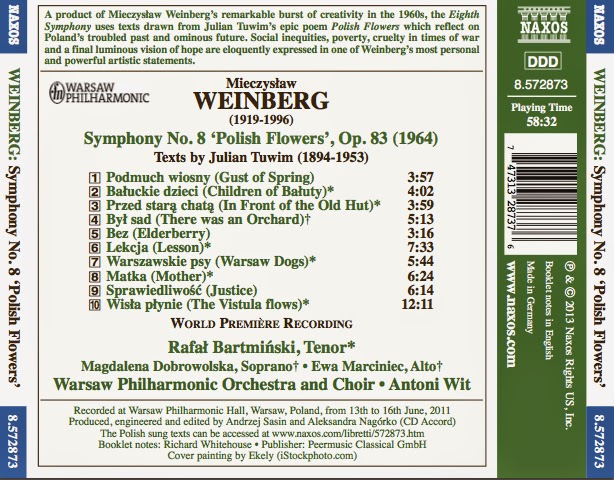
Mieczysław Weinberg - Symphony No. 8 "Polish Flowers" Op. 83 - Warsaw Philharmonic Orchestra & Chorus - Naxos 2013

Here's a Weinberg disc from my "unopened discs from 2013 pile" that I literally just unwrapped. I have to say, with other great bloggers out there, it's sometimes difficult to post Weinberg (especially more recent recordings from the past few years) that has not already been shared, especially these highly regarded Naxos recordings. It seems that this choral symphony "Polish Flowers" has not been shared, as far as I can tell anyhow. So, time to add it to the blogosphere and cosmos  :)

I am typing out the booklet notes as I cannot comment whatsoever on Weinberg's 8th.
Here's hoping we all enjoy it! I have a premonition it's going to go swimmingly. On to the notes.......


Mieczysław Weinberg was born on 8 December 1919 in Warsaw, where he emerged as a highly regarded pianist. He might well have continued his studies in the United States until the Nazi occupation saw him flee to Minsk (in the course of which his travel documents were inscribed as Moisey Vainberg, by which name he was ‘officially’ known until 1982). During 1939–41 he studied composition with Vasily Zolotaryov, then, soon after the Nazi invasion, he headed further east to Tashkent where he immersed himself in theatrical and operatic projects. There he also wrote his First Symphony, which favourably impressed Shostakovich and resulted in his settling in Moscow in 1943, where he was to remain for the rest of his life. In spite of numerous personal setbacks (his father-in-law, actor Solomon Mikhoels, was executed in 1948 and he himself was briefly imprisoned for alleged Jewish subversion prior to the death of Stalin in 1953), he gradually amassed a reputation as a composer who was championed by many of the leading Soviet singers, instrumentalists and conductors.

Despite several official honours Weinberg’s fortunes declined notably over his final two decades, not least owing to the emergence of a younger generation of composers whose perceived antagonism to the Soviet establishment ensured them much greater coverage in the West, and his death in Moscow on 26 February 1996 went all but unnoticed. Since then, however, his output—which comprises 26 symphonies and seventeen string quartets, along with seven operas, some two dozen song-cycles and a wealth of chamber and instrumental music—has received an increasing number of performances and recordings, and has been held in ever greater regard as a substantial continuation of the Russian symphonic tradition.

The 1960s was a decade of great productivity for Weinberg and not least in terms of the symphony, with seven written from 1962 to 1970. After the Fifth Symphony, moreover, his largest pieces in the genre were choral, beginning with the Sixth Symphony then continuing with the Eighth and Ninth. Composed in 1964, the Eighth is his first wholly choral symphony, its twelve movements drawing on the epic poem (itself the only completed part of an intended trilogy) Polish Flowers by Julian Tuwim (1894–1953), whose poetry Weinberg set as early as his song-cycle Acacias of 1940. At once a history and a critique of Poland over the period between the two world wars, Tuwim’s verse struck a resonance in Weinberg who, other than a visit to the Warsaw Autumn Festival in 1966, was not to see his native country after having fled the Nazi advance in 1939. The Eighth Symphony, first given in Moscow on 6 March 1966 by Alexander Yurlov with the Russian Academic Choir and the Moscow Philharmonic Orchestra, is therefore among his most personal artistic statements.

The first movement, Gust of Spring, sets the tone for the work as a whole with its reflections on Poland’s troubled past and ominous future. It begins pensively with female voices sounding plaintively over tolling lower strings and percussion, the former continuing at length until strings have an elegiac response that is continued by solo clarinet towards the close.

The second movement, Children of Bałuty, evokes the social inequities of pre-war Poland as seen through the industrial landscape of Bałuty, a suburb of Łódź. It commences with lively and rhythmically agile writing for female voices over a pizzicato accompaniment which soon draws in the strings and woodwind. A pause and then the tenor soloist responds in more immediately expressive terms, before elements of both themes are briefly combined prior to the brusque ending.

The third movement, In Front of the Old Hut, surveys the degradation endured by the mass of Polish people in earlier times. It starts with plangent woodwind entries that are joined by solo tenor in an almost Baroque-like texture, offset by discreet gestures on percussion. Strings and muted brass enter before unaccompanied voices bring about a hushed conclusion.

The fourth movement, There was an Orchard, expands on the issue of poverty with its depiction of the squalor common to peasants, gypsies and Jews alike. It begins with a burgeoning of folk-like gestures on woodwind and strings—the chorus entering stealthily, followed by a dialogue for soprano and mezzo soloists from within the chorus. The emotional mood heightens only gradually, with the instrumental component becoming more forceful prior to its sudden curtailment.

The fifth movement, Elderberry, contrasts the hope offered by springtime with the alienation of urban life. It commences with solo tenor accompanied by wistful woodwind gestures over a chord in lower strings. The chorus responds in almost prayerful terms, leading on to the work’s initial climax in which the whole orchestra is also to be heard for the first time.

The sixth movement, Lesson, is a warning to Polish infants of the inequities that they are to encounter. It opens with dance-like music for chorus and orchestra, percussion much in evidence. This tails off to leave the chorus sounding hesitant over fragmentary gestures on woodwind and brass, before the activity resumes on orchestra alone. The chorus then re-emerges at its height, after which calmer yet sombre exchanges between brass and percussion gradually subside into nothingness.

The seventh movement, Warsaw Dogs, equates the cruelties dealt out to dogs with that of the Polish people in time of war. It launches with stark unison chords on piano and percussion, chorus and woodwind replying with similarly forceful writing which builds in intensity until the initial chords are hammered out by full orchestra. An impassioned tenor solo brings a sudden hush, with only fugitive gestures from voices and instruments remaining prior to a powerful orchestral chord.

The eighth movement, Mother, takes the murder of a woman at her son’s grave as emblematic of the atrocities inflicted by the Nazi invaders. It unfolds with an eloquent solo from tenor over static chords—derived from that which ended the preceding movement—on lower (wordless) voices and instruments. At length a solo horn and then upper strings wearily assume the melodic foreground, followed by glacial gestures on celesta and lower woodwind as a rounding off.

The ninth movement, Justice, contrasts the collapse of Nazi rule with a promise of freedom and equality in the wake of the Soviet victory. It starts with starkly dramatic writing for unaccompanied voices in rhythmic unison, with a discreet underpinning from strings and brass at key moments. A more passive section (derived from the 1958 song-cycle Reminiscences) finds the chorus in subdued dialogue with woodwind (derived from the 1958 song-cycle Reminiscences) before a climactic unison gesture from chorus and orchestra.

The tenth movement, The Vistula flows, likens the poet’s verse to the flowers of Poland that each year bring new hope, with the river Vistula as a metaphor for the indestructibility of the Polish spirit. It begins with an expressive solo from the tenor, continued in more ruminative terms by the chorus over a luminous orchestral backdrop. The tenor resumes in more measured terms against an imploring choral response, before the woodwind gestures from the fifth movement reappear prior to the chorus bringing about the work’s main climax in a monumental passage for all the voices and instruments combined. This rapidly dies down to leave fragmentary choral gestures, together with recollections from the very opening of the work, as the plangent sound of upper woodwind brings about a subdued yet tenuously optimistic ending: as if to reflect, in Weinberg’s own words, ‘the deep faith of the poet in the victory of freedom, justice and humanism’.


Weinberg_Symphony_No.8_Tveti_Pol'shi-Tzadik.zip

http://www31.zippyshare.com/v/1flzA5BJ/file.html

Robert White - Hymns, Psalms and Lamentations - Gallicantus and Gabriel Crouch - Signum Classics

Here we have what I believe to be one of the finest recordings of early music of any kind. White was a Tudor-era composer who wrote some of the most beautiful and ethereal music for voices. I think many of you will agree once (or during) the hour plus is up. The quality of this Signum disc is overall flawless I think, and rather astonishingly so. The ensemble is perfect. The sound quality couldn't be any better for this music..


Robert White (c.1538-1574) was arguably the leading figure in that lost generation of English composers which came to maturity between Tallis and Byrd, in the middle of the 16th century. Along with Robert Parsons and William Mundy, White formed a school within a school, whose musical instinct was to look back to the Catholic style of Tallis's youth (a style they had all but missed) while putting it to the service of Elizabeth I's Protestant Church. The result is an idiom which is rare in Tallis, who showed himself prepared to jettison the old ways, and unknown in Byrd. To us it has a particular, almost nostalgic appeal: the polyphonic lines still unwind slowly, the scoring is still spacious, the cadences archaic; yet the phrases themselves are more highly organized than in music from the 1520s and '30s, their expression more direct and poignant.

Like every composer active in England in the early years of Elizabeth's reign, White was forced to make stylistic compromises as a result of the Reformation; and it is in the ingredients of these compromises that his individuality lay. Unlike Tallis, Sheppard and Tye, and although he was younger than them, he rarely wrote music with English words. The little Anglican music he did write was, like much of that by Parsons and Mundy, protracted and thoroughly polyphonic, coming close at times to sounding like exercises in Franco-Flemish imitation. His Latin motets, by contrast, are at once more modern and more old-fashioned: the five-voice Lamentations, which show White's Latin style at its most advanced, contain little free polyphony, but rather expansive, often non-aligned homophony - yet are scored for the almost defunct choir of treble, mean, countertenor, tenor and bass. Even in his settings of the Hebrew letters which precede each verse and were traditionally written in abstract counterpoint (a method followed by both Tallis and Byrd in their settings of the Lamentations), White's melodies seem to have been conceived in organised blocks, often repeating at the unison or octave instead of the fifth; often moving in parallel thirds, sixths or tenths: a half-way, individual style, neither exactly old nor new.

One can only guess for whom he wrote these potentially contentious and vocally demanding pieces. He seems never to have been formally attached to the Chapel Royal, the obvious recipient of them, though it remains highly probable that he was asked to contribute to their work, especially after 1569 or 1570 when he became Master of the Choristers at Westminster Abbey. Before that, in his brief career, he was a chorister and later one of the cantores at Trinity College, Cambridge (1555-1562); Master of the Choristers at Ely Cathedral - where he succeeded his father-in-law Christopher Tye (1562-1566); and probably Master of the Choristers at Chester Cathedral (c.1566-c.1569) before moving to London, where he died of the plague in the disastrous epidemic of 1574. Although White seems to have spent much of his life working to the north of the capital, his Will states that he left property of some substance in Sussex. This kind of biographical non sequitur should make us cautious of concluding that he never worked at court: it is perfectly possible that, from his Cambridge days, he regularly visited London and always kept in touch with developments there.


Enjoy..

R.White_Hymns_Psalms_&_Lamentations_Tzadik.zip

http://www17.zippyshare.com/v/Je5nWf58/file.html

Arnold Cooke - Concerto in D for String Orchestra - Symphony No. 1 - Jabez and the Devil, Suite from the Ballet - London Philharmonic Orchestra, Nicholas Braithwaite - Lyrita 1975 & 2007 (DDD/ADD)

I have been itching to listen to more of Arnold Cooke's music lately, and happily I located this fantastic and important disc, again on Lyrita, on one of my hdds. This recording proves (as do all others) how very much Arnold Cooke recording projects are not only to be hoped for, but entirely necessary as he is a composer of too much stature to be ignored. The Naxos disc of Cooke's String Sonatas (posted here, some months ago) is a very promising sign, as is
the brilliant survey of Cooke's chamber music on Dutton Epoch (I have it somewhere..). I must confess I have not played this disc in a long time, and I confess to laziness and thus a brief Gramophone review below. I do recall that this disc is a complete knock-out, full of robust contrapuntal writing and energetic, sometimes relentless orchestral wallops of the highest order-in the Concerto for Strings but also in the Symphony. The Symphony No. 1 I do also recall impressed me, not only as it was Cooke's first stab at it (he was already in his 40s, however..) but also it's ability to stand neck and neck among other 20th century symphonies by established composers, English or otherwise. And most of these symphonies were not initial efforts like the Cooke. The ballet music from "Jabez and the Devil" too is a lot of fun, however admittedly it is what I remember the least; I am excited to listen to everything once again today! 


Arnold Cooke in bronze


Gramophone:

The first of Arnold Cooke’s five symphonies was completed in 1947 and premiered under Sir Adrian Boult in a BBC broadcast two years later. At first glance both the home tonality and formal plan might imply a nod or two towards Walton’s First Symphony from the previous decade. However, it doesn’t take very long to discover that the most fruitful influence is that of Hindemith (Cooke’s teacher at the Berlin Hochschule für Musik from 1929 to 1932); anyone who responds to the German master’s Mathis der Maler, Symphony in E flat or Symphonia serena should most certainly lend an ear. Closer to home, annotator Calum MacDonald also perceives a timeless, deep-rooted quality in Cooke’s fad-free music that suggests a kinship with Rubbra (witness the long-breathed polyphony of the heartfelt slow movement). In sum, a work of impeccable resourcefulness, cogent argument and affecting sincerity that invites and repays repeated listening.

The symphony is flanked by the 1948 Concerto in D for string orchestra (a bracingly assured, big-hearted essay in three movements, which features some grateful writing for the section principals) and a splendidly colourful and diverting 18-minute suite from the 1959 ballet Jabez and the Devil (eventually staged at Covent Garden in September 1961). Kenneth Wilkinson’s 1974 Kingsway Hall sound in the latter boasts fabulous bite and presence still, but the two other works (taped in 1988-89) have likewise been ripely captured by the microphones, and Nicholas Braithwaite helms the LPO with scrupulous care and infectious commitment throughout. Definitely one for the “want” list!


*I'm including a pdf of the covers and booklet (it's not mine), and the scans of the booklet
are small thus zooming will be helpful.

Also whenever I locate my physical copy I shall upgrade the post to m4a, I guarantee there is a difference :)

Enjoy!

Arnold_Cooke_Symphony_No.1_Concerto_Jabez_Tzadik.zip

http://www49.zippyshare.com/v/i2hlpWej/file.html