Wednesday, April 8, 2015

Stanley Bate - Piano Concerto No. 2 in C major - Sinfonietta No. 1 - Franz Reizenstein - Piano Concerto No. 2 in F (World premiere recordings) - RSNO, Martin Yates - Victor Sangiorgio, Piano - Dutton Epoch 2011

It's time for more unopened/unheard music from the piles. This disc was released in 2011 but I likely
purchased it in 2013. I got it for the Stanley Bate works as I am a huge fan of this great composer. He  deserves so much recognition, and thanks to Dutton he is getting a good deal of it. Of course, most people simply do not know of Bate, and I for one have never heard any of his music played on the radio nor have I ever read about his music being part of a concert program (in the States anyhow; several Bate world premieres took place in England, during the composer's lifetime). His symphonies in particular should be getting plenty of airtime, as should his masterful concerti (the Viola Concerto for instance, it's a knock out and I posted it here last summer...click on keyword Stanley Bate at the bottom if you haven't checked the disc out yet) and, needless to say-everything else. He is a masterful orchestrator and everything I have heard, I love. 

Franz Reizenstein is unknown to me, so hopefully his Piano Concerto will be a real discovery; as far as Dutton's Epoch incredible series of lesser known, unsung British composers goes, I expect nothing will disappoint. The Bate works I can say for sure will be impressive (I have heard nothing but great things about the 2nd Piano Concerto) and I'm overflowing with excitement to hear them, especially after the day I have had! So let's survey this release together, sonic explorers...  

Here is a review from Fanfare to whet the symphonic appetite: 

Yet another irreplaceable number in Dutton’s endlessly fascinating series of premiere recordings pairs second piano concertos by two relatively short-lived and underappreciated composers born in the same year—Stanley Bate (1911–59) and Franz Reizenstein (1911–68).


After focusing on several of Bate’s most important postwar works (the Third and Fourth symphonies and the great Viola Concerto), Dutton now delves back into his promisingly active youthful 1930s with first recordings of one of his three piano concertos and the first of his two sinfoniettas. Though neither work is as complex in drama and design as the products of his maturity, the second concerto of 1940 is a very substantial and collaborative piece that does quite well by both the soloist (Bate introduced the work himself under Beecham) and its accompanying forces. As usual in Bate’s music, it is full of arresting ideas treated in unexpectedly inventive ways, reflecting his studies with another talented composer-pianist, Arthur Benjamin. 


Though adhering more or less to classical models, Bate was always able to incorporate what he learned from two of the century’s greatest teachers (Hindemith and Boulanger) into the essentially British perspective he had inherited from his early studies with Vaughan Williams. This rich synthesis makes for a highly attractive Waltonian blend of interacting color and cogency, of the nationalistic and the cosmopolitan, comparable to those of members of an older generation such as Bliss and Goossens. The Sinfonietta, written two years earlier and consisting of two pairs of presto/andante movements, is an absolute romp, moving along at a breakneck pace and resembling many characteristics of a divertimento. It makes us eager to sample some of the ballet music Bate was turning out during these formative but productive years. 


Also a gifted pianist, Franz Reizenstein was forced to leave his native Germany for the usual reasons and to emigrate to England as early as 1934. His first teacher had been Hindemith, but after further studies in England with Vaughan Williams, Constant Lambert, and the celebrated pianist Solomon, during the following three decades he amassed an impressive collection of orchestra, chamber, even choral music in many forms while making a living as a teacher and composer-for-hire, primarily for horror films. 


The Second Piano Concerto of 1961 is written in his busily propulsive and forthrightly self-assured neoclassical style whose Hindemithian origins had absorbed a wide range of idioms, including a more populist bent. Like the Bate Second, it is quite approachable and communicative and makes for a fine virtuosic vehicle for both soloist and orchestra. Both Victor Sangiorgio and Martin Yates are full up to the demands made upon them and deliver smashing readings. 


All in all, this is a most worthy and highly enjoyable addition to the Dutton catalog and leads one to hope they will explore more Bate concertos: two others for piano, three for violin, one each for cello and harpsichord. Meanwhile, no hesitation is required to acquire this disc. 

Enjoy!

Stanley_Bate_&_Franz_Reizenstein_Piano_Concertos-Tzadik.zip

http://www39.zippyshare.com/v/Xy5EPPJ7/file.html

Gustavo Leone - String Quartets Nos. 1 and 2 - Una voz, un grito, un lamento - Red Quintet - Scenes - Cuarteto Q-Arte - Marta Liliana Bonilla, Harp - Beatriz Elena Martinez, Soprano - Toccata Classics 2013

Time once again for a disc from the "unheard/unopened" piles circa 2013. I never heard of Gustavo Leone before buying this recording (I love you, Toccata Classics!!) and I am very excited about this album and composer going by what I have heard so far (track one "Una vow, un grit, un lament" and right now track two, the 1st movement of Leone's String Quartet No. 1..). This is string quartet music *just* the way I love it; it is engaging. it is beautiful. it is clearly contemporary but lyrical, and brimming with substance and ideas. Let's give a listen!!


Enjoy, thus far I sure am..

Gustavo_Leone_String_Quartets_Nos._1_&_2_Etc.-Tzadik.zip

http://www77.zippyshare.com/v/hfjeT6ue/file.html

Eric Ewazen - "Bass Hits": Concert Pieces for Bass Trombone - Concertino for B.T. & Trombone Choir - Ballade for B.T., Harp and String Orchestra - Concerto for B.T. & Orchestra - Rhapsody for B.T. & String Orchestra - Capriccio - Alabany Records 2001

Those of you familiar with the music of Eric Ewazen, whether through my blog or as longstanding Ewazen fans-know how uniformly beautiful and lyrical his language is. This disc of works for Bass Trombones and Bass Trombone with string orchestra and full orchestra is no exception. It is one of best collections of his compositions imo. When I think of Trombone music, only Alan Hovhaness's
singing, often mystical applications offer me as much pleasure. I am typing out the booklet notes, as they are by the composer himself and he might just know his works better than me. Everything here is just gorgeous!! (Okay I do have an extra soft spot for the Rhapsody for Bass Trombone & Orchestra...)


Concertino for Bass Trombone and Trombone Choir

Having been a friend of David Taylor's since 1980 when he recorded my piece, Dagon II for 9 tracks of bass trombone, I have long known of his legendary playing in so many different musical styles—from classical to jazz to popular to experimental. With the Concertino, I wanted to write a work for him which captures many of his musical personalities. The piece was premiered by David Taylor with the University of Illinois Trombone Choir, conducted by Elliott Chasanov at the 1996 International Trombone Association festival at the University of Illinois. The one movement work alternates soulful chorales with hard-driving rhythmic passages. The trombone choir provides a buoyant intricate accompaniment for jazz influenced gestures and melodies in the soloist's line. At the culmination of the piece a virtuostic cadenza leads to a final rousing coda.

Ballade for Bass Trombone, Harp and String Orchestra

Ballade for Bass Trombone, Harp and String Orchestra began life as a work for clarinet. I made the arrangements for Charles Vernon, to whom the piece is dedicated in 1996. Charlie premiered the work at the 1996 ITA convention at the University of Illinois. I well knew of his reputation as one of the genuinely great orchestral and solo bass trombonists of our time. At that convention I had the pleasure of accompanying him on a program which included such diverse pieces as Mahler's Kindertotenlieder and the John Williams' Concerto. The Ballade showcases Charlie's wonderful ability to float long, lyric lines and to dazzle the listener with his energetic vitality and golden tone. In an ABABA form, these two polar extremes are highlighted. The piece seems to rise out of a mist…sing, dance and play… and quietly, peacefully disappear again into the mist.

Concerto for Bass Trombone and Orchestra

Stefan Sanders, whom I am proud to count as one of my music theory students at Juilliard, won the low brass competition held at the school in 1997, resulting in his premiere performance of my Concerto for Bass Trombone (or Tuba) and Orchestra. Stefan's commanding sonority and his heartfelt expression resulted in a premiere performance both riveting and soulful. This is a large 3 movement concerto—modeled after the concertos of the classical period. The first movement's introduction and coda is a lilting song framing an extremely playful sonata allegro form. Much of the movement is contrapuntal, allowing the bass trombone to combine and recombine with various soloists in the orchestra. The second movement is a genuine aria, a melancholy song without words. The final movement is frenetic and agitated, sometimes angry, sometimes heroic and even joyful…but always filled with momentum and drive.

Rhapsody for Bass Trombone and String Orchestra

John Rojak has been a friend for almost 25 years, since we were students together at Juilliard. As the extraordinary bass trombonist of the American Brass Quintet, he has performed on some of the most celebrated brass chamber music recordings of the 20th, now 21st centuries. Equally adept as a terrific soloist, John approached me about writing a piece for him in 1996. This resulted in the Rhapsody for Bass Trombone and String Orchestra which he premiered at the 1997 ITA Convention in Boulder, CO. All three movements of this work are in minor keys. Although pastorale, uplifting gestures and moments of sunlight appear, the net effect of this piece remains haunting, mysterious and dramatic. In the first movement, mournful, expressive bass trombone lines are supported by high shimmering string chords. The second movement is a melancholy waltz. The third movement contains thundering, agitated themes and gestures.

Capriccio for Bass Trombone and Trombone Choir

The finale of Bass Hits is a Capriccio for Bass Trombone and Trombone Choir. It was written for David Taylor as a companion piece to his Concertino which opens Bass Hits. The rapid, spinning compound meter calls to mind a wild, ecstatic tarantella. The bass trombone dances over the punctuated, aggressive trombone choir chords, creating a feeling of boundless energy and exhilaration.

-Eric Ewazen

Track listing:

1) "Concertino for Bass Trombone and Trombone Choir" [9:54]

David Taylor, Bass Trombone, Glen Cortese, Conductor. Trombone Choir: Joseph Alessi, Blair Bollinger, Glen Dodson, Otmar Gaiswinkler, Erik Hainzl, Dietmar Küblböck, Mark Lawrence, Hans Ströcker.

2) "Ballade for Bass Trombone, Harp and String Orchestra" [13:44]

"Concerto for Bass Trombone and Orchestra"

3) Andante con moto—Allegro Vivace [5:35]
4) Andante Espressivo [6:49]
5) Allegro Ritmico [7:02]

Charles Vernon, Bass Trombone, Jessica Zhou, Harp. International Sejong Soloists

"Rhapsody for Bass Trombone and String Orchestra"

6) Andante Misterioso [5:56]
7) Allegretto Cantabile [6:15] 
8) Allegro Molto [6:56]

Stefan Sanders, Bass Trombone, Paul Polivnick, Conductor Czech Philharmonic Chamber Orchestra

9) "Capriccio for Bass Trombone and Trombone Choir" [5:20]

John Rojak, Bass Trombone, Paul Polivnick, Conductor, Czech Philharmonic Chamber Orchestra

Enjoy!

Eric_Ewazen_Bass_Hits(Albany 2001)-Tzadik.zip

http://www75.zippyshare.com/v/wzeJZWNJ/file.html

Tuesday, April 7, 2015

Bohuslav Martinů - Half-Time, Rondo for Orchestra - La Bagarre - Intermezzo - Thunderbolt P-47 - The Rock - Brno State Philharmonic Orchestra - Petr Vronsky - Supraphon 1984

Here is another rare Martinů disc from the Czech label of labels, Supraphon.

After taking residence in Paris to study under Roussel, Martinů was surprised by the extent of Stravinsky's influence and a general flux in stylistic orientation due to frenetic experimentation.  He became the leading Czech music correspondent in Paris, relating his discoveries about the Parisian music scene to the Czech cultural press.  In his essays from this time, he frequently commented on the 'outdated' and 'Romantic' musical values he felt still persisted in Prague's musical life.  Among the earliest results from his Parisian years was his "orchestral–rondo" "Half–time" (1924), a work clearly inspired by Stravinsky's Russian ballets.  Although he rightly defended the work from being a Stravinskian plagiarism, his polemical essays imply his desire to provoke the Czech critics with the sounds of the Parisian milieu. "Half–time" was premiered in Prague in December 1924 by the Czech Philharmonic under Václav Talich, who would remain Martinů's most powerful ally at home until the fall of the First Czechoslovak Republic in 1938.


Half-time celebrates 'American football'. As a frenzied crowd of fans grows ever more excited in the midst of a tense soccer match, a melody emerges fortissimo in the strings and harmonized in thirds, an obvious folk-inspired gesture. This tune clearly represents the crowd, en masse, in an excited state. It is the only extended melodic passage in the entire piece, and as such vividly stands out.

With "La Bagarre" the wit and exploration of the 1920s Parisian avant-garde trend continues, but with even more interesting implications. This is the work Martinů boldly offered to Koussevitsky when he spotted the conductor at a sidewalk cafe in Paris, and which the Russian conductor premiered in America with the Boston Symphony Orchestra to critical acclaim. Martinů submitted the following program notes for that occasion:

"La Bagarre is charged with an atmosphere of movement, dash, tumult, obstruction. ‘Tis a movement in grand mass, in uncontrollable, violent rush. I dedicate the composition to the memory of Lindbergh landing at Bourget, which responds to my imagination, and expresses clearly its aim and evolution.
In this symphonic rondo, 2-2, I have portrayed the tension of spectators at a game of football (sic). ‘Bagarre’ is, properly speaking, an analogous subject, but multiplied, transported to the street. It’s a boulevard, a stadium, a mass, a quantity which is in delirium, clothed as a single body. It’s a chaos ruled by all the sentiments of enthusiasm, struggle, joy, sadness, wonder. It’s a chaos governed by a common feeling, an invisible bond, which pushes everything forward, which moulds numerous masses into a single element full of unexpected, uncontrollable events. It is grandly contrapuntal. All interests, great and small, disappear as secondary themes, and are fused at the same time in a new composition of movement, in a new expression of force, in a new form of powerful, unconquerable human mass."

"La Bagarre", properly speaking, is a triptych, in which the intermediate phrase, usually free, is replaced (apparently by a more melodious movement) by a quicker tempo than that of the first and third, ending in a violent, presto coda.

Thunderbolt P-47 is the famed American fighter plane of World War II which this fiery orchestral scherzo aims to describe. On that note, I have to finish writing this later, time for work unfortunately..

Enjoy everyone

Martinů_Thunderbolt_La_Bagarre_etc._Tzadik.zip

http://www70.zippyshare.com/v/7vNQOndt/file.html

Monday, April 6, 2015

Bohuslav Martinů - Le Raid merveilleux (Ballet mécanique) - La Revue de cuisine (complete ballet, first recording) - On Tourne! (Ballet in 1 act) - Czech Philharmonic Orchestra, Christopher Hogwood - Supraphon 2004

This is a rather unknown Martinů disc from Supraphon, featuring lesser-known earlier works (Le Revue de Cuisine is likely the one piece here that listeners will know) which is a most exciting collection of ballet/jazz pieces; two for ensemble and one for full orchestra. All date from 1927, five years before Martinů’s move to Paris. This is one of my favorite early Martinů recordings; it is just overflowing with idiosyncratic beauty and charm-rare material done idiomatically and with an authentic zest.


"Le Raid Merveilleux" is concerned with the tragic failure of two French aviators, Charles Nungesser and François Coli, to fly across the Atlantic on 8 May 1927. Two weeks after the loss of the two fliers Charles Lindbergh succeeded where they had failed. Aviation references appear throughout the work's five movements. In the final segment, 'La Mer', the Morse code 'SOS' figure rings out on the piano rather like the homing signal in Barber's Second Symphony. The score is not at all dry as one might fear given the background, and the jazz influence is virtually undetectable. The outer movements 'Un Oiseau' and 'La Mer' as well as 'Les Cartes' (a gentle canon) are humane and quite beautiful and indeed the mature Martinů personality is very much to the fore in La Mer. I often listen to this score twice, as I do with all three pieces on this release...it's just that good to a Martinů freak like myself!

After not much of a pause we pitch into "La Revue de Cuisine". This is for six instruments and is in ten movements. The ballet music is playful, piquant, energetic and jerky and even carries a folk flavor (try the polka Prologue). Stravinsky (Petrouchka meets Pulcinella in chamber orchestration) is clearly an influence. There is also a strutting absurdist element akin to the Shostakovich First Piano Concerto. The Duel movement (track 11) is marked 'Tempo di Charleston' and that dance is prominent after the first minute or so. 'Oompah' and other popular dance elements flit to and fro through these pages. 'Le Fin du Drame' (track 15) vivaciously recaps the dances of the previous movements. This is the first recording of the complete ballet of La Revue. (Movements from it were famously included on a 1960s Supraphon LP later reissued on CD)

After the stripped-down and spare textures of the first two ballets, "En Tourne!" introduces the uproar of the full orchestra in signature Martinů full flow. There are eight movements with some amazing trumpet playing in the tumult of the first movement. (This is the CD premiere recording of the ballet On tourne!)

Hopefully I will have time for more rare Martinů after work (key word is 'hopefully'!)

Enjoy!

Martinu_Le_Raid_merveilleux_On_Tourne!-Tzadik.zip

http://www9.zippyshare.com/v/oUNU8SIn/file.html

Saturday, April 4, 2015

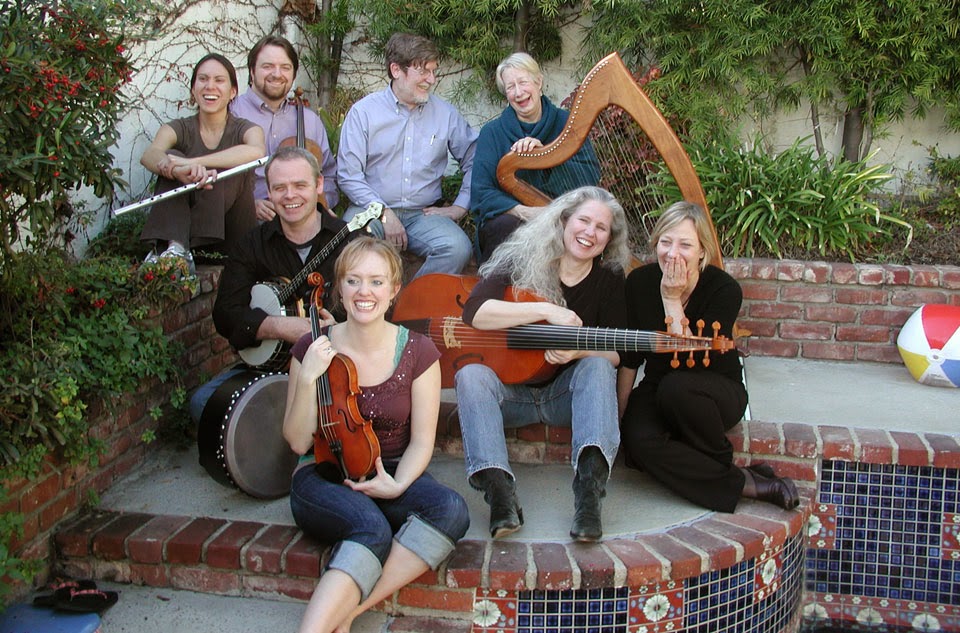
The Mystic and the Muse - Celebrating 600 Years Of Women In Music - Ensemble Galilei - Dorian Records 1997

This has been one of my all-time favorite early music recordings (there are a few "contemporary" works on here as well; they are, however, in a style that sounds ancient and timeless, and blend perfectly with the rest of the program. I especially enjoy "The Alchemist" by Marcia Diehl, which expertly conjures up the spirit of ancient worlds. She is a member of the Baltimore Consort, the recorder(s) player) since I bought it in '97 when it was released. Dorian recordings were, during those years especially, endless treasures, release after release. Like all of the Baltimore Consort's albums, Ensemble Galilei too always transports me to a special, magical place otherwise unattainable in the physical world; this is music that makes me feel good no matter what is happening in my life, and I can listen to it at anytime and it's 100% fresh.

So Ensemble Galilei is an instrumental group of five women (more recently six, with the addition of other musicians depending on the program and instrumental needs) who perform traditional folk melodies, early music, reels and airs, and original compositions. Their range of instruments-which includes fiddle, viola, Scottish small pipes, percussion, Celtic harp, tin whistle, recorder and other winds-weave a sound that is by turns sprightly and sweetly melancholy, dense as an old-growth forest and diaphanous as a fallen leaf. So steeped are the Ensemble members in early music, that their original tunes are often indistinguishable from the traditional material.


The booklet notes I might type out at some point, my fingers do not feel up to it at the moment!

Enjoy the journey...

The_Mystic_&_The_Muse-Ensemble_Galilei-Tzadik.zip

http://www73.zippyshare.com/v/BSi67LEk/file.html

Friday, April 3, 2015

Paul Lansky "Imaginary Islands" - Shapeshifters, Concerto for Two Pianos & Orchestra - With the Grain, Concerto for Guitar & Orchestra - Imaginary Islands - Alabama Symphony Orchestra, Justin Brown - Bridge Records 2012

Greetings everyone. This is yet another "previously unopened/unheard" cd piles post; I think this is possibly the best one yet...I have been enjoying *everything* about this recording so very much that I feel bad that I had it sitting in my closet for a couple years-what pleasure I inadvertently denied myself! I had heard of Paul Lansky however I had never heard anything he composed until now (he has been known mostly for his electronic/computer-based composition, and I just never got around to sampling any...now I realize I probably should). All three works I find to be terrific, and perfect examples of 21st century composition that's not only highly accessible but unique and exciting. This disc it but thrice played (my free time is so scarce still) however it's clear to me that this is something really special. Paul Lansky is a first rate composer who knows how to weave several musical styles together effortlessly and with magical effect. A triumph for Bridge and anyone lucky enough to get their ears on this music.


Typing out the booklet notes:

Paul Lansky's burgeoning career shift - from composer of computer-generated music, to composer of music written for, as he humorously puts it "carbon-based life forms" - is documented on the present recording, comprising three symphonic works created during the past five years. In Lansky's words: "I never expected to write orchestral music. On the other hand I never planned to spend more then thirty years doing little but trying to get dumb computers to sing." Lansky's comment about his work with computers is self-effacing to a fault, as his mastery of the digital genre has long been praised for its expressive qualities in a field that has struggled with this issue from its inception. To whit, a number of Lansky's compositions are regarded as classics in a genre that has all too often produced the ephemeral. These include: Table's Clear (1990), employing kitchen instruments and the voices of the composer's children; the series of "Chatter" pieces (1985-2006), featuring chanting choruses of synthetic voices which produce glorious contrapuntal and harmonic tapestries; and the ethereal transformation of folk materials in the collection, Folk Images (1980/81 and 1991). And the praise comes from all sides. Fellow composers have hailed his technical expertise and innovations, critics often point to the wide variety of his expressive palette, and average listeners love his directness of expression, his ability to make computers "sing". So the obvious question is, how did he move from computer to orchestra? 

Lansky writes: "By 2005 I had pretty much switched over to writing for instruments; life is short and I wanted to try new things. Orchestral music, however, seemed out of reach. But, that spring I taught a graduate seminar at Princeton in contemporary approaches to harmony and wrote a set of piano preludes to explore some of the things we were studying. My agent, Beck Storobin, asked if I had any two-piano music that the duo Quattro Mani might perform. I re-scored and expanded some of these preludes, and the suite "It All Adds Up" was born. At about the same time, Justin Brown, the conductor of the Alabama Symphony, was staying with David and Becky for a few days. The idea of a two-piano concerto for Sue and Alice and the ASO was discussed, and the next thing I knew, I was writing "Shapeshifters." 

The first performance of Shapeshifters became a turning point in Lansky's compositional career. The work was premiered in April 2008 to an enthusiastic sold-out house in Birmingham--an event that had more of the aura of a rock concert than a symphony performance, because the biggest draw that night was the string orchestra piece "Popcorn Superhet Receiver", by Johnny Greenwood, the lead guitarist of the English rock band Radiohead. Radiohead had encountered Lansky's music at an earlier date, and borrowed a four-chord sample from his 1973 computer piece "mild und leis", as the basis for the song "Idioteque" on the band's hit 2000 album, "Kid A". When Lansky learned that Greenwood's piece was to be on the Birmingham program, he included the same four-chord sequence in the third movement of "Shapeshifters" (listen to track 3 at 2'22''). The cheering, standing ovation earned by Shapeshifters at the premiere performance gave rise to the idea of Lansky working with the orchestra, and during the 2009-10 season he was named as the Alabama Symphony's first composer-in-residence. The ASO commissioned "Imaginary Islands" for the occasion, premiered the guitar concerto "With the Grain" (commissioned by the Fromm Foundation for yours truly), and also played two shorter orchestral pieces Lansky had just written, "Line and Shadow" and "Arches".

And how did our novice symphonist do? Judging by the results herein, admirably! Lansky's musical world seems to find its most complete expression in his orchestral works. The busy surfaces of his computer music remain, and so does the expressive imperative to communicate with swinging rhythms, soulful melodies and a mixture of tonal, polytonal, and at times, nontonal harmony. Melodies have become more expansive and quirky, suiting those carbon-based exponents and the instruments they play, and the timbral possibilities of computer music have been amplified in orchestrations that are almost pictorial in their detail (Lansky writes that he "learned a whole lot about orchestration from writing computer music: spectral balance, envelope, masking, texture etc."). But best of all, the largeness of spirit--the ability to write exalted music that makes us want to dance, meditate, or even cry, finds its fullest expression in these beautiful works, which unabashedly mix popular and classical elements. Whether or not Lansky ever returns to the digital domain, he has given us a body of repertoire that has the communicative power of a modern day Gershwin.

-David Starobin, New Rochelle, NY


Notes on the music by the composer:

"Shapeshifters" (2007-8), for two pianos and orchestra, was commissioned by the Alabama Symphony and Justin Brown for the piano duo Quattro Mani, Susan Grace and Alice Rybak. The title, Shapeshifters, denotes a kind of homage to music's ability to change and morph itself in uncanny and unusual ways. The idea was inspired while composing a moment about 2/3 of the way (4'26'') through the first movement, "At Any Moment", when an interruption of a sudden B minor chord in the horns and strings changes everything. What had been a good day is now overcast and gloomy, like what happens when you get a phone call out of the blue telling you something you may not have wanted to hear. In the other movements shapeshifting occurs in different ways. In the second movement, "Florid Counterpoint", twisting contrapuntal lines evolve into a kind of Andalusian lament. In the third movement, "Confused and Dazed", the music exhibits a kind of collage mentality,  switching back and forth between different kinds of materials rather than evolving a thematic idea. In "Topology", the final movement, the music evolves from a kind of frenetic and percussive texture to full-blown dance music. "Shapeshifters" is not a concerto in the romantic tradition. Here the pianos move back and forth between being articulate soloists and being members of the orchestra.

"With the Grain" (2009) was commissioned by the Fromm Foundation at Harvard for the guitarist David Starobin. The four movements (about 22 minutes) are named after wood grains and their kinetic qualities (these also describe the music): "Redwood Burl (slow, round, evolving shapes)", "Karelian Birch (long, sinuous, wavy lines)", "Quilted Beech (quiet, with soft contours)",  and "Walnut Burl (busy, with aggressive twists and turns)." The piece is a celebration of the classical guitar, an instrument that is manifestly about wood, and it is dedicated to David Starobin. It was David who first encouraged me to write guitar music over ten years ago, a suggestion for which I am forever grateful. 

"Imaginary Islands" (2010) was commissioned by Justin Brown and the Alabama Symphony with the generous assistance of the members of Sound Investment and the National Endowment for the Arts. The work is in three movements, each a kind of sonic landscape for an imaginary island. The movement's titles tell all: 1)"Rolling Hills, Calm Beaches, Something Brewing"; 2)"Cloud-shrouded, Mysterious, Nascent"; 3)"Busy, Bustling, With a heartbeat". Each of the three "islands" has an outward appearance and a back story; a clear first impression, but up close a deeper meaning. Then again, this is what any interesting piece of music should be all about: when you look more deeply you start to see its particular and unique aspects - each island/piece has its own story to tell, something under the surface.  -Paul Lansky    

Enjoy (and Happy Passover & Easter to all!)

Paul_Lansky_Imaginary_Islands-Tzadik.zip

http://www62.zippyshare.com/v/NEb9OYOo/file.html