Friday, June 12, 2015

Peter Sculthorpe - The Complete String Quartets with Didjeridu - Del Sol Quartet - Stephen Kent, Didjeridu - Sono Luminus (Dorian) 2014

Now THIS is a release that I was waiting with bated breath for; Peter Sculthorpe has been one of my favorite composers for many years now (I was hooked when I first heard his absolutely mesmerizing String Quartets on the original Tall Poppies discs...there's nothing quite like them) and this double-disc set is simply incredible, as I knew it would be. Truth be told I have only listened to the whole set a couple of times thus far, due to a general lack of (proper) time. Tonight I am happily remedying this, an event all it's own really :) I have always been fascinated by the Didjeridu (or Didjeridoo), and my first introduction to or "experience" with it's otherworldly deep, mysterious burbling was from an EP released in 1992 on the seminal electronic label Warp Records, by the brilliant composer and electronic musician known as Aphex Twin (Richard D James), among many other aliases. The first of the four tracks is entitled "Didjeridoo" and it's still entrancing and ahead of it's time today. Ironically, this now classic slice of relentless breakbeat/techno actually RE-produced, or rather replicated the sounds of the aboriginal instrument using a Roland TB-303 Rack-synth Bassline-pure madness and genius at the same time. That was my first outing. Later on, Aphex Twin performed the piece with actual didjeridu players. Incidentally, some of Aphex Twin's purely electronic music has been performed by the New York Philharmonic among others in transcriptions made by the man himself. Ok I know I'm getting off track here, but trust me even the mildly adventurous should get familiar with some of his work. Likely I will offer said-future-familiarity for everyone here at some point, so I will shut up now while the shuttin's good. Onwards...


Though respectful gestures to Indigenous Australian musical idioms are a defining element of his output, the issue of direct cultural appropriation of Indigenous musical materials by non-Indigenous composers like Sculthorpe can be a vexed issue. Although the Kronos Quartet had approached him in 1992 (I'm wondering for the first time just now whether or not Kronos had heard the Aphex Twin track, of that same year..) suggesting the idea of scoring a work for string quartet and didjeridu, he almost certainly never would have considered adding an actual Indigenous instrument to his scores, were it not that, in 2001 a young Indigenous musician asked him to. That year, William Barton, a 20-year-old didjeridu player belonging to the traditional Kalkadunga people of Queensland, gave the first public performance of the version of the String Quartet No. 12 recorded here-the first time any Sculthorpe work was heard with added didjeridu. Later that year, Barton gave the first performances of Sculthorpe orchestral works with added didjeridu, with the Queensland Symphony Orchestra and its then chief conductor, the young American Michael Christie, followed in 2003 by a disc of recordings. In 2004, Sculthorpe actually composed a part for Barton and the didjeridu in a major new original work, the "Requiem for Chorus, Didjeridu and Orchestra". Fittingly, this work was also a high-point in Sculthorpe's dedicated and ongoing personal attempt at a reconciliation of Australian Indigenous and settler cultures (and people), although Sculthorpe was careful to point out at the time that "reconciliation" was not his preferred word, "since we were never 'conciled' in the first place!". Since then, when commissioned to compose several new works without didjeridu, Sculthorpe has factored in the instrument's later addition, as in the String Quartet No. 16 (2006) and String Quartet No. 18 (2010) recorded here..

The didjeridu is Indigenous to the far north of Australia, where archaeological evidence suggests it has been used for at least 1000 years. Essentially it is a large wooden drone pipe, made out of termite-hollowed branches of large eucalyptus trees, most commonly 3 to 5 feet long. The outer and inner surfaces are further cut away until the tube is thin and produces a "light sounding" drone, which is then varied by being overblown. According to Indigenous tradition, the instrument dates from the creation "Dreamtime" . The Yolngu people call it 'yidaki', a name popularized by the Yolngu rock band "Yothu Yindi". The name didjeridu (also didjerry), though it sounds Indigenous-actually is probably an onomatopoetic settler invention, first recorded in print in the 1920s. 

Sculthorpe's added parts for didjeridu typically require two or more instruments, each with a fundamental drone of a fixed pitch. Where the didjeridu plays with the strings, the parts are precisely coordinated. However, apart from drone notes, it would be impractical, if not impossible to notate many of the more complex overblown didjeridu sounds conventionally. Many of these, derived from from traditional practice, are imitations of natural sounds (animal growls, bird calls) or dance movements (kangaroo hop). Some of these characteristic sounds Sculthorpe cues verbally, to be added especially between sections or movements of the string-quartet originals.       

Enjoy new sounds! 


Sculthorpe_Cpt_String_Quartets_W._Didjeridu(Disc1)-Tzadik.zip

http://www17.zippyshare.com/v/FGOFKLmS/file.html


Sculthorpe_Cpt_String_Quartets_W._Didjeridu(Disc2)-Tzadik.zip

http://www66.zippyshare.com/v/C7SkD1EV/file.html

Elizabeth Maconchy - Overture, Proud Thames - Symphony for Double String Orchestra - Serenata Concertante for Violin and Orchestra - Music for Strings - LPO, Vernon Handley & Barry Wordsworth - LSO, Vernon Handley - Lyrita (remastered 2007)

Here is a great recording from Lyrita that has done a tremendous service for many years, offering some of Elizabeth Maconchy's (1907-1994) most delightful (and well-crafted) large scale works. 


Elizabeth Maconchy was born in England but the family later settled in Ireland (Dublin). In 1923 she entered the Royal College of Music studying piano with Arthur Alexander and composition with Charles Wood; in a couple of years, she became a pupil of Vaughan Williams, saying later that "it was like turning on a light". Her progress at the Royal College was meteoric. She arrived as a shy Irish girl of 16 who knew only the music she could play for herself (there was no radio or gramophone in her house) yet by 1925 she was being referred to as 'Maestro Maconchy' by those who knew her. In 1927, moving on from writing songs and suites, she composed her first Violin Sonata and began her Piano Concertino. These striking works were already in a musical language far removed from mainstream English music (and the British pastoralists), and indicate her growing familiarity with European new music, which she was discovering for herself (Debussy, Ravel, Stravinsky, Berg, Janacek...but especially Bartok). Several Patron's Fund orchestral performances confirmed her distinctive voice-in 1929 she left the Royal College of Music with glowing reports (Ralph Vaughan Williams: "I can teach her no more; she will go far").


The overture "Proud Thames" was written in 1952 as Maconchy's entry in a London County Council competition. It is bright-eyed and magical. Like Smetana's "Vltava" it traces the Thames from bubbling source to the Capital. It's a work of singing and sighing beguilement and of regal nobility. 

The "Symphony for Double String Orchestra" is a fairly substantial work in four neatly contrasting movements. The first movement opens with a vigorous call to attention (a five-note figure that will reappear later in the work, actually in the final movement). The two string ensembles are used either antiphonally or in unison, with some forceful contrapuntal writing (one of Maconchy's strengths). The second movement opens with a 'rocking figure' paving the way for a richly melodic, impassioned theme, that momentarily gives way to the solo violin's reverie, but the music moves irrepressibly forward towards a mighty climax subsiding then into the opening mood before dissolving into thin air. The third movement is a light-footed Scherzo with the flavor of some rustic dance. The final movement is a concise, but none the less imposing Passacaglia. After the climax, the music again dies away calmly with a quiet, slow restatement of the very opening of the first movement. A wonderful work that should be in the repertoire..

The very title of the "Serenata Concertante" clearly suggests that much emphasis is laid on the symphonic nature of the argument, which is possibly tighter than in the Symphony. Indeed, the first movement opens with a short introduction stating some basic material that will keep reappearing during the course of the work. The introduction leads into the animated Allegro main section. The second movement is a Scherzo. If Bartok is often-and rightly-mentioned as an important influence on Maconchy's music, it is now Martinu who sometimes comes to mind, at least in this particular movement. The slow movement is a richly melodic and warmly lyrical arch supported by soft brass chords, over which the soloist freely muses. The work ends with a fairly extended Rondo, in which material from the preceding movements is briefly restated, thus emphasis the symphonic structure of the whole. It nevertheless ends with a beautiful, calm coda, as did the Symphony. 

The Serenata and the Symphony were made in association with the RVW Trust.
  
The "Music for Strings", too, is in four movements. The dark-hued introduction of the first movement sets the predominantly sombre mood of the entire movement. The movement is another fleeting Scherzo ending "in a wisp of sound". The dark, elegiac mood suggested by the viola in the first bars of the third movement is sustained throughout the Mesto that reaches an eloquent climax. The music slowly subsides leaving the viola alone. The tense mood prevailing in the preceding movements eventually brightens in the final that concludes with "an insouciant throw away ending". On the whole, Music for Strings is a much sterner, rather more understated work than the Symphony, but one that any composer less modest than Maconchy would have proudly called Second Symphony for Strings. Another splendid piece of music from the under-appreciated Elizabeth Maconchy.


Enjoy

Elizabeth_Maconchy_Orchestral_Works-Tzadik.zip

http://www68.zippyshare.com/v/dGo90EwA/file.html

Tuesday, June 9, 2015

Carl Nielsen's 150th Birthday Anniversary - Orchestral Works - The Danish National Radio Symphony Orchestra, Gennady Rozhdestvensky - Chandos Records 1994

Today marks the 150th birthday of Denmark's greatest composer, Carl Nielsen, who was born June 9th, 1865 (same year as Sibelius, the other Scandinavian musical giant!). He is also one of the most important symphonists of the early 20th century, and I'd say his symphonies are some of the greatest achievements in the repertoire in general, across centuries.


Carl August Nielsen was born on 9th June 1865 at Sortelung near Nørre Lyndelse on the island of Funen. His father, who was a painter, also worked as a village musician, and as a boy Carl was already playing in his father's dance orchestra. At the same time he played in the local amateur orchestra, Braga, whose repertoire, besides entertainment and dance music, also included the symphonies of Vienna Classicism. At the age of just fourteen he was engaged as a trombonist in the regimental band in Odense. Alongside his work as a military musician he played string quartets with his friends and studied Das Wohltemperierte Klavier on his own initiative. From these years came his first real attempts at composition - mainly chamber music works in the Classical style.

Thanks to patrons in Odense, Carl Nielsen had the chance to go to Copenhagen, where he studied at the Royal Academy of Music in 1884-86 with the violin as his main subject and the Joachim pupil Valdemar Tofte as his teacher. He was also taught theory (by J.P.E. Hartmann and Orla Rosenhoff), piano (by Gottfred Matthison-Hansen) and music history (by Niels W. Gade).

After his years at the Academy he continued his theoretical studies with Rosenhoff and in 1888 he felt ready to publish his opus 1, the Little Suite for Strings. The next year he was engaged as violinist in the Royal Orchestra, a position he kept until 1905. In 1890, as recognition of his talent, he was awarded the grant Det Ancker'ske Legat, which enabled him to go on a study trip to the Continent. During this trip, in 1891, he married the sculptress Anne Marie Brodersen, who remained his wife for the rest of his life, although the marriage underwent serious crises in some periods.

In the 1890s Carl Nielsen consolidated his position as one of the country's prominent composers with works like the First Symphony op. 7 (1890-92), the J.P. Jacobsen songs op. 4 and 6 (1891), the violin sonata op. 9 (1895) and the choral work Hymnus amoris (1896-97). The years around the turn of the century brought a further two operas, Saul and David (1898-1901) and Maskarade (1904-06), the last of which quickly gained the status of a Danish national opera.

From 1901 he was granted a Government salary, which meant that he was no longer forced to take private pupils to keep up the family finances. A few years afterwards he also signed a general contract with the publisher Wilhelm Hansen, who published more or less all his works until 1924. Alongside his composing career Carl Nielsen was to hold several important posts in Danish musical life. In the period 1908-1914 he conducted at the Royal Theatre, then from 1915 until 1927 he conducted the concerts of the society Musikforeningen. In 1915 he was elected to the board of trustees of the Royal Academy, where he also taught theory and composition from 1915 until 1919. Finally he was on the boards of the Danish Composers' Society and the Society for the Publication of Danish Music.

From the earliest works on, Carl Nielsen's compositions were permeated by a Classicist aesthetic which deliberately avoided any element of Late Romanticism. But in the course of the 1910s and 1920s he oriented himself more towards the new currents in European music. Little by little he now worked several modernist elements into his music, but without at any time abandoning his very characteristic personal style. This development is very clear in the last three symphonies, no. 4 (1914-16), no. 5 (1921-22) and no. 6 (1924-25).

Alongside the increasingly modernist instrumental works Carl Nielsen worked, with his friend Thomas Laub for example, to reform the Danish national song tradition. This resulted in a number of collections of simple strophic songs where he deliberately tried to perpetuate the ideals of J.A.P. Schulz' Lieder im Volkston (1784). Carl Nielsen had a distinctive literary talent which resulted in the childhood memoirs 'Min fynske Barndom' (My Childhood on Funen), which is amazingly objective and unsentimental, and the essay collection 'Levende Musik' (Living Music), where his anti-Romantic aesthetics were clearly expressed. In his later years Carl Nielsen suffered from a weak heart, and he died on October 3rd, 1931 at the age of 66. He continues to be (astonishingly to me) underrated as one of the 20th century's true geniuses, but his legacy cannot be overstated.


Carl Nielsen's childhood home


The great Dane himself, in 1908


Someplace I'd rather be-The Carl Nielsen Museum, which is also dedicated to the works of the composer's wife, the sculptor Anne Marie Carl-Nielsen.


In the large-scale "Helios Overture" from 1902, we find ourselves at the beginning of Carl Nielsen's great musical 'sunshine period', which culminated in Symphony No. 3, nine years later. If Nielsen chose the Greek word for the sun, it was because the work was written in Greece while on a visit to Athens with his wife. They stayed on that occasion in a room that overlooked the Aegean Sea. Strongly descriptive in style, the Helios has a magnificent arching form which is even condensed, towards the end of the fast main section, into a bright firework display of a fugue. Carl Nielsen himself described the progress of the work in the following words:

Silence and darkness - then the sun rises
to joyful songs of praise -
wanders its golden way - sinks silently
into the sea

It opens in total darkness, with a deep pedal on C, but this gradually yields to the first hints of light, with soft horn-calls evoking the coming of dawn, which is symbolized by a noble chorale. As the sun rises, the large orchestra comes more and more into its own with radiating colors (one can almost 'feel' the golden rays caressing the skin I'd say!) as noon approaches, and the music hoists itself into a resplendent E major as the sun attains its zenith. There follows a quieter passage, suggesting the time of siesta. A grand and bustling music then breaks out into a joyous fugue as the sun makes its way into the west, to sink finally again into C and into the warm darkness from which the music first arose...

At that time European culture had once more rediscovered ancient Hellas, as expressed for example by the resumption of the Olympic Games of antiquity. Nielsen completed the Helios on April 23rd, 1903 and dedicated it to his friend, the Germano-Dutch composer Julius Röntgen, who had also been a friend of Brahms and of Grieg. And another significant Scandinavian figure-the Norwegian, Johan Svendsen-conducted the premiere of Helios in Copenhagen on October 8th of the same year.

The Helios Overture has been of great national importance because it was-and is-the first music one hears from the Danish Broadcasting Corporation on the radio after the turn of the year on New Year's Eve. Especially when the radio was the only broadcasting medium, people were given a sense that with this music they were on their way into a new time (with their dissonances, the horns at the beginning of the work create a feeling of space and promise: far out in space, the year is turning, the light of the sun will grow). There are also points of contact with the earlier great sunrise music in Denmark, Gade's morning song from "The Elf King's Daughter"; as if one sun work is greeting another. The Helios Overture is considered by many to be Nielsen's finest (smaller scale) orchestral work.

In some of the drafts from 1892 Carl Nielsen’s first symphony (opus 7 in G minor) is called "Symphony in C". This Symphony was not his first attempt in the genre. As early as 1888 he had started on a symphony in F major, but he never went further than the first movement. So it was performed under the title "Symphonic Rhapsody for Orchestra" in February 1893, under the baton of Victor Bendix, at one of the so-called Popular Concerts in Copenhagen. While Nielsen's musical personality is not in any sense in full bloom here, the orchestral writing is clearly impressive and, imo, 'clearly' Nielsen all the same.

With the "Rhapsodic Overture: A Fantasy Journey to the Faroe Islands", we are near the end of Carl Nielsen's life, after the completion of the sixth and last symphony. It is an occasional composition written for a celebration at the Royal Theatre to mark a visit from the Faroe Islands. We hear how the music approaches the remote islands in the Atlantic and arrives at an old melody well known in Denmark as "Påskeklokken kimed mildt" (Gently chimed the Easter bell). The work is also an example of how Carl Nielsen in his later years touched on many widely differing landscapes, each of which required its own music.

The orchestral piece "Pan and Syrinx" from 1917-18 is one of Carl Nielsen's most distinctive works, and has always been so regarded. Among other things that have been pointed out is a surprising affinity with musical Impressionism - even with Debussy's well known piece for solo flute, Syrinx, written five years previously, although Carl Nielsen is unlikely to have known it. But that is only one side of the work. The other is the odd shifts in tempo and the special alternation between transparent chamber-musical passages and tutti sections. Here, for the first time, Carl Nielsen uses a relatively large array of exotic percussion; in the work he is stepping out on new paths after the conclusion of his Symphony no. 4. The work points forward all the way to works of the 1920s, especially the Flute Concerto of 1926.

The story of Pan and Syrinx comes from Ovid's Metamorphoses. Pan is attracted to the nymph Syrinx. He pursues her, dancing and bleating. But she is frightened and flees to a woodland lake, where she is transformed into a reed. That is a summary of what Carl Nielsen writes as a text in the score. But he must also have been thinking about the continuation in Ovid, where Pan makes a flute from the reeds, so that he is united with Syrinx through his art. At the end of the piece the high strings lie close to one another in a dissonant block of sound. The individual strings must then gradually stop playing with vibrato. The result is a static sound where the reeds become an instrument, the nymph becomes a thing, and love becomes art.

The "Bohemian-Danish folk tune: Paraphrase for String Orchestra" of 1928 was considered by Nielsen to be an unimportant work (the booklet notes speak of Nielsen referring to his "Rhapsodic Overture: A Fantasy Journey to the Faroe Islands" as "only a piece of jobbery" (!) which I certainly do not agree with. The "Bohemian-Danish folk tune...." is one of my favorite pieces here. I find it to be extremely beautiful, with modal string writing that is on an almost Vaughan Williamsian level,  inducing chills and sheer joy for me, anyhow. I must repeat it every time I play it. Just gorgeous, a real confection imo.

-Ok, I am including the booklet notes anyhow so I hope you will all excuse my abrupt end to this post; I have to get to work! If possible I might post the symphonies tonight (the classic Da Capo series is my first choice, but I dunnoo where I have them so we shall see)

Enjoy!!

Carl_Nielsen_Orchestral_Works-Tzadik.zip

http://www29.zippyshare.com/v/pRdLAQeu/file.html

Saturday, June 6, 2015

Franco Alfano - Cello Sonata - Concerto for Violin, Cello and Piano - Samuel Magill, Cello - Scott Dunn, Piano - Elmira Darvarova, Violin - Naxos 2009

A few years ago whilst browsing on Amazon I stumbled across this disc by a composer I had never heard of. After reading a critique by a certain Amazon reviewer who always impresses me, I was excited and literally 'sold' on this wonderful recording. Hearing the samples, while barely 20 seconds, actually made quite an impression. 

Franco Alfano's fame has always been chiefly bound up with his completion of Turandot, a completion with which Toscanini famously and crudely expressed his dissatisfaction-to put it mildly-by walking out on the opening night at La Scala in 1926 at the very point where Puccini's music ended and Alfano's began. Alfano's own work as an opera composer-notably in "Risurezzione" (1904), "La leggenda di Sakùntala" (1921) and "Cyrano de Bergerac" (1936)-has done rather more for his reputation. Franco Alfano's instrumental music finally is receiving some reassessment (this Naxos disc is an important contribution indeed) although there's much more to survey. CPO (owned by Naxos as most will know) released a recording of Alfano's first and second symphonies, which I own, but to be honest I cannot recall what I thought; I listened only to part of the disc (was rushing someplace, who knows) and then it ended up in a pile, and I still need to find it. I have a third disc also, but I cannot recall what it is.


The earlier of the two works on the present disc, the "Sonata for Cello and Piano" is an impressive piece, particularly in the way it exploits something like the full range of the cello's tonal colors. Running over half an hour in performance, it is a work of real substance. Alfano's intriguing writing and strong sense of design (along with the very fine performance), means that it is never in danger of outstaying its welcome. The first movement of the work-one of the many written to a commission from Elizabeth Sprague Coolidge-has a predominantly pensive quality, steeped in a kind of calm nostalgia, but not without spiritual overtones. The central 'Allegretto con grazia' makes one think of Ravel at times; it is a movement that has many not-always-easy-to-anticipate twists and turns and some strikingly exotic phrases at times. The closing movement is passionate and full of dark colors on the cello; angry at one moment, more optimistic at another, and ultimately falling away as if all passion has been spent. The sonata as a whole is a fine work which deserves to be much better known. 

The "Concerto for Violin, Cello and Piano" I like as much or perhaps more. It's a work of considerable subtlety and range, a work which, in its grounding in the reclamation of the Italian past, musical and otherwise-has things in common with Respighi, however that doesn't mean that the music of the two composers would be confused. The long first movement 'Con dolce malinconia' echoes the modes of the Renaissance church at its opening, but such reminiscences give way to more turbulent music which one might readily imagine to be the musical translation of a Renaissance tragedy. In the second movement 'Allegretto fantastic', which I cannot seem to get enough of-there are splendid instrumental dialogues, conversations conducted across and around rhythms which appear to owe much to basque and gypsy traditions. The final 'Presto' has more than a little of the ceremonial about it; indeed, in the booklet note cellist Samuel Magill declares that it "is clearly a celebration of ancient Rome". Certainly such an interpretation-though it needn't limit modern responses to the music-would fit in with the politico-cultural climate in Italy at the time of composition. It was premiered at the Accademia Santa Cecilia in Rome in 1933, with the composer at the piano. This "Concerto" makes considerable technical demands on all three instrumentalists and all those demands are met, and turned to thoroughly musical effect in this great performance. All around a great discovery!!

Enjoy

Franco_Alfano_Sonata_per_Cello_&_Piano-Tzadik.zip

http://www1.zippyshare.com/v/7jqTL4dn/file.html

Friday, June 5, 2015

Elliott Schwartz - "Voyager" - Five Orchestral Works - Voyager for Orchestra - Mehitabel's Serenade for Alto Saxophone & Orchestra - Jack O' Lantern for Chamber Orchestra & Lights - Celebrations/Reflections: A Time Warp for Orchestra - Timepiece 1794 for Chamber Orchestra - Albany Records 2004


Elliott Schwartz is an American composer (b1936), rather unknown to many, yet he has at least 10 discs dedicated solely to his music, and his music can be found on a handful of compilations as well.  I'm not saying they are all readily available, the compilations in particular could very well be out of print, I dunnooo. Now 79 years old, he has spent 40 years based at Bowdoin College, Maine. One of his early works was advanced enough to be included within DG’s 'Avant Garde' series but on the other hand he wrote a book on Vaughan Williams's symphonies. Schwartz fits few of the categories associated with American composers-he's a 'joker in the pack'. In some of the works here he's obsessed with quoting existing music imaginatively rescored, with a sense of allusive fun partly derived from Ives. 

"Voyager" (2002) is based on four countries represented by traditional music from Iceland and Japan, works by Sweelinck and Josquin, and selections from Boyce, Sterndale, Bennett, and Vaughan Williams. Schwartz's continuity is based on cunning maneuvers from one reference to another. An obvious one is a repeated-note figure from the first movement of Vaughan Williams's Symphony No. 4, which turns up as a kind of referee (whistles are blown, too) in a discourse punctuated by eloquent major triads. This is largely a serious piece with its principal motif based on the notes spelt by the composer's name, notable E, E flat, C, B, A. But it ends with a frivolous waltz-Schwartz is sending up his sources(more clues would help), himself and his listeners. Not since George Antheil has American music been responsible for such a kleptomaniac...in a rather quirky and fun way.

On the lighter side, "Jack O'Lantern" is a Halloween fantasy based on music by two composers called Jack (Dunstable and Offenbach make the oddest of bedfellows) and has lighting effects in a live performance, showing Schwartz's developed sense of theatre. "Timepiece: 1794", written for the bicentennial of Bowdoin College, also revels in exhilarating stylistic shifts. The retrospective Celebrations/Reflections ruminates on private associations including a Victorian parlour song and some crazy confrontations, but "Mehitabel's Serenade" is close to a conventional concerto for alto saxophone-admirably played, as well. These recordings involve a variety of forces-but no biographies are given, which is ridiculous (I'm sure I can easily get info on the performers, I just don't have time right now). All the same, this is an intriguing portrait of an American original, see-sawing his way from contemporary music to traditional music and then back again.. And a good listen I think.

1)Voyager for Orchestra

2)Mehitabel's Serenade for Alto Saxophone and Orchestra

3)Jack O' Lantern for Chamber Orchestra and Lights

4)Celebrations/Reflections: A Time Warp for Orchestra

"Timepiece 1794 for Chamber Orchestra"

5)I. Mr. B's Fancye
6)II. Clockwise
7)III. Make a Joyful Noise

Enjoy ye peepz

Elliott_Schwartz-Voyager-Tzadik.zip

http://www13.zippyshare.com/v/9lb4ssi9/file.html

Wednesday, June 3, 2015

Music for Violin and Harp - Gaetano Donizetti - Adrian Shaposhinikov - Alan Hovhaness - Angel E. Lasala - Murray Boren - Camille Saint-Saens - The Aurora Duo (Donna Fairbanks, Violin - Lysa Rytting, Harp) - 4-Tay 1998

This is a truly lovely collection of works for violin and harp, an atypical instrumental duo in most cases. Needless to say, I bought this disc years ago for the Hovhaness Sonata (his Opus 406) which was everything I expected it to be, especially given the instruments-mystical, airy, and really beautiful. 


The huge discovery for me was Adrian Shaposhinikov's "Sonata in D minor for Violin and Harp" (usually performed on Flute and Harp-I still have never heard the original version, I've been itching to for many years!). Adrian Grigoryevich Shaposhnikov (May 29th 1888-June 22th, 1967) was a Russian/Soviet composer who worked for some time in the Turkmen/Soviet Republic. His music is (supposedly) stylistically similar to Alexander Gretchaninov's, however it's impossible to speculate as this Sonata is apparently his ONLY surviving work. It's near impossible to find any real information about him, however he did apparently write several operas and some orchestral music-and possibly more. He studied with Glazunov, and graduated from the St. Petersburg Conservatory in 1913. The only other info I have is that he worked in Moscow from 1920-1935, as an engineering economist and freelance composer. Why this fantastic Sonata is his only surviving piece I haven't a clue-I have looked for answers, but with no luck. Tragic really, as the Sonata seems to have been conceived by a very talented composer with an obvious and strong lyrical gift.


Shaposhinikov's Sonata is cast in three movements. The first is dreamy and atmospheric, the second conjures up perhaps echoes of centuries past with it's minuet rhythms, and the third and final movement is a swashbuckling jig of sorts, as beautiful as can be, and brings this most memorable Sonata to a rousing conclusion. A gem.

Adrian Shaposhinikov-perhaps the only photo on the planet
Donizetti (like Hovhaness) was a prolific composer, he wrote over 60(!) operas, dozens of cantatas, about one hundred sacred works, and hundreds of other vocal and chamber works including nineteen very fine string quartets. This Sonata is a great opener, really lovely and with memorable tunes. The Larghetto has all the operatic passion of a tragic aria, and the second movement will be quite familiar (perhaps this is where it came from originally, I don't know)-and how perfect is sounds in this setting! 

Angel Lasala is an Argentinian composer and the "Poema Del Pastor Coya" was written in 1942. The work draws its material from the native music of South America. The titles of the movements evoke pastoral associations: 1)"With the native woman and boy" 2)"Quena" (a traditional flute of the Andes)
3)"Dance". The pentatonic scale, so common in music from indigenous cultures throughout the world, adds quite a bit of exoticism to the score, especially in the final "Danzando" movement. Great stuff.

Murray Boren is a prolific composer (although I know very little of his work) whose works include seven operas, dozens of songs and choral works, and apparently one hundred or so chamber works. "Movements from the Liturgical Dance", written for the Aurora Duo, began as "imaginations of what it would be like to worship through movement". These five short pieces are not meant as music to which a dance might be performed (I personally think it's best left that way..), but are, rather, "dances for the imagination and of the spirit".

In addition to being a (imo one of the most interesting) composer, Saint-Saens was an organist, pianist, and a writer. He became a student at the Paris Conservatoire in 1848 and quickly made a name for himself by winning the "second prix" in 1849 and the "premiere prix" in 1851. Throughout his life he enjoyed the friendship and patronage of Gounod, Rossini, and also Berlioz. Saint-Saens harbored a dislike for the more modern styles of Debussy and Stravinsky, something that surprises me somewhat as Saint-Saens was an adventurous spirit. Berlioz once said of him: "He knows everything but lacks (in)experience". Saint-Saens's music often has identifiable French qualities (a surprise to you all, I'm sure), including neat proportions, formal clarity, polished expression, and elegant lines aplenty. He wrote his "Fantasie for Violin and Harp" in 1907, the only work he composed for this combination. It is a long, moody work with a chain of diverse melodies until about 2/3 of the way through when, for two minutes, the harp obstinately repeats the same phrase twenty-one times while the violin plays an unusually long-breathed wave of sound which grows ever louder to the climax and then drifts away into silence.

Enjoy people (and enjoy music too..haha?)     

The_Aurora_Duo_4Tay-Tzadik.zip

http://www11.zippyshare.com/v/yIL9pz7e/file.html

Tuesday, June 2, 2015

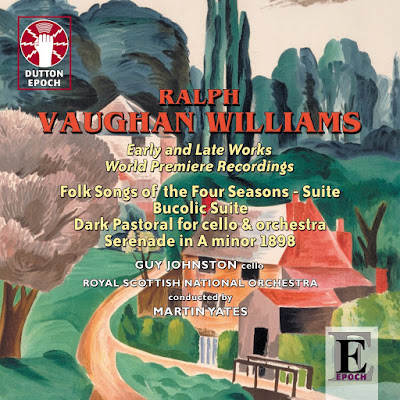
Ralph Vaughan Williams - Early & Late Works (World Premiere Recordings) - Folk Songs of the Four Seasons, Suite - Bucolic Suite - Dark Pastoral for Cello & Orchestra - Serenade in A minor - RSNO, Martin Yates - Dutton Epoch 2012

Here is another outstanding disc of unknown RVW works from his earliest (the Serenade in A minor, Vaughan William's *first* orchestral effort, dates from 1898!) period to pieces from his later years (Folk Songs of the Four Seasons, from 1949). Extra exciting for any Vaughan Williams fan is that this recording is made up of entirely world-premieres. Indeed, I almost flipped my lid when this was released.

It is well known that Vaughan Williams did not find his mature voice, a few songs apart, until his mid-thirties, despite having produced a considerable catalog of earlier music-music that while performed in the early 1900s was no longer heard after his more familiar works began to appear. It has been forgotten for a century. In fact, there exists a number of orchestral and choral-orchestral works written by Vaughan Williams during and soon after he was a student at the Royal College of Music. While not always immediately recognizable as the work of the mature composer, they are still viable works of art with something to say.

Vaughan Williams collected his first folksong (Bushes and Briars) at Ingrave in Essex 1903, an event that launched him on an intensive period of collecting from the older generation of country folk across the south of England. This was music that sound found its way into his concert music, neatly encapsulated by Anthony Payne when he wrote: "What Vaughan Williams realized was that modes held the secret to writing a new kind of symphonic music. It would enable him to cast off the yoke of Austro-German practice, and create new sound worlds".

Yet Vaughan Williams when still trying to find a musical language was already ware of folksong and its existence in printed sources. We realize this when we learn that he actually went to Ingrave to repeat a series of lectures on the "History of Folk Song", which he had given elsewhere the previous year when (the English folksong collector) Lucy Broadwood sang the musical illustrations. As soon as he realized that such songs were still known to the older residents of country districts before the days of radio and easy road travel, he went on a collecting binge, 'harvesting' a large number of songs. 

One can sympathize with Vaughan Williams that once he had found his mature voice in glorious scores such as "In the Fen Country" (1904) and the "First Norfolk Rhapsody" (1906), and later "On Wenlock Edge" (1909), A Sea Symphony (1910), and the unspeakably beautiful Tallis Fantasia (also 1910), he would not want music he might consider immature to be widely played until his mature style was established. However, more than half a century after the composer's death, with his music extensively recorded and pretty much all of his mature works well known, it seems appropriate to investigate those early scores that not infrequently display flashes of what was to come. And the early works presented here, and others that I have come to know are all very enjoyable, often more so (for me) than the mature works of many a composer. Vaughan Williams early chamber music has already been heard again, and exploration that revealed a body of enjoyable and well-made music, though generally with little stylistic relevance to his later output. In contrast, the early orchestral and choral-orchestral music is revealing in that when working on a larger canvas the vision-the idiom-that Vaughan Williams was seeking kept breaking through, more often than not leaving us with an enlargement of his catalog of works that is not only very worthwhile on its own account but cherishable as "Vaughan Williams". 


"Folk Songs of the Four Seasons - Suite"

Folk Songs of the Four Seasons is an extended choral work for massed women's voices, written in 1949 for the National Federation of Women's Institutes. Three thousand members of the Federation sang it at the Royal Albert Hall on June 15th, 1950. It did not catch on as did much similar works of Vaughan Williams, and in 1952, Roy Douglas, who contributed so much to Vaughan Williams's later music by creating fair copies from the composer's chaotic manuscript scores, started working on an orchestral suite taken from it. He wrote in his memoirs, "Working with Vaughan Williams", "In the middle of January 1952  I happened to be looking through the published vocal score of Folk Songs of the Four Seasons, and had a bright idea I could make a suite, for orchestra only, from some of the most attractive and suitable movements, based, of course, on the original orchestration". In a month or so, he was able to show a draft to the composer, and finally delivered it to Oxford University Press on August 4th, 1953. It was published in 1956, Vaughan Williams envisaging it being playable by varied orchestral forces. The five short movements incorporate nine folksongs out of the seventeen set in the original. The arrangement broadly follows the calendar, the plan of the "turning year" though without the depths of winter, taking us from ploughing and Maytime through to Christmas. 

"Bucolic Suite"

Bucolic is a word that often comes to mind for me in RVW's more "pastoral" scores that aurally depict the English countryside (Vaughan Williams just loved strolling through the countryside!). The Bucolic Suite is dated November 29th, 1900 though it was subsequently revised, dated August 30th, 1901. Like the "Serendae in A minor", it too was first performed at Bournemouth, just under a year later on March 10th, 1902. It was probably heard several times after that, and the last known performance was in Cardiff on January 30th, 1907. Professor of Music Julian Rushton writes, "the form of the Bucolic Suite is comparable to a symphony", and, at that same time, RVW's close friend Gustav Holst was working on his "Cotswolds Symphony"-itself, with its simple first movement-perhaps more "suite" than symphony. Here, Vaughan Williams asks for a bigger orchestra than in the "Serenade.." with the addition of three trombones, tuba, and harp (in the Andante). In this four movement suite, Vaughan William's orchestral manner is quite distinctive and reflects the approach in the Serenade, especially in his treatment of the woodwind and the accompanying strings, and the light, open scoring punctuated by brief tuttis. Vaughan Williams's preference for transition rather than gradual modulation is already in evidence. In this work, the European influence is more pronounced than in the earlier Serenade, with what are surely passing reminiscences of Dvorak and Bruch. 

"Dark Pastorale for Cello and Orchestra"

Dark Pastorale takes what survives of the slow movement of Vaughan William's unfinished draft of a Cello Concerto, on which he was working on in 1942-1943-and which probably tinkered with over the succeeding years. This was intended for no less a soloist than Pablo Casals. Vaughan Williams made considerable progress with the first movement, headed 'Rhapsody', and with the unfinished slow movement, but less so with the finale. Composer David Matthews (whose symphonies I have been 'trying' to like..) has now taken the short score sketch of the slow movement and completed it as "Dark Pastoral", which was performed at the 2010 Proms. We are told there are about four minutes of music from RVW's original two-stave short score, which he left with just a few indications of scoring. Parallels with "The Lark Ascending" perhaps will come to mind for many..  The A section of what would probably have been (loosely) an ABA movement was written by Vaughan Williams (the score ends just as it is branching off into something else). Matthews has orchestrated it and composed about six minutes of music based mostly on the first section, with some new material in the middle. Even with these touches it's really very lovely. 

"Serenade in A minor" (1898)

Vaughan Williams left the Royal College of Music in July of 1896 and married Adeline Fisher on October 9th, 1897. The couple spent their honeymoon in Berlin where they heard much German music including The Ring, and where Vaughan Williams took lessons from the composer Max Bruch, remaining there until April 1898 (hmm long honeymoon). During 1898, Vaughan William's was working on his doctoral exercise-a work we know now as the "Cambridge Mass", first performed on March 3rd, 2011-and this Serenade for small Orchestra. The Serenade, RVW's first orchestral work, was conceived in four movements -Prelude, Scherzo, Intermezzo & Trio, Finale-to which, a year or two later, the composer added a Romance, possibly as a replacement movement for the Intermezzo & Trio (in the autographed manuscript however, only the Trio is marked for possible deletion). It had first been heard in the UK when the Bournemouth Municipal Orchestra programmed it in April 1901, and in London in in March 1908, after which RVW's withdrew it. The autograph manuscript is now at Yale University, and the Serenade in A minor had an outing there in 1986 by the New England Chamber Orchestra conducted by James Sinclair. 

The 'Prelude' is remarkable for the arpeggiated opening motif with its upward leap, which from the outset briefly seems to have us in the mature world of RVW, and while the harmonic language is from an earlier world, he appears to have an impressive command of the orchestra in a first attempt! The scoring is transparent, and the tuttis when they occur make a powerful impression. 

The 'Scherzo' is a dancing Allegro in 6/8, almost a folk dance in its own right and with a wonderfully burbling second subject theme first heard on the bassoon and later on the trumpet, all framed by an episode of eight repeated bars.

The stately 'Intermezzo & Trio' (Allegretto - Trio (poco piu mosso)) is a slow dance with a contrasted Trio and concluding da capo (the opening is repeated). The Trio is notable for using Gustav Holst's trick of a repeated falling pizzicato scale as accompaniment or bass-could it be his contribution to his friend's score?

But it is in the 'Romance' (Andantino - Appassionato), written initially to replace the Intermezzo & Trio, that we find Vaughan Williams has developed stylistically from the rest of the Serenade. It is surely worth considering not only as part of the Serenade but also as a lovely encore in its own right. Muted strings at the outset present a murmuring accompaniment over which the clarinet sings a long tune soon taken up by the strings and horn in counterpoint. In a pastoral episode, a solo oboe evokes birdsong, thrice repeated (VW had just seen Siegfried), and the strings then introduce a lyrical theme, which at its climax seems to have us (again) in VW's mature world.

The opening of the 'Finale' (Allegro) is an ebullient march in 2/4, the harbinger of many similar movements to come. After a minute or so there follows a contrasted lyrical episode with answering woodwind solos. These alternate and eventually the movement ends with the marching 2/4.

In a letter, Adeline Vaughan Williams wrote that "Ralph.... is writing a new Serenade for orchestra, which is turning out very Dvorak-y" In fact, viewed from today we might find less influence of the Czech master here than in the Bucolic Suite that followed. Later, VW wrote to his friend Holst, telling of his "final talk with Stanford" in which he "agreed that if I added a short movement in E major in the middle & altered the coda the thing might stand". Although Stanford (as in the elder conservative composer Sir Charles Villiers) rehearsed it three times, he never placed it in a program.  

Enjoy this magnificent disc

Vaughan_Williams_Early_And_Late_Works-Tzadik.zip

http://www15.zippyshare.com/v/NB8f7QWV/file.html