Friday, March 6, 2015

Philip Spratley - Cargoes: Suite for Orchestra - A Helpston Fantasia - Symphony No. 3, "Sinfonia Pascale" - Siberian Symphony Orchestra - Dmitry Vasiliev, conductor - Toccata Classics 2013

Hello everyone. I have a busy weekend so for the time being, to hold everyone over I'm adding another of my (highly regarded, practically world renowned!) "unopened discs pile from 2013" posts; this time it's a Toccata Classics (how happy I would be to join the Toccata Discovery Club if I had any $$ left! What a great, adventurous label..the British 'Marco Polo' of the 21st century perhaps?) recording, and therefore time to get to know the music of an obscure (British) composer, Philip Spratley. I really like what I'm hearing so far, which is the 1st track on disc, from the "Cargoes" Suite..I'm only 3 minutes in and it's only getting more beautiful; rippling piano, the gentle travelings of winds, and now the awakening of the full orchestra which is making me think both of the French impressionists and the English pastoral school, especially (early) R.V.W. That's all I can say thus far, I am indeed hopeful and excited to continue on this 75 minute journey before getting to bed!

So, once again, here's hoping we all enjoy this discovery...


Philip_Spratley_Orchestral_Music_Vol.2-Tzadik.zip

http://www32.zippyshare.com/v/hvTaTdSO/file.html

Sunday, March 1, 2015

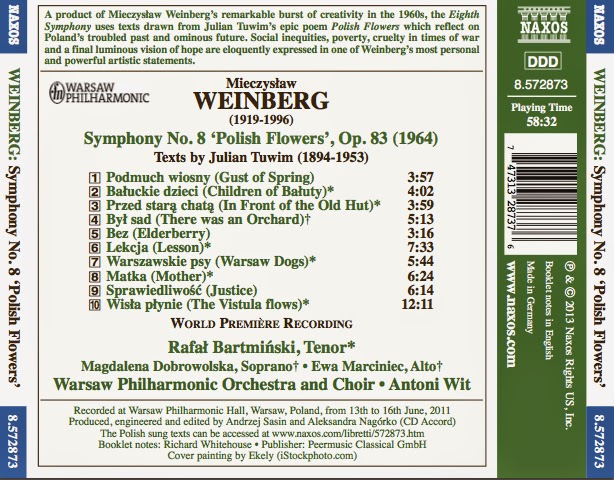
Mieczysław Weinberg - Symphony No. 8 "Polish Flowers" Op. 83 - Warsaw Philharmonic Orchestra & Chorus - Naxos 2013

Here's a Weinberg disc from my "unopened discs from 2013 pile" that I literally just unwrapped. I have to say, with other great bloggers out there, it's sometimes difficult to post Weinberg (especially more recent recordings from the past few years) that has not already been shared, especially these highly regarded Naxos recordings. It seems that this choral symphony "Polish Flowers" has not been shared, as far as I can tell anyhow. So, time to add it to the blogosphere and cosmos  :)

I am typing out the booklet notes as I cannot comment whatsoever on Weinberg's 8th.
Here's hoping we all enjoy it! I have a premonition it's going to go swimmingly. On to the notes.......


Mieczysław Weinberg was born on 8 December 1919 in Warsaw, where he emerged as a highly regarded pianist. He might well have continued his studies in the United States until the Nazi occupation saw him flee to Minsk (in the course of which his travel documents were inscribed as Moisey Vainberg, by which name he was ‘officially’ known until 1982). During 1939–41 he studied composition with Vasily Zolotaryov, then, soon after the Nazi invasion, he headed further east to Tashkent where he immersed himself in theatrical and operatic projects. There he also wrote his First Symphony, which favourably impressed Shostakovich and resulted in his settling in Moscow in 1943, where he was to remain for the rest of his life. In spite of numerous personal setbacks (his father-in-law, actor Solomon Mikhoels, was executed in 1948 and he himself was briefly imprisoned for alleged Jewish subversion prior to the death of Stalin in 1953), he gradually amassed a reputation as a composer who was championed by many of the leading Soviet singers, instrumentalists and conductors.

Despite several official honours Weinberg’s fortunes declined notably over his final two decades, not least owing to the emergence of a younger generation of composers whose perceived antagonism to the Soviet establishment ensured them much greater coverage in the West, and his death in Moscow on 26 February 1996 went all but unnoticed. Since then, however, his output—which comprises 26 symphonies and seventeen string quartets, along with seven operas, some two dozen song-cycles and a wealth of chamber and instrumental music—has received an increasing number of performances and recordings, and has been held in ever greater regard as a substantial continuation of the Russian symphonic tradition.

The 1960s was a decade of great productivity for Weinberg and not least in terms of the symphony, with seven written from 1962 to 1970. After the Fifth Symphony, moreover, his largest pieces in the genre were choral, beginning with the Sixth Symphony then continuing with the Eighth and Ninth. Composed in 1964, the Eighth is his first wholly choral symphony, its twelve movements drawing on the epic poem (itself the only completed part of an intended trilogy) Polish Flowers by Julian Tuwim (1894–1953), whose poetry Weinberg set as early as his song-cycle Acacias of 1940. At once a history and a critique of Poland over the period between the two world wars, Tuwim’s verse struck a resonance in Weinberg who, other than a visit to the Warsaw Autumn Festival in 1966, was not to see his native country after having fled the Nazi advance in 1939. The Eighth Symphony, first given in Moscow on 6 March 1966 by Alexander Yurlov with the Russian Academic Choir and the Moscow Philharmonic Orchestra, is therefore among his most personal artistic statements.

The first movement, Gust of Spring, sets the tone for the work as a whole with its reflections on Poland’s troubled past and ominous future. It begins pensively with female voices sounding plaintively over tolling lower strings and percussion, the former continuing at length until strings have an elegiac response that is continued by solo clarinet towards the close.

The second movement, Children of Bałuty, evokes the social inequities of pre-war Poland as seen through the industrial landscape of Bałuty, a suburb of Łódź. It commences with lively and rhythmically agile writing for female voices over a pizzicato accompaniment which soon draws in the strings and woodwind. A pause and then the tenor soloist responds in more immediately expressive terms, before elements of both themes are briefly combined prior to the brusque ending.

The third movement, In Front of the Old Hut, surveys the degradation endured by the mass of Polish people in earlier times. It starts with plangent woodwind entries that are joined by solo tenor in an almost Baroque-like texture, offset by discreet gestures on percussion. Strings and muted brass enter before unaccompanied voices bring about a hushed conclusion.

The fourth movement, There was an Orchard, expands on the issue of poverty with its depiction of the squalor common to peasants, gypsies and Jews alike. It begins with a burgeoning of folk-like gestures on woodwind and strings—the chorus entering stealthily, followed by a dialogue for soprano and mezzo soloists from within the chorus. The emotional mood heightens only gradually, with the instrumental component becoming more forceful prior to its sudden curtailment.

The fifth movement, Elderberry, contrasts the hope offered by springtime with the alienation of urban life. It commences with solo tenor accompanied by wistful woodwind gestures over a chord in lower strings. The chorus responds in almost prayerful terms, leading on to the work’s initial climax in which the whole orchestra is also to be heard for the first time.

The sixth movement, Lesson, is a warning to Polish infants of the inequities that they are to encounter. It opens with dance-like music for chorus and orchestra, percussion much in evidence. This tails off to leave the chorus sounding hesitant over fragmentary gestures on woodwind and brass, before the activity resumes on orchestra alone. The chorus then re-emerges at its height, after which calmer yet sombre exchanges between brass and percussion gradually subside into nothingness.

The seventh movement, Warsaw Dogs, equates the cruelties dealt out to dogs with that of the Polish people in time of war. It launches with stark unison chords on piano and percussion, chorus and woodwind replying with similarly forceful writing which builds in intensity until the initial chords are hammered out by full orchestra. An impassioned tenor solo brings a sudden hush, with only fugitive gestures from voices and instruments remaining prior to a powerful orchestral chord.

The eighth movement, Mother, takes the murder of a woman at her son’s grave as emblematic of the atrocities inflicted by the Nazi invaders. It unfolds with an eloquent solo from tenor over static chords—derived from that which ended the preceding movement—on lower (wordless) voices and instruments. At length a solo horn and then upper strings wearily assume the melodic foreground, followed by glacial gestures on celesta and lower woodwind as a rounding off.

The ninth movement, Justice, contrasts the collapse of Nazi rule with a promise of freedom and equality in the wake of the Soviet victory. It starts with starkly dramatic writing for unaccompanied voices in rhythmic unison, with a discreet underpinning from strings and brass at key moments. A more passive section (derived from the 1958 song-cycle Reminiscences) finds the chorus in subdued dialogue with woodwind (derived from the 1958 song-cycle Reminiscences) before a climactic unison gesture from chorus and orchestra.

The tenth movement, The Vistula flows, likens the poet’s verse to the flowers of Poland that each year bring new hope, with the river Vistula as a metaphor for the indestructibility of the Polish spirit. It begins with an expressive solo from the tenor, continued in more ruminative terms by the chorus over a luminous orchestral backdrop. The tenor resumes in more measured terms against an imploring choral response, before the woodwind gestures from the fifth movement reappear prior to the chorus bringing about the work’s main climax in a monumental passage for all the voices and instruments combined. This rapidly dies down to leave fragmentary choral gestures, together with recollections from the very opening of the work, as the plangent sound of upper woodwind brings about a subdued yet tenuously optimistic ending: as if to reflect, in Weinberg’s own words, ‘the deep faith of the poet in the victory of freedom, justice and humanism’.


Weinberg_Symphony_No.8_Tveti_Pol'shi-Tzadik.zip

http://www31.zippyshare.com/v/1flzA5BJ/file.html

Robert White - Hymns, Psalms and Lamentations - Gallicantus and Gabriel Crouch - Signum Classics

Here we have what I believe to be one of the finest recordings of early music of any kind. White was a Tudor-era composer who wrote some of the most beautiful and ethereal music for voices. I think many of you will agree once (or during) the hour plus is up. The quality of this Signum disc is overall flawless I think, and rather astonishingly so. The ensemble is perfect. The sound quality couldn't be any better for this music..


Robert White (c.1538-1574) was arguably the leading figure in that lost generation of English composers which came to maturity between Tallis and Byrd, in the middle of the 16th century. Along with Robert Parsons and William Mundy, White formed a school within a school, whose musical instinct was to look back to the Catholic style of Tallis's youth (a style they had all but missed) while putting it to the service of Elizabeth I's Protestant Church. The result is an idiom which is rare in Tallis, who showed himself prepared to jettison the old ways, and unknown in Byrd. To us it has a particular, almost nostalgic appeal: the polyphonic lines still unwind slowly, the scoring is still spacious, the cadences archaic; yet the phrases themselves are more highly organized than in music from the 1520s and '30s, their expression more direct and poignant.

Like every composer active in England in the early years of Elizabeth's reign, White was forced to make stylistic compromises as a result of the Reformation; and it is in the ingredients of these compromises that his individuality lay. Unlike Tallis, Sheppard and Tye, and although he was younger than them, he rarely wrote music with English words. The little Anglican music he did write was, like much of that by Parsons and Mundy, protracted and thoroughly polyphonic, coming close at times to sounding like exercises in Franco-Flemish imitation. His Latin motets, by contrast, are at once more modern and more old-fashioned: the five-voice Lamentations, which show White's Latin style at its most advanced, contain little free polyphony, but rather expansive, often non-aligned homophony - yet are scored for the almost defunct choir of treble, mean, countertenor, tenor and bass. Even in his settings of the Hebrew letters which precede each verse and were traditionally written in abstract counterpoint (a method followed by both Tallis and Byrd in their settings of the Lamentations), White's melodies seem to have been conceived in organised blocks, often repeating at the unison or octave instead of the fifth; often moving in parallel thirds, sixths or tenths: a half-way, individual style, neither exactly old nor new.

One can only guess for whom he wrote these potentially contentious and vocally demanding pieces. He seems never to have been formally attached to the Chapel Royal, the obvious recipient of them, though it remains highly probable that he was asked to contribute to their work, especially after 1569 or 1570 when he became Master of the Choristers at Westminster Abbey. Before that, in his brief career, he was a chorister and later one of the cantores at Trinity College, Cambridge (1555-1562); Master of the Choristers at Ely Cathedral - where he succeeded his father-in-law Christopher Tye (1562-1566); and probably Master of the Choristers at Chester Cathedral (c.1566-c.1569) before moving to London, where he died of the plague in the disastrous epidemic of 1574. Although White seems to have spent much of his life working to the north of the capital, his Will states that he left property of some substance in Sussex. This kind of biographical non sequitur should make us cautious of concluding that he never worked at court: it is perfectly possible that, from his Cambridge days, he regularly visited London and always kept in touch with developments there.


Enjoy..

R.White_Hymns_Psalms_&_Lamentations_Tzadik.zip

http://www17.zippyshare.com/v/Je5nWf58/file.html

Arnold Cooke - Concerto in D for String Orchestra - Symphony No. 1 - Jabez and the Devil, Suite from the Ballet - London Philharmonic Orchestra, Nicholas Braithwaite - Lyrita 1975 & 2007 (DDD/ADD)

I have been itching to listen to more of Arnold Cooke's music lately, and happily I located this fantastic and important disc, again on Lyrita, on one of my hdds. This recording proves (as do all others) how very much Arnold Cooke recording projects are not only to be hoped for, but entirely necessary as he is a composer of too much stature to be ignored. The Naxos disc of Cooke's String Sonatas (posted here, some months ago) is a very promising sign, as is
the brilliant survey of Cooke's chamber music on Dutton Epoch (I have it somewhere..). I must confess I have not played this disc in a long time, and I confess to laziness and thus a brief Gramophone review below. I do recall that this disc is a complete knock-out, full of robust contrapuntal writing and energetic, sometimes relentless orchestral wallops of the highest order-in the Concerto for Strings but also in the Symphony. The Symphony No. 1 I do also recall impressed me, not only as it was Cooke's first stab at it (he was already in his 40s, however..) but also it's ability to stand neck and neck among other 20th century symphonies by established composers, English or otherwise. And most of these symphonies were not initial efforts like the Cooke. The ballet music from "Jabez and the Devil" too is a lot of fun, however admittedly it is what I remember the least; I am excited to listen to everything once again today! 


Arnold Cooke in bronze


Gramophone:

The first of Arnold Cooke’s five symphonies was completed in 1947 and premiered under Sir Adrian Boult in a BBC broadcast two years later. At first glance both the home tonality and formal plan might imply a nod or two towards Walton’s First Symphony from the previous decade. However, it doesn’t take very long to discover that the most fruitful influence is that of Hindemith (Cooke’s teacher at the Berlin Hochschule für Musik from 1929 to 1932); anyone who responds to the German master’s Mathis der Maler, Symphony in E flat or Symphonia serena should most certainly lend an ear. Closer to home, annotator Calum MacDonald also perceives a timeless, deep-rooted quality in Cooke’s fad-free music that suggests a kinship with Rubbra (witness the long-breathed polyphony of the heartfelt slow movement). In sum, a work of impeccable resourcefulness, cogent argument and affecting sincerity that invites and repays repeated listening.

The symphony is flanked by the 1948 Concerto in D for string orchestra (a bracingly assured, big-hearted essay in three movements, which features some grateful writing for the section principals) and a splendidly colourful and diverting 18-minute suite from the 1959 ballet Jabez and the Devil (eventually staged at Covent Garden in September 1961). Kenneth Wilkinson’s 1974 Kingsway Hall sound in the latter boasts fabulous bite and presence still, but the two other works (taped in 1988-89) have likewise been ripely captured by the microphones, and Nicholas Braithwaite helms the LPO with scrupulous care and infectious commitment throughout. Definitely one for the “want” list!


*I'm including a pdf of the covers and booklet (it's not mine), and the scans of the booklet
are small thus zooming will be helpful.

Also whenever I locate my physical copy I shall upgrade the post to m4a, I guarantee there is a difference :)

Enjoy!

Arnold_Cooke_Symphony_No.1_Concerto_Jabez_Tzadik.zip

http://www49.zippyshare.com/v/i2hlpWej/file.html

Saturday, February 28, 2015

Havergal Brian - Symphonies Nos. 6 and 16 - Arnold Cooke - Symphony No. 3 - London Philharmonic Orchestra - Myer Fredman & Nicholas Braithwaite, Conductors - Lyrita 1975 (remastered 2008)

I have been a huge fan of the music of Arnold Cooke ever since I discovered it years ago on an ultra-rare Titanic Records disc that I bought for an equally rare hovhaness work. That wonderful disc also has music of Vivaldi, Boismortier, and Jonathan Lovenstein and features music for Recorder and Strings. It can be explored here: http://nocturna-artificialia.blogspot.com/2014/11/something-old-something-new-music-for.html One of his teachers was Paul Hindemith, who had a profound influence on Cooke's compositional style; Arnold Cooke's music sounds quite a bit like Hindemith's however it is not derivative, as Cooke clearly has something to say in his works. Typically his music is muscular, contrapuntally based and for the most part tonal, although clearly in a contemporary idiom. I think he is one of the greatest unsung heroes in British music and 20th century music in general. 


Havergal Brian too I have always been fond of, however for me he is much more uneven. I bought this disc specifically for the Cooke symphony, hoping the Brian works would be 'decent' listening. I feel almost like describing him the "British Allan Pettersson" however that's not really accurate. Like Pettersson however, Brian's music can often be hard to penetrate fully, and might reward only after (several) listens. The energetic Cooke symphony No. 3 I find to be a small masterpiece that I could happily play practically every day and not lose interest. Back to Brian, I have always loved his "Gothic" Symphony, (No. 1) which is an astounding symphonic record-breaker; the symphony requires about 800 musicians (!!!) and not surprisingly it's rarely performed or recorded. There are at this point a few good choices, my favorite still being the early Marco Polo disc (for nostalgic reasons almost more than anything else-it's a great performance that would have benefitted from better sound). Here are the forces needed for the Gothic (taken from the Brian Society):

Part one [1]: 
2 piccolos (1 also flute), 3 flutes (1 also alto flute), 2 oboes,  oboe d’amore, cor anglais,  bass oboe, Eb clarinet, 2  Bb clarinets, basset horn, bass clarinet, 3 bassoons, contrabassoon, 6 horns, Eb cornet, 4 trumpets in F, bass trumpet, 3 tenor trombones, 2 tubas, 2 sets (min 3 drums) timpani, 2 harps, organ, celesta, min 8 percussion:  glockenspiel, xylophone, 2 bass drums, 3 side drums, tambourine, pair cymbals, tam-tam, triangle;  strings [say 16.16.12.10.8]

Part two [1]:
Soprano, alto, tenor, bass soloists, large children’s choir, 2 large mixed double choruses [in practice 4 large SATB choirs]
orchestra: 2 piccolos (1 also flute), 6 flutes (1 also alto flute), 6 oboes (1 also oboe d’amore, 1 also bass oboe), 2 cors anglais, 2 Eb clarinets (1 also Bb clarinet), 4  Bb clarinets, 2 basset horns, 2 bass clarinets, contrabass clarinet, 3 bassoons, 2 contrabassoons, 8 horns, 2 Eb cornets, 4 trumpets in F, bass trumpet, 3 tenor trombones, bass trombone, contrabass trombone, 2 euphoniums, 2 tubas, 2 sets (min 3 [in practice 4] drums) timpani, 2 harps, organ, celesta, minimum 18 percussion:  glockenspiel, xylophone, 2 bass drums, 3 side drums, long drum, 2 tambourines, 6 pairs cymbals, tam-tam, thunder machine [not thunder sheet], tubular bells, chimes, chains, 2 triangles, birdscare; strings (20.20.16.14.12)

4 off stage groups: each containing 2 horns, 2 trumpets, 2 tenor trombones, set (min 3 drums) of timpani (in summary: 32 wind, 24 on stage brass, 24 off stage brass, 6 timpanists, 18 percussion, 4 keyboards and harps, 82 strings - total orchestra c190 players, plus adult choir of min 500 [assumes largely professionals], children's choir of 100, 4 soloists = c800)

I have yet to post the Gothic, but feel this info is worth adding here as it's an almost unfathomable musical expedition (the symphony actually holds a "Guinness record" as the longest symphony in history, typically just under 2 hours!) and quite intriguing.

Focusing on Arnold Cooke..

Arnold Cooke was one of the few English composers of his generation who chose to study abroad in the inter-war years (Lennox Berkeley went to Nadia Boulanger, Humphrey Searle to Webern, and Walter Leigh, like Arnold Cooke-to Paul Hindemith). Cooke was 23 when he went to Berlin; a mature student does not seek out a teacher to be 'formed', but because, in view of his own character and philosophy of life-already senses the direction in which to go, and hopefully finds teachers (sooner than later) whom can help him on this road. As mentioned Cooke's melodic and harmonic idiom shared a good many characteristics with that of Hindemith, particularly in his middle years. He did not feel the need to learn or invent a new language every few years, and as a result acquired great freedom, subtlety and certainty in handling the one language of his choice. More generally, he shared many of Hindemith's attitudes to music. He liked economy and clarity, disliked grand displays of theatrical emotion, and was ready and able to serve the needs of all types of music makers both amateur and professional. Besides six symphonies, his works include concertos for violin and piano, a full length opera "Mary Barton", cantatas and song cycles, and Cooke was particularly active in every field of instrumental music. Cooke wrote brilliant instrumental music when the occasion demanded but his writing was always practical (and exciting) -without introducing superfluous complexities or difficulties. The relatively compact Symphony No. 3 is a perfect example of this and indeed, the more one listens to it, the more one discovers in it's pages..

The first movement gets right down to business without wasting time on preliminaries. Risings scales in the first two bars lead to a lively staccato theme and thence to a slowly-rising passage in slurred and paired quavers and a forceful entry for trumpets, trombones and tuba. A longer second paragraph of peaceful dialogue between strings and woodwind is followed by a rapid crescendo and two syncopated brass outbursts, with a clinching fortissimo brass unison set against a hammered staccato rhythm from the rest of the orchestra. All this happens in two minutes no less! The development is at first concerned with the initial rising scales, and then the slowly rising passage is dissected into its constituent parts with the trumpets, trombones and tuba forcefully entering once again. Solo horn announces a new theme over pianissimo trumpets and trombones, at once converted into an ostinato (at twice the tempo) which passes through the woodwind, horns once again and then down to the basses, leading back to the recapitulation. When this has run its course, the rising scales return once again; a crescendo builds up quickly from pianissimo depths, preparing the way for a final statement from the brass in unison and by way of the ostinato a powerful fortissimo ending. Now *this* is a knockout first movement!!        

In the second movement one should note the falling thirds of the opening clarinet phrase, which are to play a large part in later developments. Variants and derivatives of the the first phrase occupy strings and woodwind at first-the end of this section marked by a punctuating chord built up cumulatively from below. An angular dotted-rhythm theme follows-horn over pizzicato cellos and basses-which soon combines with itself in triple imitation. A short canonic passage based on the falling thirds of the clarinet leads back to a varied recapitulation from which the clarinet is rarely absent. The last appearance of the angular dotted-rhythm is supported by a bass ostinato derived from the falling thirds of the clarinet; the movement ends with a second punctuating chord of the same type as the first. (the last bars always remind me of the opening of "Mathis der Maler")

In the finale the opening major-minor arpeggio theme trails away into a triplet figure as a new rhythmic figure on horns appears above. Many themes follow-some bearing a resemblance to the first movement themes-the last of them, a short figure on oboe accompanied by horns, assuming considerable importance later. The uprushing scales of the first movement are perhaps referred to in the development, which in later stages is much concerned with the major-minor theme. We hear more of the triplet figure in the recapitulation and the oboes and horns take a major role in the action. Towards the end, the arpeggio theme and the oboe accompanied by horns contend for attention; the symphony ends brilliantly and positively, all problems resolved, both motives combining in the final massive tutti.   

I have to add that the remastering Lyrita has done here is superb, as you will hear for yourself..

Enjoy!

Brian_Symphonies_6&16_Cooke_Symphony_No.3-Tzadik.zip

http://www30.zippyshare.com/v/bgvz3ULO/file.html

J.S. Bach - The Transcriptions for Solo Harpsichord of Concertos by Vivaldi and the Marcello Brothers - Sophie Yates, Harpsichord - Chandos 2013

These elegant and delicious transcriptions for solo harpsichord I have been listening to much the last
couple days; I am indebted to Pappa Bach for distracting me from a good deal of chaos over the week. Sophie Yates plays this music with such precision and mastery; something to behold indeed! 


Around 1714 J.S. Bach suddenly (and apparently without provocation) transcribed and adapted a number of Italian instrumental concertos, mainly by Antonio Vivaldi, for the keyboard. Why he did so is subject to some speculation, though it is often suggested that he had become aware of the publication a couple of years earlier in Amsterdam of Vivaldi’s op. 3 L’estro armonico, possibly through the efforts of his patron, Prince Johann Ernst of Saxe-Weimar. While it's true that his main duties in Weimar at the time were mainly as an organist, he also provided a host of other musical services, including secular concerts, for which these transcriptions were probably most adaptable. Moreover, they offered him the opportunity to absorb thoroughly the popular Italian style. 

Clearly, a simple transcription would not suffice for the sort of work that Bach envisioned, and moreover there are inevitable difficulties in arranging the various orchestral ritornellos, though of course the unison openings offered an immediate solution. His arrangements often transpose the works to fit the keyboard compass better. Nowhere is this better demonstrated than in the version of Alessandro Marcello's Oboe Concerto, now transposed up a whole step to D Minor, or in the C-Minor Concerto by his brother Benedetto, which was originally in E Minor. The result is to bring the works into a more intimate and manageable focus, even though they do not lose their often virtuoso lines. The result is somewhat of a tour de force that has intrigued keyboardists (mainly harpsichordists) for a long time. Moreover, the art of the transcription reaches pretty much its apex here, for one cannot deny that Bach has essentially turned these concertos into brand-new works, in essence deconstructing and recomposing already well-known and acknowledged significant pieces, thus giving them an alternative life. 

Enjoy all

J.S.Bach_Transcriptions_for_Solo_Harpsichord-Tzadik.zip

http://www62.zippyshare.com/v/NIfesj8M/file.html

Tuesday, February 24, 2015

Mieczyslaw Weinberg - Trio for Violin, Violoncello & Piano - Sonatina for Violin & Piano - Sonata for Double Bass Solo - CPO 2014

Let's explore some of Weiberg's chamber works on this fine CPO recording. Although some of the bio info here is likely (somewhat) similar to my earlier posts, I've added (a few) what I think are pretty interesting quotes by Weinberg, Shostakovich and others as well as (frankly) extremely depressing information that is truly testament to Weinberg's inextinguishable spirit and unfathomable strength. What a fascinating, great composer and human being he was!!


There are various ways of approaching the composer Mieczyslaw Weinberg. A purely musicological idea would be one of them. After all, Weinberg was one of Dmitri Shostakovich's most important companions, advisers, and personal friends. This is not the only reason-but certainly one reason-why Weinberg’s compositions have experienced a renaissance during recent years.
Like many composers (not only in the Soviet Union), Weinberg had to earn his everyday livelihood. The composition of music for feature films or television films enabled him to do so. It was thus that he even wrote the music for the animated "Winnie the Pooh" (a Russian short film version, from 1969). Weinberg's compositions are distinguished by a very personal idiom. Their overall mood differs substantially from that of the compositions of his friend Shostakovich. Considered individually, however, they are often quite different stylistically. 


Mieczyslaw Weinberg was a Polish Jew by birth and fled to the east during the Nazi occupation of Poland. He felt like a foreigner in the Soviet Union throughout his life. Other colleagues of his had made a better decision; they had fled to the west (e.g., Alexandre Tansman, to Paris) or even overseas. Weinberg had underestimated one important aspect-the anti-Semitism inherent in the Soviet regime. Additionally, until his death he spoke Russian only with a strong Polish accent, which was another reason why he was not highly regarded by the bureaucrats in the communist party and music world in the Soviet Union. Weinberg never served the Soviet system. What saved him was his friendship with Shostakovich. (Shostakovich, among other things, wrote a letter to Lavrentiy Pavlovich Beria, the head of the Russian secret police; the officer in charge of the hearing commented with cynicism, "Your little friends are helping you...but an old German proverb states "from the frying pan into the fire". Shostakovich wrote of Weinberg, "He is so different, and he is no slave". Shostakovich's decisive intervention and perhaps Stalin's death, which for Weinberg occurred at the right (last) moment, alone kept Weinberg, who had already been imprisoned, from being deported to Siberia. Stalin's cultural policies had brought about the virtual silencing of Dmitri Shostakovich as an opera composer-at least since the scandal involving the premiere of his opera Lady Macbeth. However, Weinberg was not eliminated from this sphere; instead, he continued to write operas (a total of seven), including "The Passenger and The Idiot", which have recently been presented with great success in Germany and Austria..


"A human being of incredible purity; he did not live in a country-not in the reality that surrounded him". It was thus that the conductor Thomas Sanderling, one of few people of those times who had the opportunity to meet Weinberg personally, described this composer. Even though Weinberg's music was quite literally prohibited, many great artists such as Emil Gilels, Leonid Kogan, and Mstislav Rostropovich performed his works. They all held Weinberg in great esteem-especially as a human being. Kirill Kondrashin also played a very important role; he firmly committed himself to Weinberg’s cause and conducted his works.


Weinberg's childhood years were wonderful and music was often the top priority. His father was a violinist and composer who wrote music for a Jewish theater, traveled with it throughout the country, and conducted. Weinberg later stated, "I was certain that Father's baton sounded like a trumpet". He was apparently very disappointed when his father explained to him that it did not produce any tones at all! By the the age of eleven Mieczyslaw was playing the piano with his father in the theater and
indeed Weinberg was an extraordinary pianist and all of his piano compositions (and especially the trio) clearly demonstrate just how phenomenal his technical gifts as a pianist were. 


Weinberg's plans for his life were repeatedly painfully dashed, and the war very quickly caught up with him in Minsk, the city to which he had initially fled. In 1953 he spent three months in prison-on the charge of having advocated the establishment of a Jewish republic in the Crimea.


Much of the grief, tears and constant worry during the war years is reflected in the music of the "Trio op. 24 for Violin, Cello, and Piano" from 1945. By this point in time, Weinberg was certain that he has lost his parents and his sister (upon fleeing with his sister, Weinberg could not have imagined that this would literally be the last moments that he would ever see her...all because she attempted to run back home to put on another pair of shoes) and his feelings were indeed correct; all three were murdered at Trawniki concentration camp, about 25 miles southeast of Lublin, as Weinberg would learn after his escape. Weinberg reflected on the general nightmare which surrounded him that day: "I will never forget the mothers, with children on the border, who embraced the legs of the horses of Soviet customs soldiers and pleaded with them to let them go over to the Soviet side, for the Nazis were on one side, and the Soviet soldiers were on the other". 


Weinberg wrote the Trio op. 24 during the same time he composed the Clarinet Sonata (1945), the Sonata for Cello and Piano No. 1,  and the Children's Album No. 3 for piano solo, and the String Quartets No. 4 and No. 5. The premiere of the piano trio was held on 9 January 1947 along with two members of the Beethoven Quartet, the violinist Dmitri Tsyganov and the violoncellist Sergei Shririnsky. The trio creates the impression of a grand architectonic work. As in all of Weinberg's compositions, tempo and mood shift relatively quickly, almost as if they were reproducing a theatrical scenario. After a monumental beginning 'Prelude and Aria', doubts about this almost euphoric seemingly optimistic basic mood quickly spread-the shift from A major, previously the movement’s dominant key, to A minor, and the conclusion in terrifying eighths in pianissimo confirms this. The ensuing toccata, beginning in 5/16 time, is endowed with enormous power. The tireless thundering of aggressive rhythms produces an eerie, intense, and almost hectic effect. And things gradually intensify to what is like a devilish dance of the kind often encountered in Weinberg-for example, in the Quintet for Piano and Strings (1944). The third movement 'Poem' begins with a slow piano solo-and this too is something that we often find in Weinberg's chamber music-full of passion and melancholic intensity. When the cello assumes the melody, one cannot yet imagine that the violin accompaniment recalling descending drops of water will later lead to the relentlessly hammering culmination point. The circle closes, but there is a role reversal in the concluding adagio: it is now the violin that narrates the story and concludes it melancholily and poetically. The finale is a masterpiece of counterpoint, but before it becomes a genuinely monumental fugue, Weinberg avails himself of a genial dissimulation. The first theme, presented by the piano in pianissimo as if ex nihilo is so pure and clear that it could be a fugue subject by Bach-but instead of the expected canonic entry of the other voices, it is initially a hurried insert of the violin that at this point leads to the first rhythmic diminution in the piano. The actual fugue subject (completely different thematic material) is presented to us only much later by the cello, and we also first reencounter the hectic violin motif in other circumstances. A fugue truly to be termed genial then follows, and the tension repeatedly increases on the basis of dynamic sequences ascending in pitch and then finally-almost abruptly-is released by a nostalgic waltz (now in the interval sequence of the initial motif), which brings the movement to its conclusion in a conciliatory A major.


Weinberg wrote the lovely "Sonatina for Violin and Piano" op. 46 in 1946. Forming associations with the depiction of an idyllic landscape, in what is almost a Schubertian tone, everything is actually situated -though peacefully, tranquilly, harmonically, or narratively-in the key of D minor(!). The tragic element in all these idylls is first eliminated in the final chord, which at last is in the desired key of D major. The second, very tragic movement reflects concern and incredible misfortune. One feels as if one has been petrified, and then suddenly a marking reads 'very fast, mysteriously'. Weinberg seems to be attempting to render the listener breathless..   By way of sarcasm, theatricality, and then a lento concluding the third movement, the tragic element of life's experiences nevertheless again finds its place. But-the lento is again in D major. Weinberg’s quest for a "good" ending, for peace, is found in a quantity his works.


Weinberg: "I believe that each moment in the life of a genuine artist is work. Interesting work, hard, endless. Work not only at the writing desk but the observation and assimilation of sounds, colors, movements, and rhythms in the real world. I am always at work".


During the 1970s, Weinberg wrote some solo sonatas: three for violoncello in 1971 (op. 106), one for viola (op. 107), two for viola in 1978 (op. 123), and one for violin in 1979 (op. 126). The sonata for solo bassoon came later (op. 133), and the "Sonata for Double Bass Solo" op. 108 was written in 1971. The performance history of the double bass sonata is not documented in any sources. All that is known is that it first appeared in print in Moscow with the 'Sovietsky Kompositor'. Since it was published in an anthology organized by the Russian double bassist Rodion Azarkhin, it seems natural to assume that it was he who first performed this work. Although there is no dedication in the autograph, Azarkhin is regarded as one of the double bassists who wanted to enhance the role of this rather underrepresented instrument in the solo literature by writing arrangements of his own and also by lending his energetic support to new compositions. Shostakovich stated of Azarkhin, "The double bassist Rodion Azarkhin is an outstanding virtuoso. Apart from his brilliant technique, his recital artistry is of high culture and expressive power".
This sonata does not really belong to the standard repertoire of double bassists. With its six movements, it is similar to a suite in which each movement is structured very clearly thematically. It's a work that, although it's taking some time, is growing on me.


Enjoy!

Weinberg_Piano_Trio_Violin_Sonatina_Dble_Bass_Sonata-Tzadik.zip

http://www51.zippyshare.com/v/Nz4VrnTG/file.html