Showing posts with label Arnold Rosner. Show all posts

Saturday, July 23, 2016

Modern Masters III - Dello Joio: Meditations on Ecclesiastes - Hovhaness: Psalm & Fugue for String Orchestra - Rosner: Responses, Hosanna and Fugue ***Repost - Encoded @ 320 and Apple Lossless***

Greetings and good weekend to all. I haven't posted anything for about a week, and the last time I was on here there was a comment asking if I would repost the Arnold Rosner discs. Ironically, this recording (yes, I have already mentioned that it's one of my top five of all time) unlike some of the others is still available as an active download. That makes me happy as all of my downloads (zshare) expire after 30 days if there is no activity. Clearly visitors continue to feel a sense of intrigue. For me it is personally rewarding, a "mission accomplished" if you will as I feel that this gem is the perfect introduction to the compositional grandeur of the late American master Arnold Rosner. This is music that needs to be heard. Regular visitors around here will already know that Arnold was a dear friend of mine. Indeed it was this recording - a potent 'gateway drug' for my ears, mind, and spirit if you will - that blew me away, and after just a few hearings of "Responses, Hosanna, and Fugue" (my introduction Rosner) I was downright compelled to try to contact the composer. In short, it was a life changer. 

The original post - babble and all, can be found here along with the original download encoded @ 256 kbps AAC:


The links provided at the bottom are for higher quality 320 AAC or highest quality Apple lossless files (also AAC).


Photo of Rosner from the booklet - one of my favorite shots of Arnold. A real sense of intensity & sincerity.


*I will re-up all of the other Rosner discs as well. At this time (which is 99% of the time) the bulk of the recordings are nestled in my car. And it's been 97 degrees all day - yep I am as lazy as the cheshire cat. (ermm I happen to keep my regrettable flab and grin constant however) 


If you are "new" to my blog I hope you find your listening experience to be powerful, moving, and drenched in overwhelming beauty. 


Encoded in 320 kbps:

Modern_Masters_III_Rosner_Dello_Joio_Hovhaness@320-Tz.zip

http://www21.zippyshare.com/v/93PQ32No/file.html


Encoded as Apple Lossless: 

*For this (entire) recording I highly recommend the lossless files!!

Part 1

Modern_Masters_III_Rosner_Dello_Joio_Hovhaness(Part1)Tzadik.zip

http://www71.zippyshare.com/v/vYIwHmkU/file.html


Part 2

Modern_Masters_III_Rosner_Dello_Joio_Hovhaness(Part2)Tzadik.zip

http://www9.zippyshare.com/v/g1Jxve2G/file.html


Enjoy (anew or for the first time!)

Sunday, June 5, 2016

Recording triumph! Arnold Rosner on Tocatta Classics with the LPO

Now this is/was news that lifted my spirits. As I have been dealing with so much I really have been ignoring everything, including my email as I haven't gone online until recently. Much to my surprise and joy there was an email waiting for me from Arnold's sister, Irene Rosner-David. She wrote to me about the literally just released (available now on Toccata Classics, Amazon on June 7th) recording of Arnold's Orchestral music on Toccata, recorded at Abbey Road, and with the LSO no less. I had no knowledge of the project whatsoever! It brings together a few major works, including one of my favorites, "Gematria". I have been waiting (impatiently) for many years for it's premiere recording. The Piano Concerto No. 2 was written when Rosner was all of twenty years old, and it's a beautiful, big-boned concerto from the pen of a young man still searching and paving his path to brilliance. Not unlike Rosner's gorgeous "Five Meditations", The early "Six Pastoral Dances" takes its inspiration from Renaissance dances and Baroque forms. Extremely tragic and touching, "From the Diaries of Adam Czerniaków" for narrator and orchestra is powerful both as a musical depiction of Jewish life within the ghetto at Warszawa and of course as a first-hand account. This is a major work,  and although I have only just heard it this morning, it's impact was instantaneous and profound. Rosner would have been so very proud of this project! 


Arnold's sister sent me an advanced copy of this major and invaluable release, and while I will most likely post it here at some point - I would like to strongly urge visitors of my blog to buy it and directly from Tocatta if possible. I plan to do just that. Tocatta is one of the finest labels that we have, and as far as musical exploration and steering clear of the "establishment" goes - this is a priceless source for adventure and discovery.

The page for this release is here:

https://toccataclassics.com/product/arnold-rosner-orchestral-music/

I know of no other record label that is so very generous with their sound sampling; once on the page you can listen to each work, not for 30 seconds or a minute but almost in it's entirety. I might be getting carried away, but It seems that one gets to sample about 65-70% of each and every work. 

Wednesday, November 18, 2015

Arnold Rosner "Songs Of Lightness And Angels" Psalm XXIII - The Leaving Light - Three Elegiac Songs - Minstrel to an Unquiet Lady - Into Thy Hands (from The Chronicle of Nine) - A Plaintive Harmony - Songs of Lightness & Angels - Poseidon - Of Songs & Sonnets - To the Keen Stars - Strictly Personals - (2 CDs) - Albany 2012

I am surprised that I have not posted all of Rosner's music already; I was listening to one of my favorite vocal works by Rosner earlier, and indeed again right now as I cannot ever get enough - his "Songs of Lightness and Angels" for Soprano, Horn and Piano. Texts from Finnish poetry are used and the work is sung in Finnish. It was such a sheer delight for me when Albany released this two disc set; I already had all but one of the pieces recorded here on private cassette recordings, and the performances here are equally as fine, more so as they benefit from a crisp digital recording. But back then Rosner was doubtful that these works would reach the public; as a composer writing gorgeous and accessible music in the late 20th century it was just something that he became sadly used to-I think all of us know how trendy and over emphasized minimalist and neo-minimalist types of music were at the time (this was a time for instance, when I had every Hovhaness recording-all FIVE of them on cd...of course there were many LPs but only one had been transferred to cd at the time!). Rosner's sublime song cycle "Nightstone" was recorded on Albany Records in 1995, however it remained (and remains) a hidden gem unless one is a seasoned Rosner enthusiast. 


Another gem, among dozens and dozens (I'd confidently call it a masterpiece) which I hope sees the light of day, is Arnold's Chamber Opera "Bontsche Schweig" for Two Sopranos, Alto, Two Tenors, Baritone, Bass, and Chamber Orchestra. It is based on a poignant Jewish folk-tale about a man who has had the hardest life, with many tragedies and tribulations, yet remained a mensch (from Yiddish for a selfless, wise and noble individual, of the highest honor etc.) til the very end. When I first met Rosner, it was an invitation to sit in on a performance of Bontsche Schweig at Kingsborough Community College, one of the schools that Arnold had been professor of composition and music theory for many years. It was a "reduction" (oh how I wish it had been included in this collection) of the Chamber Opera, performance by two sopranos, alto, two tenors, baritone, bass and piano. It was one of the finest experiences of my life. I would have enjoyed it even more had I not been nervous the entire time (first meeting with the composer after a year-long correspondence solely via email). My hands were as clammy as the nearby Sheepshead Bay! Anyhow I have been worried for a long time that the recording I have, also a cassette, will degrade and I'm desperate to transfer and preserve it. -If anyone out there has the appropriate equipment, or better yet a studio within 100,000 miles of the Eastern U.S....let me know.


Here's Arnold's personal and illuminating booklet notes:

This recording essentially completes my entire “oeuvre” to this date of songs (“art songs,” or “lieder”) on compact disc, given the presence already of two song-cycles. In addition we have included in this program only those examples from opera that have beginnings, endings and structures which enable them to stand as integral pieces without the remainder of the theatrical work.

The texts range widely and their sources range from the gospel according to St. Luke and the Jewish Aramaic liturgy to friends writing occasional poems, as early as at age five. The predominant language is English, but in addition to the aforementioned Aramaic, there are songs in French, German and Finnish.

I wrote my setting of the 23rd Psalm in three or four days some months before my 18th birthday. One learns the words only too well at funerals, and at that early stage I was suffering from the usual youthful “crush” directed to a certain mezzo-soprano, for whose voice the piece was intended. 

In high school I met and became good friends with one Michael Sussholtz. He was something of a mystic, played flute, and while we got along very well our musical tastes largely diverged—with the notable exception of agreeing on a very warm feeling about Renaissance music. Mike later sang in various small non-professional choirs devoting their time largely to that repertoire, and indeed many of the choir colleagues attended his funeral in 1989 to sing motets (in Hebrew) of Salamone da Rossi. (Mike died of AIDS at the age of 45.) He was a poet, but I must confess I generally found his pieces heavy in both words and meaning. He often asked me to consider setting one of them—and I finally decided to read them one at a time—not as a collection, and determined that one untitled two-stanza poem did indeed suit me. The ending, especially, struck me as a “coup”—where one verse concludes with “the brilliance of the night” and the second with “the brilliance of the light.” I reached into my harmonic bag of tricks, found the passage I wanted, and, of course, marked “night” fortissimo, and “light” subito pianissimo. This was written in 1972, and I went on to use the piano introduction as a passacaglia pattern in my extremely tragic 4th String Quartet (recorded on Opus One, no. 150)

In the 60s and 70s the films of Ingmar Bergman were all the rage, at least among my friends. And the piece de resistance among them was The Seventh Seal, where Max van Sydow stars as Antonius Block, a knight, who, when confronted by death, challenges him to a chess game, for his life. All this is among sub-plots and other characters, and wonderful if fatalistic visual cinema. The film has music, by Erik Nordgren, but I found it severe, which I suppose was intended and in agreement with Bergman’s direction but to my ears it seemed understated. I decided to obtain the printed screenplay and use it as a libretto for an opera. I was in my 20s and arrogant enough to believe that the director would be pleased with such a project. 

I tried to reach him—my letters were unanswered (this was years before e-mail, of course). In the summer of 1972 I went to Europe—celebrating the completion of my doctorate, and during a few days in Sweden, got as far as meeting Bergman’s attorney and speaking briefly via telephone with the great man himself. I volunteered at my own expense to make my way to his little private island and play and sing what I had already written. But I met with cold stone. He claimed he did not like ANY interaction of cinema and opera (although soon after he produced a movie version of Die Zauberflöte), and that he did not even like the Seventh Seal anymore and wanted to discour-age its proliferation. It was made clear that I would be sued, and anybody performing the project would be sued—if I went ahead with this idea.

I was youthful, but not entirely irrational, so the idea had to be scrubbed. However, there was some good music already. One aria described young people eating strawberries and drinking milk; and there was a duet for male voices describing the chess/life struggle and match between the hero and death. So I did what composers generally do in reverse, and searched extensively for words that would both emotionally and spiritually fit the music I had. Of course, the usual procedure is to find the text and then write the music to fit. The first piece did indeed fit Francois Villon’s Ballade des dames du temps jadis, and the second, now using just one voice, fit Gottfried Benn’s Ein Wort, ein Satz. These became two movements of what developed into a 10 movement Requiem, consisting of vocal, choral and instrumental sections from many ethnic traditions and spiritual viewpoints. Only one other movement turned out to be a one-singer aria, and that is the setting of the Mourner’s Kaddish in the Jewish tradition.

Anticipating a “slow-go” in ever getting the Requiem performed, I gave a separate title and opus number to the three arias—thus constituting the Three Elegiac Songs here recorded.
My next venture into art songs was written in 1979 and is a setting of three extracts from the Song of Songs. The title is Nightstone and it is recorded on Albany (TROY163).

Having been defeated by Ingmar Bergman in my first attempt to write an opera, it took me a while to consider the idea again, but in 1980 my friend and bridge partner Jack Millstein, an attorney who also dabbled in theatrical production, told me of a drama by one Florence Stevenson, which read very well but did not seem to play effectively on stage. It was called The Chronicle of Nine and was something of a history of Lady Jane Grey. I contacted the author who was more than happy to give me permission to write an operatic version. The complete work has never been per- formed, but piano/vocal recitals of some 50 minutes of excerpts have been successful, and the four main orchestral excerpts are available on CD (Albany TROY548). That suite is substantial enough that I have now somewhat belatedly re-titled it “Symphony No. 7 in A Minor, The Tragedy of Queen Jane, Opus 78.”

The structure Ms. Stevenson used, and that I carried through, includes a minstrel introducing each act in the drama. This was not uncommon in English opera and drama—we know it best these days in Kurt Weill’s Threepenny Opera (set in England, despite its German words and style). While my three minstrel ballads are fairly similar in design and dynamic, I strove for a really mellow and vocally tender, yet deep sadness, and I felt they would work as a separate piece, so again assigned a separate title and opus number, thus constituting Minstrel to an Unquiet Lady. In the main action of the opera there is only one really clear self-standing aria, although a lot of the style is “arioso” or “recitativo appassionato.” The aria is scene 2 of Act I and young Lady Jane has just learned that a marriage has been arranged for her, by virtue of which she will likely become queen. Having no desire for either the crown or the marriage bed, she opens her bible and sings the passion as described in the gospel according to Luke.

In the late 80s, I tried at first to find texts in the Judeo-Hispanic language “Ladino,” spoken by the Sephardic community in Spain before being scattered by decree of Queen Isabella in 1492. However what texts I found in that language were still extant largely because they had been set to music during that period. These settings were beautiful and I saw no reason to compete with them.

Thus I reverted to non-Judeo Spanish and wrote Besos sin Cuento, for contralto, flute, viola and harp, available on Albany (TROY553). In this program of some 23 songs it seems opportune to provide a break from verbal content and vocal sonority, and thus it was decided to include A Plaintive Harmony, for unaccompanied French horn. Fortuitously, in the chronology of these pieces, that work precedes a three-movement work of which much of the “ethos” involves a horn obbligato. The Israeli horn player Meir Rimon had heard my Sonata for Horn and Piano, Opus 71 (available on Albany TROY163) and wanted me to write a horn concerto for him. Somehow nothing seemed to “flow” for me in that genre—so I went the other way and composed the unaccompa- nied piece. In European languages “harmony” has two meanings. One, of course, is the simultane- ous combination of pitches—chords, as we know them. The lesser-known meaning associates the word with any wind instrument. So—for example, the French call the concert band “l’Orchestre d’harmonie.” Thus it seemed an interesting play on words to title the unaccompanied work as I did considering that the work has no actual acoustical “chords” at all. The horn is the most difficult of orchestral instruments, and the demands on breath and lip created by a fairly long unaccompanied composition are arduously physically and artistically. Meir Rimon died prematurely of cancer so never had the chance to play it. On this recording, Daniel Grabois is more than equal to the challenge.

I was approached in 1989 by a student both of Slavic and Nordic languages AND of the French horn. He had heard my horn sonata and asked me to write songs for medium female voice, horn and piano, to help fill out a concert including Schubert’s Auf dem Strom, for the same combination. As his companion as singer and language teacher was Finnish, that was the language he requested. Of course I said words to the effect that I was very good indeed at writing pieces that never got performed, but such a project would “take the cake” and likely lie on the shelf perpetually. I wrote it anyway, and sure enough, the horn player and singer had parted ways by the time the work was completed, although they had helped me find good texts amongst Finnish poets, and to coach me as to phonetics and rhythm with full translations.

One hears that there is a certain mysticism to the Finnish soul. I never quite heard that to any great extent in Sibelius—but it is there in Rautavaara and in Kokkonen and others, and there they are in the far north, with a language that does not relate to neighboring Sweden and Norway at all, but rather to the Finno-Ugric family including Hungarian and Turkish—none of which countries border one another. I wrote my piece double-texting for performance either in Finnish or English (Lauluja Kevedeista ja Enkeleista; Songs of Lightness and Angels) and trying to evoke this spirit and Nordic atmosphere in various technical ways—never having visited Finland myself. There is not one single bar in rhythm of 3, 4 or 6 or 9 throughout. The songs are in 5/4, 11/8 and 7/8 respectively. In the particularly spiritual third poem, the music moves fairly fast and I have attempted a textural/harmonic scheme that I do not believe has ever been used before. Each 7/8 bar has one main “tonic” pitch, throughout the bar, with no particular rules about how one connects to the next bar. Within each bar, however, there is plenty of texture for the pianist. The scheme is that any bar with a tonic “G” will have EXACTLY the same piano figuration. If the tonic is “B” the figuration is identical for each bar, but distinct from the one on “G.” Thus for each of the 12 possible pitches (and each one comes in at least once), there is one precise textural filling out of the 7/8 measure. I did not, of course, mean this as a technical game. Rather the idea was to give each harmony, even pitch, a certain color and fantasy-attitude of its own. Both horn and voice parts are not under similar restraint, so there is plenty of room for melody and variety, but one hopes the general texture will be atmospheric and hypnotic.

I was composer in residence at a community orchestra in San Diego in 1992-1994 and an ancillary event to this would include a performance of the Three Elegiac Songs. The singer first engaged took a good look at the Kaddish and changed her mind. Not only was it vocally demand- ing, but she was Jewish and had recently lost close family members, and it was simply nothing she wanted to handle. She recommended a certain very talented young singer, with all the vocal stamina on earth, named Barbara Post. All this worked out and Barbara and I became friends. She showed me certain poems she had written, including Poseidon, about a woman and a male God-like figure. She included musical settings attempted by a friend or two, which did not fully satisfy her. Well—that was challenge enough to me, and my setting was written forthwith. Barbara, by the way, is now in full mid-career singing in opera and concerts and living in Milan.

Around the turn of the century—or millennium—I was commissioned by the foundation The Lark Ascending to write settings of such poets as John Milton and Percy Bysshe Shelley. The three-movement Milton example, Of Songs and Sonnets, is for either medium female voice or counter-tenor, with harpsichord accompaniment. I have used the lute stop in the first movement more than I usually do—tried for some musical tricks in the second (such as setting the word “AC-cent” with a syncopated moment) and attempted for the graceful parental feelings of the third to lie comfortably in a 7-rhythm. In the Shelley (To the Keen Stars; his title was “to Jane”) we are back to the piano again, and the text tries to bring together earthly romance with music of the spheres and the stars. Quintuplet subdivisions of bars already in five beats spin around the ear, requiring not only virtuosity but a lightness of hand and voice on the part of the performers.

I had often wondered whether my head is in the clouds too much, and perhaps my music does not address how we feel right here and right now. During such a period of contemplation I attended a performance of a work about the poet Allen Ginsburg by the composer Elodie Lauten. This was enough to start me writing Strictly Personals—a song-cycle consisting essentially of texts one might actually find in “personals” ads in print or on-line. These are, of course, humorous and needy at the same time, and bespeak various individual viewpoints on the loneliness and vulnerability of the human condition. I wrote the texts entirely myself, though they may well resemble real examples of such advertisements. The work is for soprano, baritone and either piano (as recorded here) or string quartet. The soprano sings in nos. 1 and 3, the baritone in 2 and 4, and no. 5 is a duet. Yes, I have considered Strictly Personals “too” and may yet write it. Despite the variety of the characters in the present piece, there are considerably more personas out there.

The violinist Paul Vanderwerf has been instrumental (no pun intended) in the performance and recording of my string chamber music (see Albany TROY210 and TROY553). He and his wife Sarah have two children as of current count, and the older one is Mattias. Apparently one day, when he was five years old, mom and dad were out, he was in the care of a baby-sitter, and he made up a song—about the state of BEING five years old—too old for this, not old ENOUGH for that—at odds with life, either way. The baby-sitter managed to get the words of the song written down, and proud Papa sent them via e-mail to all his friends. Getting words but not music meant I was not going to engage with a five-year old in an unfair musical competition, so I was “in the clear,” and Five, Opus 120 is the result.

—Arnold Rosner


"Songs of Lightness and Angels" and the humorous, touching and witty "Strictly Personals" were among the works performed at Rosner's memorial concert last year. Once again it was as if the great maestro was with us in the hall, lifting the audience up and out, albeit briefly, from any earthly problems or discomfort. It was like a long, radiant (and musical) hug goodbye.

-I have included the booklet (pdf) which has the same notes by the composer that I typed out here-I felt it important to include them on the blog. Also included are the texts to the works.

Enjoy everyone!

Arnold_Rosner_Songs_of_Lightness_&_Angels[Disc 1]-Tzadik.zip

http://www63.zippyshare.com/v/wRaK3ryd/file.html


Arnold_Rosner_Songs_of_Lightness_&_Angels[Disc 2]-Tzadik.zip

http://www38.zippyshare.com/v/EP38JgyZ/file.html

Saturday, July 11, 2015

Chamber Music of Arnold Rosner Volume III - Sextet for Strings, "Nun Komm der Heiden Heiland" - Besos sin Cuento (for Low Voice, Flute, Viola and Harp) - Sonata for Trombone and Piano - Albany Records 2003

I did not expect to find myself teary-eyed today; after all it's a bright (albeit too warm and humid) no-plans-or-responsibities Saturday, and although depression sometimes imprisons me even on the best of days, whether working or free to roam, happily this isn't one of them. I have been thinking about Arnold quite a lot (and realize that I stopped posting his music for quite sometime-an unconscious decision to self-protect from "feeling" if ever there was one!), needless to say his passing has left a painful chasm in my heart and soul, and although time is passing the loss is forever, as are the emotions that come with it. Every one of you, dear visitors, undoubtedly have grieved and experienced such losses in life. That is life. Mine are but a microscopic cluster, among over 7 billion others-buoyant in cerebrospinal fluid. Further description or ramblings on my personal feelings are clearly not needed! Volume three of Rosner's Chamber music is a fascinating and important issue indeed. His String Sextet is one of his finest (recorded or sitting in archives) compositions, and I confess to finding it touched by brilliance. I listen to it, and like most Rosner works the music takes over entirely, everything else is blackened out-not unlike observing the Polaris (or traveling close to it's fiery plasma), with intense clarity from an isolated observatory.

This photo was taken near Sea Gate, Brooklyn on a humid summer day with a temp. of  94 degrees. It's hard to tell, but Rosner felt as if he would faint-he couldn't wait to "get the hell out of there!", understandably.


Rosner always admired Schoenberg's sextet "Verklarte Nacht", and not surprisingly I suppose, had hoped to see his sextet sharing a recording with the Schoenberg. We talked about pitching the idea to Naxos, whose American Classics series was still rather new at the time; thus something of an obstacle to wait out I felt. This recording is near perfection though-that is if one is fortunate enough to discover it. "Besos sin Cuento" is an exotic and sensual cycle inspired by Sephardic music as well as poetry and stories-specifically as told in the ancient Ladino. I have a cassette recording of Besos sin Cuento that Arnold gave to me around the year 2000, which excited and whet my appetite beyond belief for a proper recorded release-much to my delight three years later Albany made this possible. I hope the day comes when it is performed; Arnold had specific instructions (as related to me anyhow) concerning the performers authentic Sephardic appearance/dress for the performance, as well as quite the seductive, subtle movements of the vocalist, who should sonically bring to life the tambourine (track 6, "En Jaén") by 'playing' it against her side...I for one would be quite keen to see this display.

The Trombone Sonata is a further example of Rosner's ability to make a big-boned, potent musical argument from the most minimal of chamber forces. Somewhat Hindemithian in style, the sonata has much of the driving, motoric energy as found in large works such as the knock-out "Concerto for Two Trumpets, Strings, and Timpani" which I have already posted here.


Rosner's notes on the works:


String Sextet "Nun Komm der Heiden Heiland," Op. 47

Attracted I guess to the Dvorak Sextet, Op. 48, and the two Brahms Sextets, Opp. 18 and 36, I ventured in 1970 to write a Sextet of my own. From the outset, I wanted the added symphonic richness afforded by six parts, but with each of the players having plenty of developmental and contrapuntal linear activity, as befits well-written chamber music. Somehow I decided on two equal movements, the one (variations) to be the darker, more instrumental in attitude and closer to classical-period forms, and the other (motet) the brighter, more vocal, and akin to Renaissance attitude. The Lutheran hymn Nun Komm der Heiden Heiland stimulated me, much more in the mid-Baroque setting by Praetorius than in the fully-tonal (and thus predictable if better-known) J. S. Bach version. I decided to make this tune the crown of the Sextet, barely—and devilishly—hinted at in the first movement, more comfortably beneath the surface in the second, and finally sung forth in all its glory near the end, replete with ribbons of contrapuntal decoration and enhancement.


All manner of other invention occurred to me, various stretti, augmentations, quasi recitativos and the like, including a high point to the first movement in which a fugato in six parts and 9/8 meter would develop into a 9-against-4 climax. For a quarter-century the piece was never performed, as befits anything so ambitious, I suppose. In the early 90s, I made the acquaintance of Paul Vanderwerf, violinist, then a doctoral candidate at Northwestern University. When he and ensembles among his colleagues performed and recorded my string chamber music it was clear to me that new opportunities were available for the Sextet. I took a "long hard look" at it and decided all the structure and pretense were rock-solid, but that much of the connective material was mechanical or pedestrian. So, in 1996, I revised the work, and dedicated it to Paul and his wife Sarah. It was performed at Northwestern in February, 1998, and recorded by that ensemble for this compact disc.


Besos sin Cuento (Kisses Without Number)

Six Spanish Songs, Op. 86

1. La Belle Ines

2. Y Dulce Olvido

3. Al Amor

4. En Jaen

5. Duermes, Licisca

6. Glosa de las Vacas

My Spanish Songs Besos sin Cuento resulted from two motivations, and it should be admitted from the outset that I have absolutely no knowledge of the Spanish language other than certain culinary terminology. For some time, I was drawn to the remarkable songs in the Sephardic tradition more than 500 years old, in the Judaeo-Spanish language Ladino. Performances and recordings of this literature are abundant and my motivation was to find some poetry of this heritage that had not yet been musically set. My search, however, revealed that most of the secular texts had indeed survived specifically because there were musical settings; all that seemed to remain were religious meditations, and for once I wanted to write a piece with no references either to religion, or mortality, for that matter. I decided to split my motivation towards two different works. I planned (and ultimately wrote) A Sephardic Rhapsody for orchestra, and proceded to research Renaissance Spanish poetry, the result of which is Besos sin Cuento.

The second motivation is more grandiose, very simply summarized, and probably something I will not come near to achieving. Languages, at which my skills are exceedingly minimal, all sound so different, all express meaning in subtly different ways, all impact upon melody so profoundly, that I feel a composer with good lyrical and rhythmic sense should be able to write settings in all of them! This, of course, is ridiculous, and the non-phonetic and highly inflected languages, such as Swahili or Mandarin, will clearly confound any Westerner. A somewhat more modest drive is to compose settings in all the European languages, and I think it is no accident that shortly after the Spanish songs I wrote three settings in Finnish, Songs of Lightness and Angels.

For Besos sin Cuento, I chose the "broken consort" but very sensuous combination of low female voice, flute, viola and harp. The six-movement design attempts a certain symmetry; the medium-fast outer movements are the more complex and set somewhat humorous amorous texts. No. 1 is in 5/8 meter and no. 6 is something of a rondo, where the “A” occurs on different tonics each time; movements 2 and 5 are the more pensive slow movements, no. 2 has a coda in 11/8 meter; no. 5 uses a drone; the middle movements are the true scherzi; no. 3 is a duet for voice and flute; no. 4 adds the tambourine.

Sonata in Bb for Trombone and Pianoforte, Op. 106

As I have felt driven to compose songs in as many languages as possible, I have also wanted to write sonatas or concertos for all the standard orchestral instruments. We know that Carl Nielsen intended to cover the instruments of the Woodwind Quintet in that way, and got as far as Concerti for Flute and for Clarinet before his death, and Paul Hindemith's prodigious list of sonatas is incomparable. For my part, over many long years, I realized I had come fairly close, and decided in the mid 90s to fill in the gaps, at that time clarinet, bassoon, trombone and double bass. (My A Plaintive Harmony for unaccompanied horn is also playable, one octave lower, by tuba.) As of this writing only bassoon and double bass remain.

The power and nobility of the trombone cannot and should not be denied, and my sonata, therefore, is rather “big-boned.” The pianist is a true equal partner, requiring strong playing and an open instrument. (I generally like nothing less than a piano with its lid closed.)


In terms of structure, the sonata is fairly conservative despite its aggressiveness of sound. The first movement is largely in three-strand counterpoint, and may suggest the quality of ars antiqua or even organum counterpoint; many of the harmonies are fifths, and there are some noticeable on-the-beat dissonances. The second is in something of a three-part “song” design but is in 7/8 meter throughout. The third movement is the most difficult to play, and has its share of gritty complexity, but is in fact the most traditional example of classical sonata form I have ever used, replete with a clear contrast between the two main themes, and all the “correct” tonal-center relationships.

Notes by Arnold Rosner

Track listing:

Sextet for Strings, "Nun Komm der Heiden Heiland" Opus 47 (1970, revised 1997)

1) Variations (13:59)
2) Motet (10:54)

*Sestetto Agosto (Paul Vanderwerf & David Katz, Violins - Terri Van Valkinburgh & Claudia Lasareff-Mironoff, Violas - Peter Szczepanek & Julie Zumsteg, Cellos

"Besos sin Cuento",  Six Spanish Songs, Opus 86 for  Low Voice, Flute, Viola and Harp

3) La Bella Inés (2:56)
4) Y Dulce Olvido (3:43)
5) Al Amor (1:53)
6) En Jaén (1:58)
7) Duermes, Licisca (5:26)
8) Glosa de las Vacas (4:54)

*Pinotage (Julia Bentley, Voice - Janice MacDonald, Flute - Claudia Lasareff-Mironoff, Viola
 Allison Attar, Harp)

"Sonata in B flat for Trombone and Piano", Opus 106

9) Maestoso (5:05)
10) Adagio (5:43)
11) Allegro (6:20)

*Gregory Erickson, Trombone - Angelina Tallaj, Piano


Enjoy, and as always - please tell me what you think!

Chamber_Music_Of_Arnold_Rosner_Vol.3-Tzadik.zip

http://www24.zippyshare.com/v/WmKnS44y/file.html

Sunday, February 1, 2015

"Oboe On The Road" - Miguel del Aguila - Walter Piston - Arnold Rosner - Robert Sibbing - David Gompper - Michael Angell - Mark Weiger, Oboe - Robert Conway, Piano - Centaur, 2000

This is not only a great gem of a disc, but also a serious candidate for worst album cover of all time. The brilliant oboist Mark Weiger is sitting on a camel, who frankly looks to be in pain (who knows perhaps he or she dislikes oboe music and oboists) in an arid landscape complete with rock avalanche. Clearly, this is the "On the Road" part of the enterprising release at hand. Ah the life of a wandering gypsy oboe player. Rosner used to joke that the photo looked like it was him who was up on the camel; there is actually a very slight resemblance! All I know is it was a great day when I was mailed a promo copy of the release. Needless to say the day it was commercially released I was I'm sure the first to buy it.


At the time this Centaur disc was recorded (1998) and then released (2000), any and every recording of an Arnold Rosner work was a triumph and a completely joyous occasion. I actually think it's fair to say that it was as joyous for me as it was for Arnold himself; the 1990's and early 2000's were frustrating times, yet hopeful as well, Arnold and I would often chat about recording projects in the pipeline, and unfortunately, and with greater frequency-projects that were tentatively "planned" yet often did not come to fruition (the Naxos recordings are a good example, there had been ideas thrown around, especially a project that would feature two American Composers on one release-that other composer might have been Flagello, Persichetti, Dello Joio, or Mennin. I might be forgetting one or two others. 

Anyhow I wrote to Naxos of America several times urging them to do such a project, especially as the "American Classics" series had proven to be a huge success. I did hear back from them but the replies were pretty much as expected, that such a venture was at best, in the future, "a possibility". I even contacted founder Klaus Heyman who was very warm and thanked me for the suggestion. At least it was something, I thought. It was ultimately the encouragement and suggestion of music critic and musicologist Walter Simmons (a colleague of Rosner's, and also a friend) who for years wrote (sometimes harsh and hypercritical reviews tbh) for several music journals, including the fabulous Fanfare.) that finally "sealed the deal". Simmon's own review of the disc can be found on his page, here: http://www.walter-simmons.com/articles/99.htm Simmons is possibly the strongest advocate of the music of Nicholas Flagello, and it was indeed the Rosner/Flagello inception that made the project a reality, in 2008 and then again in 2013. Indeed these were cork popping moments!! 


The Walter Piston "Suite" and Arnold Rosner's "Sonata" Op. 54 deserve at least, small masterpiece status. The other work that I find at least interesting is Miguel del Aguila's "Sommergesang", however I think the work could have said just as much in a more compressed version, perhaps 5 or so minutes shorter. That, of course, is just my opinion. I still enjoy the piece just the same. Honestly the rest of the program I can do without. I will listen to the whole disc at times, but the other pieces strike me as bland. The Rosner and Piston offerings make the price of admission worth it-at any price.

Walter Piston's Suite has become, with the Hindemith and Poulenc sonatas, standard repertoire for the instrument. It's early Piston, hailing from around 1931, and rather aggressively neoclassic in a Stravinskian way. Little "back-to-Bach-and-Mozart" riffs pop up throughout its five brief movements, although within a modern harmonic vocabulary. Piston moved on from this kind of obvious evocation fairly quickly, and one does see signs of that letting-go even here. The "Sarabande" takes on a hint of a tango. The "Menuetto" is as much a waltz, though pastoral in feeling. The most remarkable movement, the "Nocturne," with more than a hint of Chopin, shows most clearly the neoclassical Romantic Piston became. Really Piston is one of America's finest; why I have not posted more of his music already I dunnoooo. 

Rosner's Sonata for Oboe & Piano simply grabs and entrances you from the opening bars. That is a consistent attribute of his music, and says so very much about the heart and soul of the man and his masterful gifts. Rosner can take a bone-simple harmonic idea and make it sheer magic. Try to not feel cheerful whilst listening-especially during the sunny and lyrical opening "Allegro moderato" which sings effortlessly and beautifully.  The "Adagio," following such a lighthearted opening, opens up vast spaces and soaring heights. The "Vivace" dances, with an evocation of the Middle East-with touches of melancholy and even of heroism. The emotional punch of this music is positively symphonic. In the last pages there is a remarkable level of something approaching aggression and almost brutality. Quite a juxtaposition to the first movement!

From the opening movement to the last bars of the finale, we travel a great emotional distance on, really, the fairly slender means of oboe and piano....that takes, imo, a ridiculous amount of talent and craftmanship. 

Miguel del Aguila (b 1957) was born in Uruguay. He later moved to the States and has written music in, I believe, every genre including (one?) opera. "Sommergesang" (summer song) was written in 1988 and is in a somewhat "quasi-rhumba" style.

Track listing:

Miguel del Aguila 

1)Sommergesang (13:01)

Robert Sibbing "Ballad, Blues & Rag"

2)Ballad
3)Blues
4)Rag

David Gompper (b. 1954) 

5)"Anon" (6:57)

Walter Piston "Suite"

6)Prelude (1:15)
7)Sarabande (2:08)
8)Menuetto (1:39)
9)Nocturne (2:33)
10)Gigue (1:15) 

Michael Angell (b. 1964)

11)Noon Song (7:32)

Arnold Rosner "Sonata, Op. 54" for Oboe & Piano

12)Allegro moderato (3:46)
13)Adagio (5:09)
14)Vivace (4:19)

Enjoy!


Oboe_on_the_Road_Centaur_Records_Tzadik.zip

http://www56.zippyshare.com/v/s9cE4qxT/file.html


Monday, November 10, 2014

Arnold Rosner - Orchestral Works Volume 1 - Altoona Symphony Orch., Owensboro Symphony Orch., Nicholas Palmer


I had the extreme pleasure of accompanying Rosner to Pennsylvania to watch/hear the rehearsals and also for the actual recording sessions for the first half of this disc (and I did NOT cough once!): "A Millennium Overture" op. 112 and the "Sephardic Rhapsody" op. 95. Arnold
had at the time recently had surgery and due to certain complications, his leg was extremely
swollen and the doctors advised him not to fly to Pennsylvania for the recording sessions. Thus
I was asked to do the driving from Brooklyn, New York (Rosner lived and composed in an apartment
near Brighton Beach and the bay) to Altoona, Penn. I was beyond thrilled at the prospect for such a
journey. We stayed the weekend and the rehearsals and recordings were both fantastic, and the trip was a tad surreal as, believe it or not, I hadn't ever travelled with a great composer before ;)


The "Concerto for Two Trumpets, Strings, and Timpani" composed in 1997, is a real knock-out and
in my humble opinion- it kicks some serious auditory ass. It's a quite muscular and fiery concerto that is angular and chromatic at times, to the point of near-atonality. It's instrumentation and structure is a Neo-Baroque tour-de-force. The outer movements maintain a driving, contrapuntal vigor that at times verges on the relentless, while the second movement, conceived along the lines of a passacaglia, achieves a certain grim eloquence. This, along with "The Tragedy Of Queen Jane" are my favorite
works on the disc. -Play the concerto with the volume way up!!

"The Tragedy Of Queen Jane" is an extremely beautiful work, derived from his opera "The Chronicle of Nine" (A work that *needs* a recording, it's magnificent start to finish from what I know of it).
Here's Walter Simmons's review of The Tragedy Of Queen Jane:

'In many ways, the most interesting music on the orchestral disc is The Tragedy of Queen Jane, the name Rosner gave to the orchestral suite he drew from his (still unperformed) opera, The Chronicle of Nine (1981), which tells the story of the nine-day reign of the ill-fated Lady Jane Grey of England. Such groups of excerpts have often served as means of introducing the music from little-known operas to a broader public—presumably with the hope that exposure to representative selections may create a demand for the entire work. Perhaps that will be the result in this case, because—more than the other orchestral music offered here—these excerpts provide a particularly revealing glimpse of Rosner’s strange stylistic juxtaposition. The first section is the “Prelude,” which sets the mood of the opera with sumptuously celestial harmony—largely triads and open-fifths—scored for strings, widely spaced, and accompanied by harp arpeggios, creating a sense of awe-inspiring serenity, abruptly interrupted by fierce neo-Renaissance episodes in the brass. The second section, “Masque,” is a delightful group of Elizabethan-style dances, along the lines of A Gentle Musicke, which appears on an earlier all-Rosner orchestral disc (Laurel LR-849CD). This movement could benefit from a lighter, livelier interpretive approach. The third section, “Clarion,” is an excellent example of Rosner’s subtle originality: Built upon neo-archaic fanfare-like ideas introduced by the brass, it develops a rather menacing power through unusual harmonic juxtapositions effected through pedal points. The final section, “Dirge,” will be familiar to Rosnerians, as it was included on the aforementioned Laurel disc in a performance featuring David Amos and the Jerusalem Symphony. This elegiac processional is the most striking movement of the suite, and is an excellent example of the composer’s application of a neo-archaic language, which he uses naturally and “from the inside out” to create a personal neo-Romantic expression. Palmer and the Owensboro musicians offer a performance marginally more potent than Amos’s earlier reading. This suite will certainly whet listeners’ appetites for the entire opera, as intended.'  Walter Simmons, FANFARE

"A Millennium Overture" is one of Rosner’s few short, compact orchestral works. Commissioned by the adventurous conductor David Amos (a staunch advocate of the composer’s work) on behalf of his San Diego TICO Orchestra, the overture is actually an orchestration of the exuberant and tuneful finale of Rosner’s Cello Sonata No. 2 (1990). The work fully meets the expectations of its new role, and it is rousing and extroverted, but not without considerable developmental activity.
The "Sephardic Rhapsody" is another work originally commissioned by Amos. Here Rosner ventures into the ethnic rhapsody genre, evoking the flavor of Mediterranean Jewish Melos, while acknowledging that most music of the region employs similar modal features, despite the political issues that may divide its various peoples. The work follows the norms of the genre, beginning with a slow, improvisatory section, and gradually accumulating energy and speed for a dance-like finale in irregular meter. Although the rhapsody maintains a strongly Middle Eastern flavor throughout, it reveals a thorough application of the developmental processes found in most of the composer’s music.

Track list:

1)A Millennium Overture, op. 112 [6:34]

2)A Sephardic Rhapsody, op. 95 [16:15]

(Altoona Symphony Orchestra, Nicholas Palmer, tracks 1-2)

Concerto for Two Trumpets, Strings and Timpani, op. 107
3)Allegro [6:49]
4)Adagio-Andantino-Lento-Largo-Grave [7:08]
5)Allegro molto [7:51]

The Tragedy Of Queen Jane, op. 78
6)Prelude [8:00]
7)Masque (Intrada-Minuet-Round Dance-Reprise) [9:51]
8)Clarion [6:18]
9Dirge [6:06]

(Owensboro Symphony Orchestra, Nicholas Palmer, tracks 3-9)

*As always, I would *really* appreciate hearing from many of you about what you think
of Rosner's music. Comments in general are a constant motivation...        Enjoy!


Orchestral_Music_Of_Arnold_Rosner_Vol.1_Tz.zip

http://www45.zippyshare.com/v/37137231/file.html

Sunday, November 9, 2014

Etz Chaim: Piano Music of Arnold Rosner - Donna Amato, Piano


This is a broad cross-section of Arnold Rosner's solo piano music, beginning with music he wrote as a teenager in the early 1960s. In these works, beginning with "Adam and Eve", (written when Rosner was 16) and ending with "Etz Chaim", from 1993, there is a careful sense of craft, without any sense of preciousness, enlivened by extra-musical dramatic inspiration. 

Rosner admits that his "Adam and Eve" is “juvenilia,” but is obviously proud enough of it to include it in a major survey of his piano music. He should be; it is confident and distinctive, and points the way to the composer’s mature style. The three sonatas span a 15 year period of Rosner’s creative life, from 1963 to 1978, and seem to represent very different moods. The earliest sonata is imbued with a jazzy vitality, while the second sonata is built around the unusual three-part division of toccata/passacaglia/toccata, that is, a broad and calm center flanked by music of speed and high energy. The last of the sonatas, "Sonata Eterea" is also constructed in an unconventional way, opening and closing with slow movements, with a gentle Pastorale at the center. The work, which is intentionally meditative, is effectively solemn and inward looking; it's some of the most personal music on the disc. 


The short works from the early 70s, "And He Sent Forth a Dove" and "Wedding March" are both sweetly lilting dance-like compositions with the harmonic influences of Israeli songs. The most recent work here is "Etz Chaim", written in 1993. The title is Hebrew for tree of life, one of the central metaphors of Jewish thought. Rosner sets up a steep challenge for himself here, attempting to conjure the very mystery of life, as well as a kind of resolution (Traditionally, Jews do not expect to ever solve this mystery; it is too great. But to ponder and reflect upon it is natural and provocative, and that is the direction that Rosner takes in this moving eight-minute musical prayer.) 

Last night at the memorial concert for Arnold, the 1st and 3rd movements of Rosner's Sonata No. 1 were performed, as well as Sonata No. 3 "Sonata Eterea" in it's entirety, among other works. The memorial began with a most touching eulogy by Rosner's sister, Irene Rosner David. Directly after, a slide show of Arnold (from baby all the way up to his last couple years) was projected, whilst a piano piece (not included on this disc) gently played. My eyes succumbed to tears from that point forward.  

Track list:

1) Adam and Eve, op. 4 (1961) [4:16]

Piano Sonata No. 1 in F major, op. 25 (1963)

2) Allegro molto e marcato [6:01]
3) Largo [4:30]
4)Allegro con spirito [4:38]

Piano Sonata No. 2 in A major, op. 48 (1970)

5)Toccata I (Allegro con fuoco) [4:44]
6)Passacaglia (Largo) [3:39]
7)Toccata II (Allegro con fuoco) [3:35]

8) And He Sent Forth a Dove, op. 49 (1971) [2:06]

9) Wedding March, op. 53 (1971) [2:48]

Piano Sonata No. 3 in A minor "Sonata Eterea", op. 69 (1978)

10)Aria [5:43]
11)Pastorale (Allegro) [4:05]
12)Benediction (Adagio) [5:25]

13) Etz Chaim, op. 99 (1993) [8:07]  

Enjoy everyone

Etz_Chaim_Piano_Music_of_Arnold_Rosner_Tz.zip

http://www59.zippyshare.com/v/18956214/file.html

Tuesday, October 21, 2014

Arnold Rosner - Lester Trimble - Irwin Swack - "A Second Trio of (String) Quartets" - The Alorian, Ondine, and Sierra Quartets -Opus One Records

Needless to say at this point I bought this disc years ago for Rosner's String Quartet No. 4. The other two composers were completely new to me at the time. This was the first recording of any of Rosner's String Quartets, until the priceless disc on Albany records featuring three other of Rosner's Quartets.

Rosner is at his most prickly in the Fourth Quartet with his accustomed fastidious expression and tragic inclination here magnified by highly intense drama. This piece ties in with his much later opera Chronicle of Nine. Stylistic alliances flit briefly across the auditory horizon: Shostakovich in his later quartets, Bartók and even RVW’s Tallis. The other two Quartets are good, however I confess I find the Rosner Quartet alone the reason to own this collection if one is interested in fantastic late 20th century Quartets.


Of his Fourth Quartet Rosner has written:

"Several simple observations may guide the listener in this work: 1) The language is largely chromatic but based on consonant harmonies. However, these harmonies are intensified either by major/minor effects or by moving or overlapping voices, such that purely resolved sounds occupy less than a majority of the total time. (Wagner applies this technique to more tonal vocabularies) The overlapping voice activity is probably foremost in the second movement, which draws most of its power from it. 2) Each of the movements uses, or perhaps I should say abuses, an archaic structure - French Overture, Isorhythmic Motet and Passacaglia, respectively. While a purist may argue with my treatment of each, this is not the only time I have employed any of them though it is my only work in which all the movements are in very old forms. In examples among the recorded repertoire, passacaglias can be found in my Horn Sonata, and Musique de Clavecin and a French Overture in my Concerto Grosso No. 1. I find there is a certain tautness and a tragic import implicit in these designs. 3) After the initial measures of triple forte Grave, the speeds of the movements are, simply: fast, moderate, slow. One would hardly expect this to be unique, but I find myself hard pressed to think of other examples, though schemes with emphasis on slow, unquiet denouements can be found in Berg's Lyric Suite, Bartok's 2nd and 6th Quartets, or any of several late Quartets of Shostakovich" 

The Trimble work has a much higher incidence of dissonance than the Rosner. A pupil of Copland, Honegger and Milhaud, he seems to have gone down the road of Copland’s Piano Fantasy. An intriguing piece but decidedly thorny. Irwin Swack was a pupil of Vittorio Giannini (always a promising connection) and he seems to have been drawn to the music of Shostakovich and Bartók. These voices and the deftly astringent lyricism of the Berg Violin Concerto have each infused the horizontal and vertical grid of this music. He is most assuredly of a romantic inclination. 

Each of the three works are performed by a different quartet String Quartet. 

*Annoyingly the three quartets are recorded in single movements (three tracks on the disc) which doesn't effect the listening pleasure really but I never understand such a choice when a disc is being mastered or edited. Thus I will list the movements below:

Arnold Rosner - String Quartet No.1 (1972)
1. Overture
2. Isorhythmic Motet
3. Passacaglia

Lester Trimble - String Quartet No. 1 (1950)
1. Vivace
2. Andante
3. Vivace

Irwin Swack - String Quartet No. 4 (in one movement) (1986-1990)
  
Enjoy!

Rosner_Trimble_Swack_Second_Trio_Of_Quartets.Tz.zip

http://www46.zippyshare.com/v/91771646/file.html

Monday, October 6, 2014

***Modern Masters III - Dello Joio - Alan Hovhaness - Arnold Rosner - The Philharmonia Orchestra - David Amos***

I wanted this disc to be my very first post on this blog however I couldn't locate either of my 2 copies of it. This disc is in my "top 5" recordings-of all time. It is also of profound significance for me, as it is the reason, or pathway if you will, to my long-term friendship with composer Arnold Rosner. Hard to find even back in 1991, I was looking for this disc for Hovhaness's "Shepherd of Israel", a magnificent opus for String Orchestra, Cantor, and Flute. I had never heard of Rosner before, and whilst I was already in complete bliss by the time (both) Hovhaness works had ended, it was Rosner's "Responses, Hosanna, and Fugue" that "changed" me. I was simply blown away, speechless...this was music of the gods I thought, music that sounded *exactly* how I wanted music to sound, music that affected me precisely how I wanted music to affect me, and on every possible level move me and provide the highest level of emotional impact. I could barely sit still while experiencing this music, I found myself swaying, often with my eyes closed or sitting still whilst holding my head, the music pulsing thru my veins. Soon after I bought every Rosner recording available, which was perhaps 4-5 relatively unknown discs, to even the most seasoned listener. I was compelled to contact the composer, and managed to find a simple site that listed his works, and also listed "contact" info on the works, an email address. So I wrote an email, for over an hour, at least three pages worth. To my delight it was Rosner's email (I though it might just go to a publisher, thus my heart-spilling email to be left in vain). He wrote back and the rest is history as they say. It's a fascinating story imo but I wont bore you all with the details!


"Responses, Hosanna, and Fugue" is for String Orchestra, String Quartet and Harp. The first movement will recall for the listener RVW's "Fantasia on a theme of Thomas Tallis", however in Rosner's entirely unique voice; stylistically there are similarities, which as I mentioned above falls in the category of exactly how I wish music to sound. The second movement has a lively dance-like theme, with unexpected twists and turns along the way. The third movement is a stately fugue, which ends quietly, allowing this listener to "recover" from all the beauty ;) 

Here is a paragraph by Rosner himself, taken from the liner notes of the disc:

Responses, Hosanna, and Fugue was written in 1977 and is my only work purely for string orchestra. Who among us is not moved by responsorial singing, in the mosque, the synagogue, a tribal open field, or innumerable denominations of churches? Classical works (by Victoria, among others) have made telling use of the idea; in the first movement of my work, I have applied it to an instrumental setting. Toward this end a string quartet is separated from the main orchestra, the harp freely joining either group, and we hear any number of dialogues and overlaps. For the rest, the quartet players rejoin their colleagues, although little ensembles (such as three violas and harp) may form and dissolve along the way.

The middle movement should sound rather jaunty and is in 5/4 time, with additional wrinkles and irregularities. The modal theme is subjected to several manipulations, some contrapuntally motivated. One variant diverges from the 5-meter and may recall folk tunes. No particular song was consciously used; my sub-conscious pleads nolo contendere.

The Fugue is not especially rigorous after the imitative opening. The main subject recurs often, but much of the material is harmonically (or dramatically) driven. The content is a bit plaintive, but in the end all urgency is relieved, and the close may recall the attitude of the first movement. (Notes by Arnold Rosner)


Dello Joio's Pulitzer award winning "Meditations on Ecclesiastes" is written in densely drenched harmonies twisted through the spectrum by Bergian ecstasy. This is of such intensity that it tips over into anguish. It is not music of Oriental inclination (not Hovhaness; not Bloch) rather do we veer reflectively between Finzi-Barber and Shostakovich's writing for strings. The Spumante movement revels in the debonair flush of Britten's Simple Symphony. However this is overwhelmingly a work of inwardness and brooding and the effect is brilliantly carried off by the Philharmonia aided by the open-minded engagement of David Amos and the solo 'voices' of Hugh Bean (remember his Lark Ascending with Boult and his brilliant broadcast Bax Violin Concerto) and the solo cello of David Jones. 

Hovhaness's "Psalm and Fugue" is a gorgeous work for Strings, which Hovhaness composed in 1940 in a coffee shop in Boston. The work was actually written "for" the composer himself, to help him stay calm and centered during a time of personal crisis. This is a spine-tingling modal work, here speaks a composer utterly in thrall to tonality -it's a bit like exotic Vaughan Williams branching out from Flos Campi via chant and descanting melisma.

Hovhaness's "Shepherd of Israel" is entirely entrancing and authentically a mystical experience. 
It was dedicated to the founding of the State of Israel. It's sonorities alternate between the improvisatory sounds of a shepherd's pipe (flute) and the cantillation of a synagogue cantor. Also heard is AH's trademark pizzicato adding to the mystery. All these sounds are interlaced with lush string sonorities utilizing fugal subjects and contrapuntal technique. A small masterpiece. 

Please enjoy. *More than ever I would appreciate feedback on this disc*

Modern.Masters.III.DJoio.Hovhaness.Rosner_Tz.zip

http://www22.zippyshare.com/v/52766501/file.html

Sunday, September 14, 2014

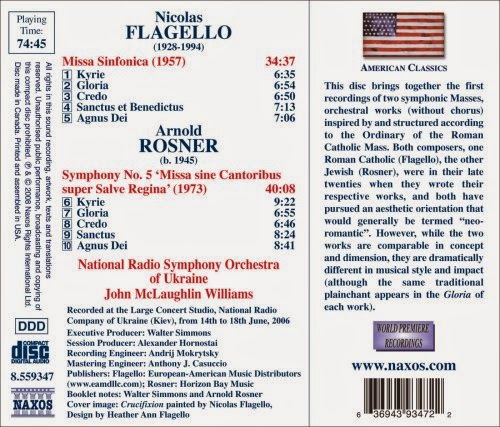
Arnold Rosner - Nicolas Flagello - Symphonic Masses (Rosner Symphony No.5/Flagello Missa Sinfonica)

I am endlessly grateful to Naxos for releasing some of Rosner's music in the recent past; while his
music has been on several labels including Albany Records & Harmonia Mundi France, Naxos is
the major player at least as far as reaching larger audiences go. Just like the prior Flagello/Rosner
post, I quite prefer the Rosner to put it mildly however Flagello is likeable and easily accessible.
Arnold Rosner's Symphonic Mass is his Symphony No.5 "Missa sine Cantoribus super Salve Regina"
and, like most of his works, it's a real knock-out; equally powerful and beautiful. Enjoy!


This disc brings together the first recordings of two symphonic Masses, orchestral works (without chorus) inspired by and structured according to the Ordinary of the Roman Catholic Mass. Both composers, one Roman Catholic (Flagello), the other Jewish (Rosner), were in their late twenties when they wrote their respective works, and both have pursued and aesthetic orientation that would generally be termed “neo-romantic”. However, while the two works are comparable in concept and dimension, they are dramatically different in musical style and impact (although the same traditional plainchant appears in the Gloria of each work).


Rosner_Flagello_Symphonic_Masses .zip


http://www37.zippyshare.com/v/60658538/file.html

Arnold Rosner - Nicolas Flagello - Symphonies for Winds

Firstly I'd like to thank everyone again for the recent kind feedback. It truly is appreciated and needless to say makes me want to post more. This disc features Symphonies for Winds, Flagello's Symphony No.2 and Rosner's Symphony No.8. The Rosner symphony was a request about a month
ago. I'll let the music speak for itself. Enjoy!


Symphonies_for_Winds_Rosner.Flagello.zip
http://www12.zippyshare.com/v/31393153/file.html

Tuesday, September 9, 2014

Arnold Rosner-Music of Arnold Rosner (Chamber Music Vol.1)

This is the first volume of Rosner's chamber music from Albany records. "Of Numbers and of Bells" op.71 (1983) is one of the most beautiful things I've ever heard, especially in the repertoire for works
for two pianos. It is at turns delicate, thunderous, mystical, mysterious. The Sonata French Horn & Piano and the Sonata No. 1 for Violoncello & Piano are also fine works, The Former has quite the
Hindemithian feel to it. "Nightstone" "Three Settings from The Song of Songs" (1979) for Tenor & Piano is a drop-dead gorgeous song-cycle. My only disappointment is that the Tenor on this recording seems unprepared and uneasy with the music; at times his voice sounds weak. In the hands (vocal chords) of someone like Ian Bostridge this would be an other-worldly experience. That said, "Nightstone" is still gorgeous, even with a weak tenor.

I would really *APPRECIATE* feedback/opinions on Rosner's music; his music changed my life and I'm still stunned that almost no one has shared thoughts or comments...     Enjoy!


A major work in the repertoire for two pianos is Of Numbers and of Bells, completed shortly after New Year’s Day 1983, as Rosner’s Opus 79 and dedicated to his close friends Terri and Robert Hope. Possessing an enormous dynamic range, this work moves from a delicate filigree of tintinnabulation to massive, bell-like sonorities of symphonic—one is tempted to say cosmic—proportions, all within its 15-minute duration. Its direct emotional appeal derives from its uncanny evocation of time suspended like a glittering crystal of frozen light, then released—suddenly and inevitably—as a torrent of sound. In writing about the work, the composer had this to say: “When I started work on what would have been my fourth piano sonata I conceived a first allegro theme which was fine to listen to and easy to play once or twice, but which dwelt on the weaker fingers of the right hand so much as to make it downright painful to play repeatedly. As I thought the tune would bear some restatements, it occurred to me to convert the piece into an essay for two pianos. This entirely pragmatic solution lead to some technical and even spiritual directions, as the title Of Numbers and of Bells may suggest. I decided to make extensive use of cross-rhythm, generally much easier for two players than one, although some passages in the finished work still involve extremely difficult ensemble. Several sections or tableaux are built on conflicting steady rhythms, which I tried to differentiate and clarify by wide spacing of tessitura and stereophonic distance between the keyboards. To codify just one example, about 6 minutes into the piece, the first piano right hand plays a line in flute range in straight 4/4 meter consisting of mixed 8th and 16th notes. The left hand is in baritone range in unvarying 8th notes, but the melodic and accent pattern amount to 11/8. The second piano uses both hands to play a modal chorale ‘in mid-range in notes precisely 5/16 long. The listener is not expected to perceive these algebraic relationships and would probably be distracted from the music if he tried. I hope some mystical and pleasantly complex overlays may make themselves felt in a directly emotional way.”

http://www47.zippyshare.com/v/16461096/file.html