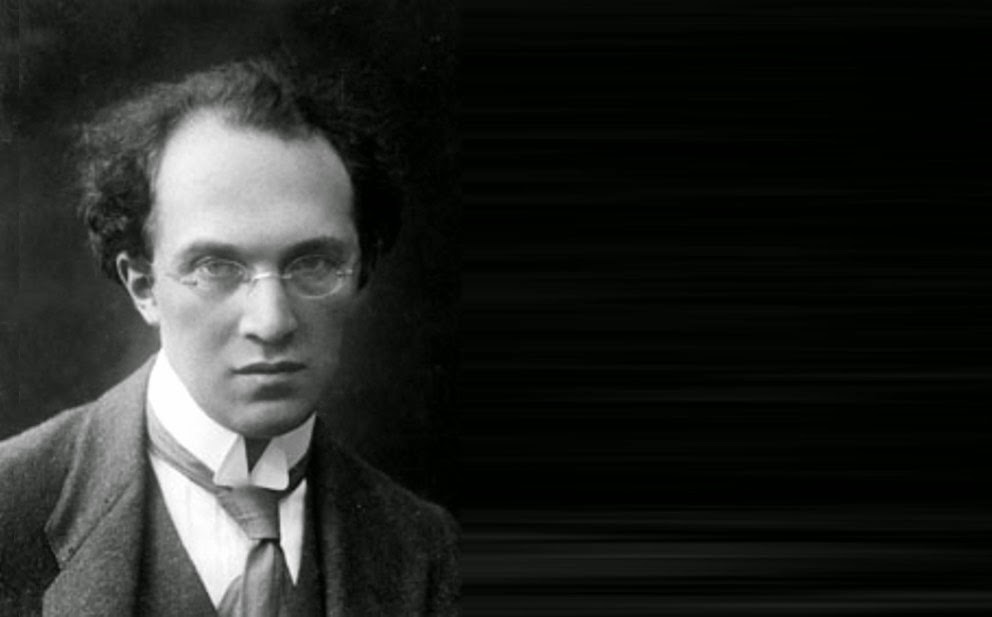
Showing posts with label Ervin Schulhoff. Show all posts

Sunday, October 23, 2016

Erwin Schulhoff - Concerto for Piano & Small Orchestra Concerto Doppio for Flute, Piano, String Orchestra & Two Horns - Concerto for String Quartet and Wind Ensemble - Beethoven/Schulhoff, Rondo a capriccio - Deutsches Symphonie-Orchester - Capriccio 2014

I think every piece here (except for the Beethoven arrangement) has been included on one or more Schulhoff discs that I have posted in the past. Never mind that. This is one hell of a recording, and all three concertos here are handled masterfully. Not unlike the concertante works of Bohuslav Martinů, Schulhoff's concertos always dazzle and delight the senses - for me. ......Hopefully you agree! 


Because of time I am going to rely on any notes that I (hopefully) have added to past Schulhoff shares. Click on the keyword at the bottom if you'd like to check!

Enjoy this under-appreciated Czech master and all of his delightful and tuneful eccentricity!

Erwin_Schulhoff_Concertos-Tzadik.zip
http://www36.zippyshare.com/v/CYQPTEdh/file.html

Tuesday, February 10, 2015

Tantz Grotesk - Schreker: 'Der Geburtstag Der Infantin' Schulhoff: 'Die Mondsüchtige' Hindemith: 'Der Dämon' ('Entartete Musik' Series, Decca, 1995) Gewandhausorchester Leipzig, Lothar Zagrosek

Here is another interesting disc from Decca's 'Entartete Musik' series, one of the most important and rewarding musical surveys of the 20th century, and from a major label no less. My personal favorite here is Paul Hindemith's "Der Dämon", although the other two scores also make for enjoyable listening-stylistically in very different ways.


The three "grotesque" ballet scores fulfill most of the Nazis's criteria for 'degenerate music': two of them are by Jewish composers, one of which is jazz-based with 1920's-1930's "bad boy" expressionism and cacophony, and the third is by that then "unreformed" avant-gardist, Hindemith. Of the three composers, Schreker, sacked from his academic posts, died from the shock within months of the Nazis's rise to power; Schulhoff, whose devotion to Communism led him to take Soviet citizenship, died in a Bavarian concentration camp in 1942 as mentioned in prior Schulhoff posts. And Hindemith escaped into exile. All three works, though, were written during the heady years of the Weimar Republic, or earlier. "The Birthday of the Infanta" by Schreker (a 1922 suite from a 1908 score) is a melodious and colorful dance-pantomime and based on the same Oscar Wilde story that was later to inspire Zemlinsky’s finest opera. Schreker’s music here is luminous, often poignant, and sounds somewhat like a Viennese Respighi, while Schulhoff's "Moonstruck" (1925) which is subtitled "a dance grotesque", has his 1920's signature ragtime, jazzy, raucous atmosphere. Hindemith’s "The Demon" (1922), scored for chamber ensemble and set to a disturbing scenario by Max Krell about a sadomasochistic demon that subjugates two sisters, is one of his more colorful and engaging works (and actually just a tad more "accessible" I'd say for those who are normally not Hindemith fans) and was his first ballet. Like his contemporaneous opera "Cardillac," the work is notable for the contrast between its expressionist subject and the dry objectivity with which Hindemith treats the subject musically.

Franz Schreker

Schulhoff

Hindemith


Track list:

Franz Schreker "Der Geburtstag Der Infantin" The Birthday Of The Infanta (19:40)

1)Reigen (1:48)
2)Aufzug Und Kampfspiel (2:19)
3)Die Marionetten (2:40)
4)Menuett Der Tänzerknaben - Die Tänze Des Zwerges (2:51)
5)Mit Dem Wind Im Frühling: In Blauen Sandalen Über Das Korn - Im Roten Gewand Im Herbst (5:02)
6)Die Rose Der Infantin - Nachklang (4:58)

Erwin Schulhoff "Die Mondsüchtige" Moonstruck (23:49)

7)Introduzione - Ragtime (5:14)
8)Valse Boston (6:31)
9)Shimmy (2:32)
10)Step (1:40)
11)Tango (5:07)
12)Jazz (2:46)

Paul Hindemith - "Der Dämon" The Demon, Op.28 (34:28)

13)Tanz Des Dämons (1:16)
14)Tanz Der Bunten Bänder - Tanz Der Geängstigten Schwalben (5:51)
15)Tanz Des Giftes - Tanz Der Schmerzen (4:08)
16)Tanz Des Dämons (Passacaglia) - Tanz Der Trauer Und Sehnsucht (5:54)
17)Einleitung Zum 2. Bild - Tanz Des Kindes (3:36)
18)Tanz Des Weiten Gewandes - Tanz Der Geschlossenen Orchidee (6:51)
19)Tanz Der Roten Raserei - Tanz Der Brutalität (2:17)
20)Tanz Des Geschlagenen Tieres - Finale (4:31)

Enjoy!

Tanz_Grotesk_Hindemith_Schreker_Schulhoff_Tzadik.zip


http://www76.zippyshare.com/v/7P7PJn46/file.html

Sunday, January 18, 2015

Ervin Schulhoff - String Quartets Nos. 1 and 2 - Five Pieces for String Quartet - Aviv Quartet - Naxos 2010

Let us listen to some of Schulhoff's chamber music for today. This Naxos disc won the critic's choice award and it's a great reading of both quartets and the Five Pieces alike. I only wish Naxos had included Schulhoff's "String Quartet No. 0" in G major, Op. 25 from 1918; this could have been a near-perfect recording, at least in a completist sense-at just 51 minutes certainly there was room for
the early quartet. Quibble aside, the Israeli Aviv Quartet do these highly memorable quartets proud, the performances are just electric!


The "String Quartet No. 1" from 1924 was strongly admired when it was heard at an ISCM (International Society for New Music) concert the following year. It’s a terrific work, one that manages to fuse Bohemian and Slovakian folkloric elements with tensile Stravinsky-inspired qualities, and more besides. One hears the drones right from the first movement, and the feeling of attaca vitality is convulsive. Indeed, the mixture of powerfully accented rhythms and folk-dance imperatives reminds us that Stravinsky’s Concertino for string quartet had been written only four years before and its microcosmic example was surely influential on Schulhoff. The skittering, muted elements of the Allegretto open out into "malinconia grotesca" and it’s for each quartet to convey that spirit with as much intensity and accuracy as possible. The rural Slovak tune in the scherzo is dynamic and hugely effective, whereas the balance of the quartet then falls on the unexpected, slow final movement. 

The dance patterned and brief affairs that make up the "Five Pieces for String Quartet" are robust and magnetic, a suite of dance movements which seem straightforward: a Viennese waltz, a serenade and a tango are among their number. But these works are not for the faint of heart; they are traditional dances viewed through the prism of Stravinsky or, perhaps, Schoenberg, and, like Ravel’s "La Valse" but with more of a bite, they are probably meant to some degree to be satirical. The waltz is almost unrecognizable as such in the opening bars, but soon becomes irresistible; the other dances are similarly gripping. The tarantella is a good example; relatively straightforward in form, the harmonies nevertheless make us feel as if we are in the musical equivalent of a house of mirrors.

The String Quartet No. 2 hasn’t received as much attention as the two companion works, something for which one can be grateful to the Aviv players. It has a theme and variations second movement, an "Allegro gajo"-Czech speakers will enjoy the resonance of the word-and a similarly compact four movement structure as the earlier work. However it is the more conventional. The melancholic viola statement that starts the slow theme has, unusually for the composer, a degree of pathos attached to it in the ensuing variation. There’s a Slavic dance in variation three, with a degree of syncopated jazz as well. The rusticities of the folkloric gajo movement are even more explicit than the "Alla Czeca" movement in the Five Pieces. And the ruminative start of the finale picks up on the uneasy tristesse of the variations before control is re-established and the work ends on a note of renewed vitality and positivism. I feel that it is safe to assign 'small masterpiece' status to both of these string quartets, but
that's just my opinion. What do the rest of you string quartet lovers think?


More Schulhoff sometime soon..I am not a fan of complete "overload" posting for any composer,
and happily there's many more Schulhoff gems to be explored...so stay tuned (well tuned..ahem)


Enjoy!

Schulhoff_Music_For_String_Quartet_Tzadik.zip

http://www28.zippyshare.com/v/H2s01TbG/file.html

Saturday, January 17, 2015

Ervin Schulhoff - 'Concertante & Ballet Music' - Concertino for String Quartet & Winds - Double Concerto for Flute & Piano - Ogelala, Ballet Suite - Panton 1993

I might keep the Schulhoff posts coming tonight if I can, although I have been given the gift (from my friend's daughter I speculate) of a respiratory infection which, incidentally, is the most pleasant thing happening over here at this time (once again music remains my only true medicine!). Complaining aside, listening to Schulhoff and having quantities of teas is an otherwise lovely way to spend time. 


This Panton disc is one of the first Schulhoff discs I bought in the early 1990s. It is among my favorites, and the interpretations are near-perfect to what Schulhoff intended.  Interestingly we have
a bit of a pattern going on here-my post from January 13th contains the Concerto for Piano and Small Orchestra, on Koch Schwann-following that post is the Decca "Concertos alla Jazz" disc posted perhaps 45 minutes ago-It contains not only the Piano Concerto from the Schwann disc, but also two of the three works on *this* recording, leaving only the ballet suite "Ogelala" on this Panton recording "new" so to speak. This cannot be disappointing however unless the music itself is disappointing, and those of you already enjoying the Schulhoff needn't any persuading. 

Thus I am only briefly talking about Schulhoff's exotic, oddball post-Bartokian "Ogelala", which summons in the mind of the listener the fantastic and barbaric, not unlike "The Rite of Spring" or the "Scythian Suite", by Stravinsky and Prokofiev respectively.  When the young Schulhoff wrote the ballet Ogelala in 1923, he was still absorbing influences from all over. "Le sacre.." is usually cited as the major influence, but it appears only late in Schulhoff’s score. This is the Ballet suite-the whole ballet has a duration of about 40 minutes.

Termed a "Ballettmysterium", "Ogelala" was finished in short score in 1921, but the busy Schulhoff required another three years to orchestrate the 'neo-primitive' work, which was premiered in Dessau on 21 November 1925. It is based on a pagan legend from pre-Columbian Mexico: the warrior Ogelala, taken captive by the tribe of the king Iva, nonetheless manages to seduce the princess Ivala and withstand all manner of taunts and torture before he finally succumbs. The ritual, erotic, and war-like dances take place whilst Ogelala is tied to a stake for sacrifice to the gods.  The dazzling variety of Schulhoff’s invention obscures the fact that the 13 sections of the full score are all variants of the 'Ogelala' theme presented at the outset. And although "Ogelala" shows the influence of both The Miraculous Mandarin and The Rite of Spring, not least in the occasional passages for solo bassoon, it also reveals Schulhoff looking forward-the innovative dominance of percussion in the orchestration was based on a close study of Amerindian rhythm and dance (Schulhoff supposedly studied American Indian dances at phonographic archives at Berlin University), allowing this Czech-born German Jew to predate by several years the use of native American rhythms by the Mexican composers Carlos Chávez and Silvestre Revueltas. 

Neo-primitivism in art

Track listing:


Concertino for String Quartet & Wind Orchestra (1930)

1)Allegro moderato (8:16)
2)Largo (6:25)
3)Allegro con brio (5:13)

Double Concerto for Flute, Piano and Orchestra (1927)

4)Allegro moderato (7:31)
5)Andante (4:21)
6)Allegro con spirito (Rondo) (6:24)

Ogelala, Suite from the Ballet (1923)

7) (19:58)


Enjoy!

Schulhoff_Concertante_and_Ballet_Music(PART1)_Tzadik.zip

http://www53.zippyshare.com/v/Euqpl9s2/file.html

Schulhoff_Concertante_and_Ballet_Music(PART2)_Tzadik.zip

http://www39.zippyshare.com/v/iu3fMXdZ/file.html

Ervin Schulhoff - 'Concertos alla Jazz' - Piano Concerto - Double Concerto for Flute and Piano - Concerto for String Quartet - Piano Pieces (*Schulhoff, piano, 1928) - 'Entartete Musik' series - Decca 1995

This Schulhoff disc from London/Decca's "Entartete Musik" series (devoted to composers killed or suppressed by the Third Reich) is, certainly in my opinion anyhow, one of the highlights from this supremely important recording project. Schulhoff's artistic personality seemed at war with itself. On the one hand, just about everything he wrote displays a high degree of musicality and finish. On the other, he never seemed to settle on any one style for long. He loved American jazz. Indeed, he was one of the few Europeans who had heard the real thing early on and amassed one of the largest private jazz record collections in Europe. Yet aside from surface gestures, jazz never -really- influenced the music he wrote. In essence, Schulhoff used jazz just as Stravinsky, Weill, Honegger, early Hindemith, and Martinu did-as a way to clear out lingering spores of late nineteenth-century musical habits and gestures. For almost all of these men, jazz represented a way-station on the journey toward a deeply personal Modernism. Schulhoff, on the other hand, seems "unsettled," like Lukas Foss. His death leaves us with (time and again) speculations as to how his music would have continued.. 


This is an original German poster from 1938.

The Piano Concerto "Concerto for Piano and Small Orchestra" of 1923 is actually on the Koch Schwann disc that I posted directly before this post just a few days ago. As I wrote about the concerto in detail there, I shall refer the listener/visitor to that post from the 13th. I will say that I marginally prefer the Koch version.

The "Double Concerto for Flute and Piano" is one of my favorites and one of the composer's most artistically vigorous and psychologically most integrated works. Schulhoff wrote it for himself and the great French flutist Rene Le Roy as soloists. One gets from the work a great feeling of Paris in the Twenties (although Schulhoff didn't write it there exclusively) and of what the French imply by the word "mesure" - a sense of proportion, balance, elegance, and restraint. At the time, Paris, of course, had diverse strands and a wide expressive range of music, most of which derived from either Stravinsky or Debussy. From the fripperies of Les Six's "Les Mariés de la Tour Eiffel" to the granitic "Oedipus Rex" by Stravinsky, you could hear just about anything in Paris, probably the great music capital of Jazz-Age Europe. Schulhoff stands a little apart, but not much. The first two movements eschew shock for a noble and athletic neo-classicism-similar to the later works of Hindemith (and the American Walter Piston). For the third movement, Schulhoff creates a theme right at home with something light by Auric, Milhaud, or Poulenc-a cheeky combination of folk song and street ditty. Here, too, a jazzy passage flits through, sort of like a hotel band half-heard in the distance. All the movements are beautifully worked out. The byplay between the two instruments, soli and with the orchestra, satisfy beautifully. The orchestra doesn't merely accompany, as it does mostly in the Piano Concerto, and it doesn't dominate. Everybody gets their licks and, most importantly, takes part in the conversation. One might miss the competitive, heroic aspect in this concerto, but something more mature and congenial replaces it. This brings the concerto closer to the ethos of great chamber music. Martinu's concertante works especially often occupy the same exquisite cosmos. One cannot love this concerto too much!

For another take on it, check out this version of the Double Concerto posted in September:


The "Concerto for String Quartet" comes from the days of Schulhoff's experience as a radio and recording-studio musician, and the composer wrote it with contemporary 'electric-mike techniques' and capabilities in mind. Schulhoff emphasizes the contrast in sound between winds and brass (a 15-piece wind ensemble comprises the orchestra) and the string quartet. The soloists and tutti very rarely blend. The solo wind writing is mainly harsh and in-your-face (in a wonderfully Hindemithian way) despite a downright lovely opening to the second movement. What delicacy we encounter comes from its accompaniment to the string quartet-often just one or two instruments, so as not to drown out the strings-although the string writing itself is hardly gentle in idiom. The language, though neoclassical, sounds more Central European than French, coming close in spots to Bartok. The seriousness of emotional purpose has increased from Schulhoff's music in the early Twenties, without falling into his occasional early trap of neurotic obsession. One could fairly describe the concerto as "grave." The idiom differs from every other work on the CD-Schulhoff's mind getting restless again. The third movement begins like a folk dance from a very sophisticated village band, much like the faster parts of Bartok's Hungarian Sketches. Martinu and Hindemith fans should be especially delighted.

The solo piano pieces, historic documents played here by the composer himself, sound like bagatelles, interesting particularly for how far the music lies from the promise of the titles: "Tango," "Blues," "Charleston," "Tango-Rag," and so on. Some of the most interesting music comes from the "5 Etudes". The composer plays with a rhythmic elasticity that indicates his familiarity with real jazz playing. Since Schulhoff recorded these works in 1928, the sound of course is mono, but electrical rather than acoustical. There's a mild patina of surface noise, but nothing irritating. The performances are, needless to say, infectious and affecting. I cannot imagine a more poignant conclusion to this most exceptional disc.


Enjoy!

Schulhoff_Concertos_alla_Jazz(PART1)_Tzadik.zip

http://www72.zippyshare.com/v/myWm2Es1/file.html

Schulhoff_Concertos_alla_Jazz(PART2)_Tzadik.zip

http://www43.zippyshare.com/v/JRgI2bio/file.html

Tuesday, January 13, 2015

Ervin Schulhoff - Concerto for Piano and Small Orchestra - Symphony No. 5 - Kolner Rundfunk-Sinfonieorchester - Gunther Schuller - Michael Rische, Piano - Koch Schwann 1995

I should stop making promises I cannot keep! This is the second Schulhoff post, meant for last night. I was too deflated emotionally and physically so here it is this Tuesday afternoon.

Two extremes of Schulhoff’s art are represented here. The jazzy (Second) Piano Concerto is here played by the pianist Michael Rische, the work’s first champion in modern times. The concerto displays the fashionable, 'Roaring Twenties' aspect of Schulhoff’s oeuvre before plunging into the gritty socialist realist world he created for himself in the 1930s. The idiom of the Fifth Symphony is consistent with that of the Third. Schulhoff completed its orchestration after the fall of Czechoslovakia and it is not easy to consider the work as an abstract entity when we know what became of its maker. There are four movements, each longer than its predecessor.


The "Concerto for Piano and Small Orchestra" occupies a special place within the group of works inspired by Dada and jazz. Schulhoff composed this piece in June and July 1923 in Berlin, where he lived with his wife and his one year old son until November of that year. He returned to Prague afterwards. The influence of provocative Dadaist poetry was already ebbing as he was writing the Piano Concerto. He has sown his wild oats as an "Uber-Dada" (as Schulhoff referred to himself in a letter to Richard Stiller) the previous year, when he had composed "The Cloud Pump" (texts by Hans Arp), the "Bass Nightingale" for contrabassoon solo and, earlier yet, the lascivious "Sonata Erotica" for solo 'mother trumpet' and vocal whispers of an aroused female (!), and the unperformable "Symphonia germanica", which took aim at militaristic patriotism. The Piano Concerto is an homage to jazz, which bursts like a hurricane into the calm musical flow which strives to abide to the good old traditions. Schulhoff held the same views as Jean Cocteau and the Paris group "Les Six" and felt that jazz dances should fulfill the same function in today's serious music as the sarabande, contredanse, minuet, polka or furiant did in the days of Bach, Haydn, Mozart, and even that of Smetana. Though the work was intended to be programmatic, jazz did not make its entrance as a victor determined to do away with past musical tradition, but as a champion of vital new impulses. Jazz sought to become a part of this tradition by imparting these impulses on it. There is no denying that this program was far removed from the Dadaist slogan of "anti-art".  Thus the one-movement Piano Concerto is based on a stylistic bipolarity; on the one hand it is the music of a distressed soul of a musical poet and romantic dreamer troubled by the restlessness of the Fin-de-siècle; on the other, there is the primitive, challenging sound of jazz, bursting with energy and spirit, the symbol of the new way of life, of technological revolutions, and thus of America. 

The stylistic divergences which poked fun at the aesthetic ideals of the time are practically programmed into this work and permeate all parameters of the musical structure. In the first section, the orchestra serves up samples of refined sonorities a la Debussy or more pungent Straussian bits. The solo part recalls Liszt's virtuoso technique and lets loose in the frequent cadenzas. The harmonic apparatus obviously includes the augmented fifth and the seven-nine chord, for chromaticism is omnipresent in this work. But it is not the only device which weakens the foundations of major-minor tonality; its stability is also undermined by sequences of whole tones, tritone intervals in the melodic line, pentatonic passages and gypsy scales, thus by means which Schulhoff frequently used in earlier times. The head motif, which plays a crucial linking function in the work, appears very soon introductory cadenza over the chrdal pedal C - G - d flat - g flat - b flat in the descending sequence of the gypsy scale with its characteristic lowered second: f - e - d flat - c. By adding a further descending tone, Schulhoff does not attack the gypsy mode but reinforce it with an even more characteristic raised fifth which now comes to the fore.  Though the work is theoretically a one-movement concerto, the traditional three-movement form is clearly recognizable, for the sostenuto section which now follows is nothing else than the second movement. Here the head motif extends from a perfect fourth to an augmented fifth, whereby it descends on a whole tone scale. Although this motif does not return in e closing movement, the "Allegro alla jazz", its distinctive form is recalled in the main theme by the two altered tones of the gypsy scale: it is heard once again in its whole-tone form. In addition, the central section, "Alla zingresca", features a completely new, pentatonic theme which modulates in steps of a second. It can only be associated with the Zingaresca  through its whimsical humor however. 

-The jazz entrance is nothing less than stunning. The motoric drive, which pulsates in a fox-trot rhythm, is accompanied by the din of a steamer siren, car horn, anvil, cowbells, rattle, zobo, tam tam, Japanese drum and a number of other percussion instruments. So....bruitist music? In the Dadaist manifesto he drew up in 1918, Richard Huelsenbeck wrote: "Life is like a simultaneous jumble of noises, colors, and intellectual rhythms which is unerringly reproduced in Dadaist art, with all its sensational screams, the agitation of its everyday psyche and in its brutal reality". Indeed, Schulhoff's Piano Concerto is the last work that really reflects the composer's affinity to Dadaism-a farewell to a style.

*I will write about the Fifth Symphony tonight, I must get to work! 

Track Listing:

Concerto for Piano and Small Orchestra (1923)

1)Molto sotenuto -Allegro expressivo -Alla marcia maestoso - Sostenuto - Cadenza- Molto sostenuto e astrattamente- Allegro alla jazz - Alla zingeresca -Tempo 1 - Prestissomo (18:45)

Symphony No. 5 (1938)

2)Andante, ma molto risoluto (4:38)
3)Adagio (9:18)
4)Allegro con brio (10:12)
5)Finale. Allegro con brio (14:49)


Schulhoff_ Klavierkonzert_Sinfonie_No._5_(PART1)_Tzadik.zip

http://www22.zippyshare.com/v/frdx4Wm0/file.html

Schulhoff_ Klavierkonzert_Sinfonie_No._5_(PART2)_Tzadik.zip

http://www71.zippyshare.com/v/evNbb69Q/file.html

Sunday, January 11, 2015

Ervin Schulhoff - Symphonies 1-3 - Philharmonia Hungarica - George Alexander Albrecht - CPO 1994

Greetings everyone. Sorry that it's been silent around here but 2015 is thus far proving to be a very difficult time for me. Sometimes I think it is music and music alone that keeps me going. As Duke Ellington once said (and I second the statement), "music is my mistress". I truly love that quote and
I'd add that it's my entire cosmos as well. 

On to the music. I was really happy to find a large part of my Ervin Schulhoff collection recently, thanks to a trip over to my parents house. Indeed I have about 20 more boxes in their attic that have been there for many years. How on earth I will take them with me anywhere I haven't a clue. So this was the first Schulhoff disc I ever bought, motivated in part by the most enthusiastic of reviews (the shorthand being that it was a very exciting and special release..) circa 1994 in "Classical Pulse" which was a magazine that was put out by (the sadly defunct) Tower Records. Many of you will, I'm sure, have fond memories of browsing the glorious shelves for hours as I do. (Tower exists as an online store but has nothing to do with the original owners who filed for bankruptcy and liquidation in the early 2000s) Anyhow to get back on-topic..

The composer and pianist Ervin Schulhoff was born in Prague on June 8th 1894. Like many in the lost, inter-war generation of Czech-German composers, Erwin Schulhoff was drawn to a wide range of idioms from Schoenbergian expressionism to Stravinskian neo-classicism. His love of jazz is well known, but he was also prone to an open-air modal folkiness which gives even his most eclectic scores a fairly distinctive profile. The first three symphonies show him stylistically in transition over a decade of compositional activity. By the time of his death at the hands of the Nazis, the Dadaist prankster had remade himself as a socialist realist composer of big statements and, latterly, a Soviet citizen. 


Schulhoff was from a Prague family of German-Jewish origin and, like Franz Kafka, Max Brod, Franz Werfel and others, represented the important and unique German-Jewish stratum of Prague cultural life. His family tree included professional musicians, and his parents encouraged the development of his extraordinary talent from his childhood onwards. Schulhoff began his studies at the Prague Conservatory in 1904-at the age of ten and on Antonin Dvorak's recommendation. He studied privately in Vienna and and then went on to study composition and piano at the conservatories in Leipzig from 1908-1910, partially under Max Reger's tutelage and after this he studied in Cologne from 1911-1914. Max Reger, Richard Strauss, Claude Debussy and Alexander Scriabin were his original compositional models. WW 1 intervened just as he was setting out on a promising career as a composer and pianist. 

Schulhoff was an impressionable, sensitive young man, and his experiences on the Western front brought about dramatic changes in his artistic and political orientation. After the war he became an adherent and zealous advocate of the leftist musical avant-garde in Germany, where he lived until 1923. As a dazzling, phenomenal piano virtuoso he performed new modern works in the important European cultural centers during the 1920s. As a composer he produced avant-garde music combining, spontaneously so, expressionistic influences with inspiration from jazz, dadaism, and neoclassicism. He developed a great fondness for grotesqueries and parodies, complicated rhythms, and tone-color effects, and his predilection for jazz led to his composition of the H.M.S. Royal Oak jazz oratorio in 1930. Many of the works he composed after his return to Prague in 1923 were distinguished by his astute, characteristic oscillations between German expressionistic, French neoclassical, and Slavic folkloric impulses and tendencies. He also worked together with Alois Haba on microtonal music, became a leading advocate of the 'microtonic' compositions of Haba and his pupils, and offered flawless piano performances of these works on various occasions. For all Schulhoff's modernity, radicalism, and cosmopolitism, it is pretty remarkable that his oeuvre contained elements of the musical mainstream of his native Prague (such as the Czech Dvorak School, Josef Suk and Vitezslav Novak).

Schulhoff's career reached its peak in the 1920s and early 1930s. His chamber and orchestral works were performed with success at the International Society for Contemporary Music festivals in Salzburg in 1924, Venice in 1925, Geneva in 1929, and Oxford in 1931. He was one of the most active and best known exponents of the Bohemian musical avant-garde between the two world wars.

During the 1930s Schulhoff earned his living as a pianist for Prague and Brno radio corporations. As a composer he espoused the doctrine of so-called proletarian art and began to compose musically conservative works in the interest of communist propaganda. He lost his job in 1939 when the Nazis gained control in Czechoslovakia. Two years later he was imprisoned; house arrest in Prague was followed by deportation to Germany. A year later, on August 18 1942, he succumbed to tuberculosis in a Nazi concentration camp. Like so many other similar cases-we are left to ponder what else this musical polymath might have accomplished and contributed to the world of music, and therefore, humanity in general.


Schulhoff's first, second and third symphonies have a number of features in common. All three are of cyclical design, and all three based on the contrast of spirited swift movements and slow movements. The sequence of movements is almost classical. The expression is contemporary and unconventional, but the music continues to operate on a thematic and tonal basis. The music not infrequently has a sharp, harsh, and complicated sound, and the points are surprising and exciting. The composer has a wealth of ideas at his disposal, his invention is broad, fresh and rich, and his treatment of the large orchestra is sovereign. Ten years separated the first and third symphonies, and changes in Schulhoff's artistic poetics, view of the world and vital consciousness are evident in all three. 

Symphony No. 1 has three movements and lasts almost a full half hour. The 'Allegro ma non troppo' introductory movement is full of happy, playful, lively music. The 'Andante con moto' second movement is extended and lyrical. It contains impressionistic solo parts, melodies of deep longing, melancholy, rich harmonization and dance scenes of an almost 'oriental', sensuous magic. The 'Molto allegro con brio e agitato' third movement presents spirited, rhythmically vital music. The gradations and climaxes are I think very effective. The suggestions of oriental music appearing at important places in all the movements are a special feature of this symphony, and like the whole work- entranced me upon my very first listen. It is overflowing with vitality and joy.

Symphony No. 2 has four short movements and Schulhoff's apparent aim here was a simplification of all the compositional elements. The symphony feels almost like a chamber piece. The structure is quite simple, the colors clear, and the form is obvious. The kinetic neoclassical beginning has a steady forward drive and the second movement too has a neoclassical sound, while the sources of the rondo finale can be traced back to Viennese classicism. 'Scherzo alla jazz', a jazz stylization of grotesque, remarkable expression, is quite the interesting miniature. The overall mood of the final movement is that of the symphony as a whole-playful, unproblematic, and conflict-free.

Symphony No. 3 has three movements and offers an entirely different picture. The 'Moderato' first movement extends over a single musical plane and forms one sole gradation, indeed an effective one.
A suggestion builds up and emerges from the persistent, tenacious music and creates the impression of a dark, menacing and powerful mob scene. The 'Grave, ma deciso' slow second movement does without the tender lyricism of the andante movements of the first and second symphonies. Here we have anxious, disconnected, excited, expressive, almost explosive and resolute music. In the 'Allegro non troppo' third movement we hear the robust march of the committed masses and its massive, optimistic and victorious conclusion. Here ideological models have exerted a strong influence on the composer.


-I hope everyone enjoys the Schulhoff as much as I do!

Track listing:

Symphony No. 1  (1925)
1)Allegro ma non troppo (6:41)
2)Andante con moto - Allegretto alla marcia (9:43)
3)Molto allegro con brio e agitato (8:38)

Symphony No. 2  (1932)
4)Allegro ma non troppo (4:46)
5)Andante con moto (4:57)
6)Scherzo alla jazz. Allegro assai (4:29)
7)Finale. Allegro con spirito (6:49)

Symphony No. 3  (1935)
8)Moderato (9:55)
9)Grave, ma deciso (6:46)
10)Allegro ma non troppo (6:16)

This disc is quite special to me and thus I have, like some other recent posts, imported it as Apple Lossless files (again, still m4a files).


Schulhoff_Symphonies_1-3(Part1)_Tzadik.zip

http://www35.zippyshare.com/v/5AEkxBo7/file.html

Schulhoff_Symphonies_1-3(Part2)_Tzadik.zip

http://www46.zippyshare.com/v/RnQYcGmh/file.html

Lastly-I am too burned out to continue any later into the a.m. hours, however I will be posting more Schulhoff Monday night and perhaps Tuesday as well..